
I didn’t come to the Anti-Atlas looking for stories.
I came because the road from the Souss Valley kept climbing, winding higher into red hills until the air grew thin and the silence deepened into something almost sacred. My mind was still full of tea steam and bread crusts, but my body needed elevation not just in altitude, but in perspective. I’d spent days learning to wait, to receive, to sit without agenda. Now, I needed space to let it all settle.
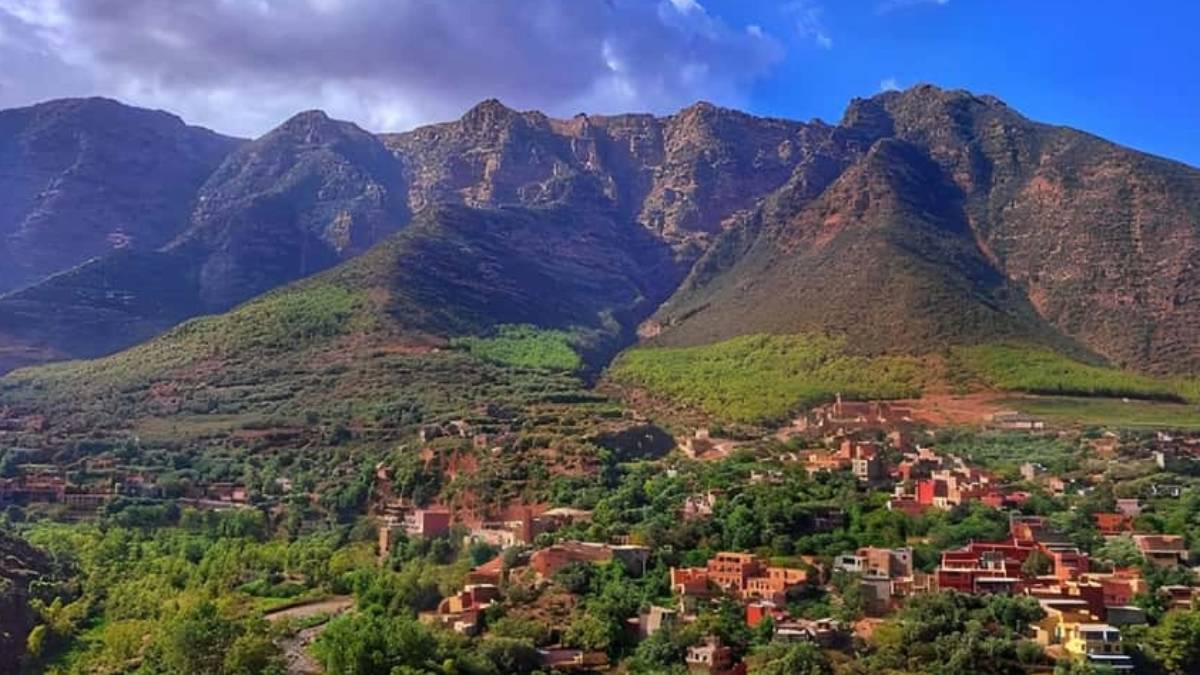
My car sputtered near a bend where the asphalt ended and a dirt track began, leading upward through terraced fields of barley and almond trees. There were no signs, no names, just stone houses clinging to the slope like barnacles on a rock. I pulled over, not out of plan, but because the light on the hillside was so soft it felt like a hand on my shoulder, gently saying, This is where you rest.
At the center of the settlement, an ancient fig tree spread its branches over a circle of flat stones, its roots gripping the earth like old fingers refusing to let go. An elder sat beneath it, his back straight, eyes closed, hands resting on his knees. He didn’t open them when I approached. He just said, in French, “Sit. The story isn’t ready yet.”
I did. And for the first time in years, I understood that some wounds aren’t healed with advice but with witness.
The Village That Speaks in Silence
The village had no name on any map I’d seen. The locals simply called it Taddart “the home” in Tamazight. There was no shop, no café, no guesthouse with a sign. Just a cluster of stone houses with flat roofs, blue-painted doorframes, and courtyards hidden behind high walls. Water came from a spring higher up the mountain, carried down each morning in clay jars balanced on women’s heads. Goats wandered freely, their bells soft against the wind.
I was offered shelter by a woman named Khadija, whose husband had passed two winters ago. She didn’t ask my name right away. Didn’t inquire about my work or where I was from. She simply pointed to a low room off her courtyard, swept clean, with a mattress on the floor and a wool blanket folded at the foot. “Rest,” she said. “The mountain takes what you carry.”
That night, I lay awake listening not to music, not to traffic, but to the sound of wind through almond branches, the distant cry of an owl, the slow drip of water from the cistern. In California, silence is something you pay for a luxury retreat, noise-canceling headphones, a weekend cabin. Here, silence was the default. And within it, everything else became audible: your breath, your heartbeat, the quiet hum of your own thoughts settling like dust after a storm.
The next morning, I returned to the fig tree. Brahim was already there, sipping tea from a small glass, his eyes now open, watching the horizon. He nodded when he saw me but said nothing. We sat together as the sun climbed, warming the stones beneath us. No one rushed. No one spoke. And yet, I felt more welcomed than I had in any hotel lobby or guided tour.
This is the first lesson of the Anti-Atlas: presence isn’t announced. It’s practiced in the way people move, in how they share space, in the quiet certainty that you don’t need to earn your place here. You simply arrive. And if you’re willing to sit long enough, the land will speak.
The Circle Beneath the Leaves
By midday, others began to gather beneath the fig tree not all at once, but gradually, like water finding its level. A boy of about ten brought a basket of fresh almonds, cracked them open with a stone, and offered them without a word. An older woman, her face lined like a map of sun and wind, sat cross-legged near Brahim and began mending a woolen scarf, her fingers moving with the quiet certainty of decades. Two men returning from the fields washed their hands at a basin by the wall, then joined the circle, their boots still dusty from the red earth.
Brahim didn’t stand to greet anyone. He simply shifted slightly, making space. And when the sun reached its peak, he began to speak not loudly, not dramatically, but in a voice so calm it felt like the tree itself was talking.
His story that day was about a river that changed course after an earthquake. It wasn’t a myth. It was memory passed down through generations, carrying lessons about resilience, adaptation, and the quiet strength of letting go. He spoke of how the villagers didn’t fight the new path of the water. They followed it. They built new gardens along its banks. They learned to live with change, not against it.
No one interrupted. No one took notes. Children listened with the same attention as elders. This wasn’t entertainment. It was inheritance. And in this circle, stories weren’t told to impress they were told to mend.
If you’ve ever felt that words alone can’t reach your deepest ache if you sense that true restoration might live not in solutions, but in shared silence then Where the Atlas Meets the Atlantic: Living Traditions Around Agadir reveals how this entire region, from coastal bays to mountain ridges, offers a language of care written not in prescriptions, but in parables, patience, and presence.
When the Story Becomes the Listener
One evening, after days of sitting in silence, I found myself speaking not because I was asked, but because the space held me gently enough to try. The sun had dipped below the ridge, painting the sky in layers of rose and violet, and the circle beneath the fig tree had thinned to just Brahim, the boy with the almonds, and me.
I told him about a loss I’d carried for years a friendship that ended without closure, a grief I’d buried under work and travel, never naming it aloud. My voice trembled. I stumbled over words. But Brahim didn’t offer advice. He didn’t say “I understand” or “It’ll get better.” He simply nodded and said, “That story needs time. Let it rest under the tree.”
The next day, he began a new tale about a bird that lost its song after its nest burned in a summer fire. The bird wandered silent for many seasons, until one spring, it heard a child humming the same melody it once sang. It didn’t sing again that day. But it stayed. And in time, its voice returned not the same, but changed, deeper, wiser.
No one in the circle knew the story was mine. But I did. And in that anonymity, I felt seen not as a problem to fix, but as a part of the whole. My pain wasn’t isolated. It was woven into the fabric of something larger: a parable, a memory, a shared human truth.
This is the quiet genius of Amazigh storytelling: it doesn’t isolate your wound. It weaves it back into the community. Your grief becomes a river in someone else’s dream. Your fear becomes a shadow in a tale about courage. And in that weaving, you remember you’re not alone you’re part of a story that’s been unfolding long before you arrived, and will continue long after you leave.
The Children Who Carry the Tales
The boy who brought the almonds was named Yusef. He couldn’t have been more than ten, but he carried himself with a quiet dignity that belied his age. Every afternoon, he’d arrive before the others, sweep the stones beneath the fig tree with a broom made of palm fronds, and fill a small clay bowl with water for Brahim.
“He listens like his grandfather,” Khadija told me one morning as we walked to the spring. “Not with his ears, but with his bones.”
I watched him closely after that. He never fidgeted. Never interrupted. When Brahim spoke of droughts or floods, Yusef’s eyes would narrow slightly, as if storing the lesson for a future he hadn’t yet lived. And when the story ended, he’d ask just one question never about plot, always about meaning. “Why did the river choose that path?” “What did the bird hear in the child’s voice?”
These weren’t idle curiosities. They were acts of preservation. In a world where stories are streamed, scrolled, and forgotten, here they are passed hand to hand, ear to ear, heart to heart. Yusef wasn’t just listening. He was learning how to hold space for pain, how to speak without fixing, how to be present without performing.
One evening, as we walked back from the spring, he looked at me and said in careful French, “You carry a heavy stone. But stones make good foundations.” I didn’t know how to respond. So I simply nodded just as Brahim had done for me.
In that moment, I realized: the healing isn’t just in the telling. It’s in the receiving. And the next generation is already being taught how to receive it well.
The Tree That Holds Time
Brahim told me the fig tree was older than the village itself planted by his great-great-grandfather when this slope was still wild. Its trunk was gnarled and split in places, scarred by lightning and drought, yet it bore fruit every summer without fail. “It doesn’t speak,” he said one afternoon, resting his palm against the bark, “but it remembers everything.”
Villagers came to it not just for shade, but for solace. A woman grieving a child would sit beneath its branches for days, saying nothing. A young man facing a difficult choice would sleep near its roots, hoping for clarity in dreams. Even disputes between families were settled here—not with shouting, but with stories told in its presence, as if the tree itself could weigh truth from falsehood.
I began to understand that the tree wasn’t just a setting. It was a witness. A silent elder. A living archive of joy, sorrow, birth, and loss. Its roots reached deep into the mountain’s memory, and its leaves whispered back the wisdom of centuries.
One morning, I found Khadija placing a small bowl of milk at the base of the trunk a quiet offering, not to a god, but to time itself. “We give so it keeps giving,” she said simply. No explanation. No ritual. Just reciprocity, woven into daily life like breath.
In California, we memorialize the past with plaques and museums. Here, memory lives in bark, in stone, in the slow unfurling of a story beneath a leafy canopy. And healing happens not by moving on but by remembering you belong to something that endures.
From Mountain Parables to Valley Steam
As the days passed, I noticed something else: the stories always ended near sunset, when the light turned golden and the call to prayer echoed softly from the village mosque. People would rise slowly, stretch, and begin the walk home but not before placing a hand on the trunk of the fig tree, as if thanking it for holding space.
In this part of Morocco, the mountains don’t exist in isolation. They flow downward, into valleys where steam rises from hammams built into the earth, where clay walls hold heat like memory, and where another kind of healing unfolds not through words, but through touch, warmth, and surrender.
The same patience that teaches you to sit beneath a fig tree also prepares you for the quiet strength of the hammam where silence isn’t empty, but full of release, and where the body speaks in sweat what the heart cannot say in words. You don’t enter the hammam to cleanse your skin. You enter to let go of what the stories have stirred loose the grief named, the fear acknowledged, the weight finally shared.
And if your spirit has been mended by parables whispered under leaves if you’ve learned that healing often arrives not as an answer, but as a companionable silence then Steam, Clay, and the Quiet Strength of the Moroccan Hammam Near Agadir will guide you to the warm rooms where wellness isn’t scrubbed away, but drawn out, layer by layer, like a story finally ready to be told.
The Language of Unspoken Care
In the days before I left, Khadija began leaving small things outside my door: a handful of dried figs, a sprig of wild thyme, a woolen sock knitted in red and blue. She never said why. Never waited for thanks. The gifts appeared like quiet affirmations You are seen. You are held.
One morning, she handed me a small leather pouch. Inside were three smooth stones from the riverbed below the village. “For your pockets,” she said. “So you remember the weight of this place.”
This is how care is given here not in grand declarations, but in gestures so small they could be missed if you weren’t paying attention. A bowl of milk at the base of a tree. A stone placed in your palm. A story told not to fix you, but to sit with you in the dark.
In California, we’ve turned healing into a transaction: pay for a session, book a retreat, download an app. But here, healing is a relationship with land, with community, with time. It doesn’t happen in an hour. It unfolds over seasons, under trees, in the space between words.
And the most powerful stories aren’t the ones that offer solutions. They’re the ones that say, without saying: You’re not alone. Stay awhile.
The Story That Walks With You
Before I left the village, Brahim walked me to the edge of the ridge where the path begins its descent toward the valley. The fig tree stood behind us, its leaves rustling in the wind like pages turning in an ancient book. He placed his palm on my shoulder not a blessing, not a farewell, but an acknowledgment.
“You carry a story now,” he said. “Not mine. Not yours. Ours.”
I didn’t understand it then. But as I drove down the mountain, past terraced fields and almond groves, I felt it: the weight of the stones in my pocket, the echo of parables in my bones, the quiet certainty that I hadn’t just heard stories I’d been woven into one.
Now, back in Los Angeles, when the noise of the city grows too loud, I don’t reach for a podcast or a therapist’s note. I find a tree. I sit beneath it. And I wait not for answers, but for the quiet certainty that I, too, am being held.
Because some stories don’t need to be fixed.
They just need a place to rest.
And once they’ve rested, they walk with you
not as wounds, but as wisdom.