
I didn’t go to Fes looking for direction.
I went because I was lost not in the way a tourist misreads a map, but in the deeper, quieter way a man can be lost inside his own life: surrounded by choices, yet feeling no path; drowning in noise, yet hearing nothing true. My days in California had become a loop of screens, notifications, and curated feeds that promised connection but delivered only echo. I could navigate any app, book any flight, find any restaurant but I couldn’t find my own breath.
So when a friend who’d studied herbalism in Morocco said, “Go to Fes. Not to find your way. Just to get lost. The city will find you,” I left my phone in airplane mode, tucked my notebook into my bag without opening it, and stepped into the medina with no plan, no guide, and no expectation only the quiet hope that if I stopped trying to be found, something might finally find me.
What I found wasn’t a landmark. It was a scent rose, cedar, and something older, like dust stirred by memory. And it didn’t just fill the air. It led me.
The Alley That Breathes in Spices
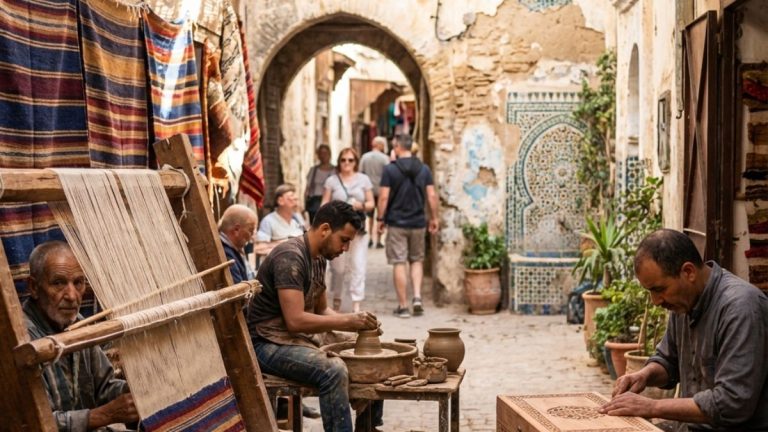
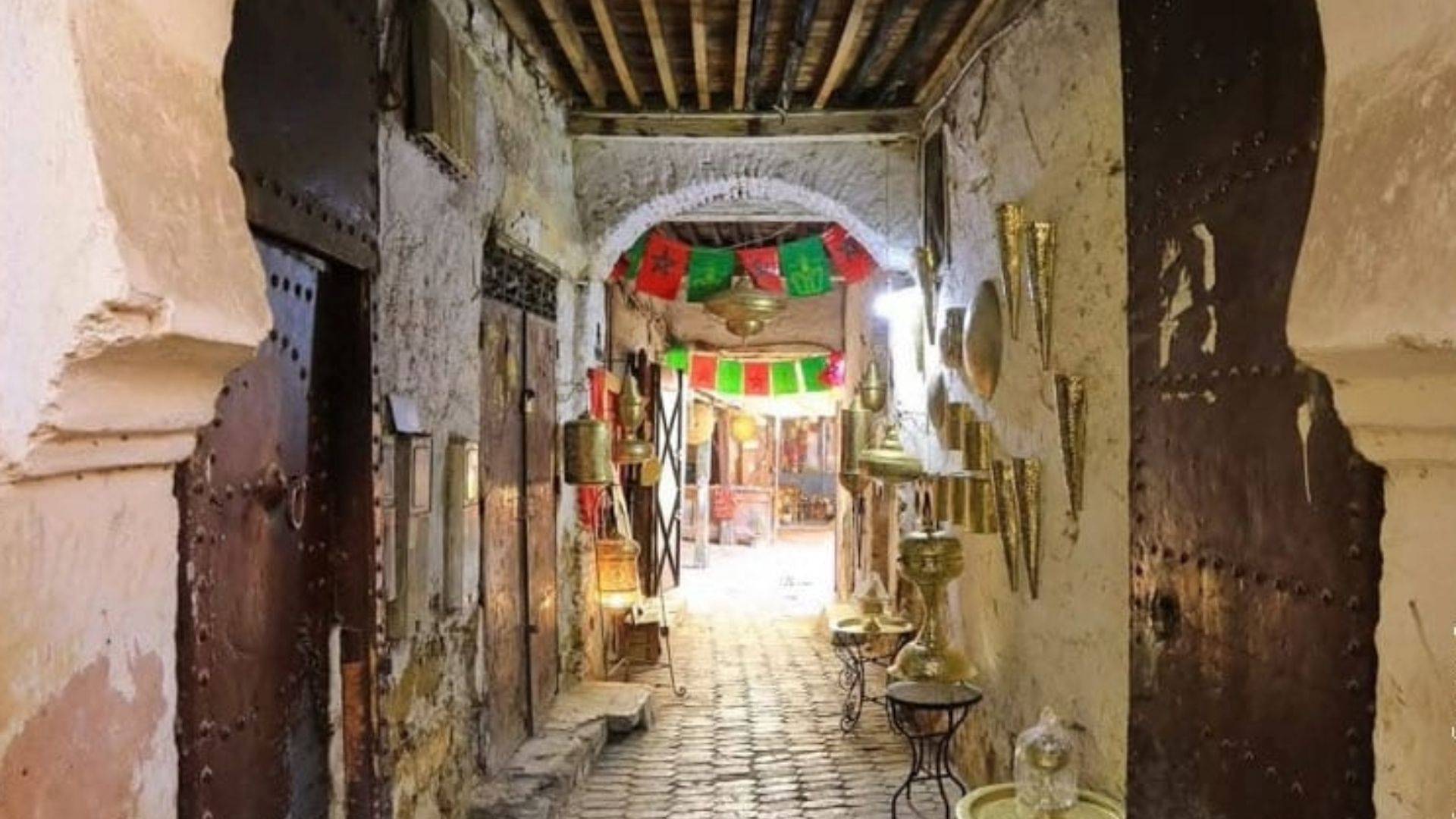
The medina of Fes doesn’t announce itself. It swallows you. One moment you’re on a wide street with taxis honking and tourists snapping photos; the next, you’re in a narrow passage barely wide enough for two shoulders, where sunlight filters through cracks in wooden lattices, donkeys carry sacks of olives balanced like prayers, and voices echo in Tamazight, Arabic, and French all at once, yet never in conflict, as if the walls themselves have learned to hold multiple truths without breaking.
I wandered for hours, turning corners at random, trusting nothing but my feet and the faint hum of my own pulse. Then, near a bend shaded by ancient fig trees, I caught it: a warm, resinous aroma that pulled me toward an unmarked doorway draped with faded indigo cloth. Inside, an old woman sat behind a low table covered in small clay bowls each filled with a different powder, oil, or dried herb. She didn’t speak. She just held out a sprig of dried rosemary. “Breathe,” she said, her voice soft as falling dust.
Her name was Lalla Khadija, and she’d been blending scents in this alley for sixty years long before tourism turned Fes into a destination. “The medina doesn’t confuse you,” she told me later, grinding cinnamon with a stone mortar worn smooth by generations of hands. “It reveals you. And scent is its language. Your nose knows what your mind has forgotten.”
She explained that each blend serves not to perfume, but to restore balance. Rosewater for grief that sits in the chest like stone. Cedar for fear that tightens the throat. Orange blossom for exhaustion that lives in the bones. “You don’t choose the scent,” she said, stirring a mixture of crushed mint and sea salt. “It chooses you. By how your breath changes when you smell it. If your shoulders drop, it’s speaking to your body. If your eyes water, it’s speaking to your soul.”
For those who’ve felt that true guidance comes not from maps, but from presence, Fes Unfolds: Traditions Where Time Stacks in Layers reveals how an entire city heals not by giving answers, but by asking the right questions through wind, stone, and the quiet wisdom of those who know that some paths are found only when you stop looking.
The Bowl That Holds Your Breath
Lalla Khadija didn’t sell perfumes. She offered “breath tests” a practice passed down from her grandmother, who learned it from Berber healers in the Middle Atlas.
She placed three small bowls before me: one with dried rose petals gathered after the first spring rain, another with crushed cedar bark from trees that grow only above 1,500 meters, a third with amber resin aged in clay jars for ten years. “Close your eyes,” she said. “Breathe in each. Don’t think. Just feel where your breath stops or where it finally begins.”
I did. With the rose, my chest tightened, and a wave of grief I hadn’t named in years rose like tide memories of my father’s last winter, the silence in our house after he was gone. With the cedar, my shoulders dropped as if a weight I hadn’t acknowledged was finally seen and held. With the amber, nothing happened. My breath moved through it like wind through an empty room neutral, distant, untouched.
“That one,” she said, pointing to the cedar, “is yours today.”
She mixed it with a drop of argan oil pressed from nuts gathered near Essaouira and a pinch of sea salt carried inland by caravan traders centuries ago. Then she dabbed it on my wrists, behind my ears, and on the center of my chest. “This isn’t fragrance,” she said. “It’s memory. Cedar remembers mountains. Salt remembers ocean. Together, they remind you that you are held even when you feel lost.”
For the next hour, I walked the medina again but this time, the scent clung to my skin like a second pulse. Every turn felt less like confusion and more like conversation. The alleyways weren’t a maze. They were a mirror. And the scent? It wasn’t leading me out. It was leading me in to the parts of myself I’d abandoned in the rush to be productive, visible, useful.
In Fes, healing doesn’t come from escaping the labyrinth. It comes from learning to listen to its whispers and trusting that the right scent will always find you when you’re ready to be found.
The Distiller Who Listens to Rain
Not all scents in Fes come from bowls. Some are born from sky and stone, distilled from patience and prayer.
I met Amina on the edge of the medina, where the city gives way to olive groves and the foothills of the Middle Atlas rise like sleeping giants. She doesn’t have a shop with glass cases and price tags. She has a still a copper contraption passed down from her grandmother, set up under a fig tree in her courtyard, shaded by vines heavy with grapes in late summer.
Every spring, she collects rainwater in clay jars buried halfway in the earth to keep it cool. Every summer, she gathers wild herbs: thyme from rocky slopes, mint from riverbanks where women wash clothes at dawn, orange blossoms from trees that bloom only after the first storm breaks the dry season. “Scent isn’t made,” she told me as she fed rose petals into the still, her hands stained with pollen. “It’s released. Like a secret the earth has been holding for the right moment.”
She showed me how steam rises through the copper coils, carrying the essence of the flowers with it, then condenses into a golden liquid that drips slowly one drop every few seconds into a glass vial. “This,” she said, holding it up to the light, “is the breath of the flower after it has spoken to the rain. You can’t rush it. If you do, you get water, not essence.”
She doesn’t sell her distillates by the bottle. She gives them by the drop placed on the tongue for clarity, on the wrist for calm, or on the third eye for dreams, depending on what the person carries in their silence. “One drop of rose for a broken heart,” she said, her eyes steady. “Two drops of thyme for a mind that won’t rest. But never more. Too much truth can drown you.”
Later, I watched her give a vial of orange blossom water to a young woman who’d just lost her mother. No words passed between them. Just the vial, pressed into her palm. The woman closed her eyes, inhaled, and wept not from sadness, but from recognition. The scent had brought back her mother’s hands kneading bread at dawn, the smell of blossoms drifting through their kitchen window, the sound of her humming old Amazigh songs. In that moment, grief wasn’t erased. It was honored.
In Fes, fragrance isn’t decoration. It’s time travel. And those who make it aren’t perfumers. They’re keepers of memory, alchemists of belonging.
If your spirit has been stirred by the quiet alchemy of scent and soil if you’ve sensed that healing sometimes arrives not in words, but in a single breath that unlocks a door you didn’t know was closed then Hands That Shape Silence in Fes’ Clay will carry you to the potter’s wheel, where silence is shaped into vessels that hold not water, but presence.
The Scent That Remembers You
On my last evening in Fes, I returned to Lalla Khadija’s alley. The medina was quiet, the day’s heat softening into dusk, the call to prayer echoing from distant minarets like a lullaby. She didn’t ask where I’d been or what I’d learned. She simply handed me a small clay vial sealed with beeswax, its surface etched with a single geometric pattern. “This,” she said, “is your scent. Not for now. For when you forget who you are.”
I held it in my palm. It was warm from her hands. Inside, a blend of cedar, orange blossom, and a hint of something smoky like the memory of a fire long gone, or incense burned in a courtyard at midnight. “How did you know?” I asked.
She smiled, her eyes crinkling like old parchment. “Your breath told me. On the first day, it was shallow, fast, like a bird trapped in a room. Today, it’s deep, slow, like the tide returning home. The scent changed with you.”
Back in Los Angeles, I keep the vial on my windowsill, next to a single sprig of dried rosemary. I don’t open it often. But when the noise of the city grows too loud when deadlines crowd my chest, screens blur my vision, and I feel myself slipping back into the old rhythm of doing instead of being I hold it to my nose and breathe. Instantly, I’m back in the medina: the cool stone under my feet, the murmur of voices in distant courtyards, the certainty that being lost is not failure, but invitation.
In Fes, scent isn’t just smell. It’s witness. It remembers who you were when you arrived tense, hurried, fragmented and who you became when you left: softer, slower, whole. And it waits not to bring you back, but to remind you that you never truly left yourself behind.
Because sometimes, the clearest path isn’t found on a map.
It’s carried on the wind, waiting for your breath to recognize it as home.