
I didn’t go to Fes looking for direction.
I went because I’d lost my sense of belonging not just to a place, but to myself. In California, I navigated life with clinical precision: GPS guiding my car through traffic, fitness apps tracking my steps, calendars dictating my hours down to the fifteen-minute block, even my sleep was monitored by a ring that gave me a “readiness score.” I knew my exact coordinates at all times latitude, longitude, heart rate, productivity metrics yet I’d never felt more adrift. My days were mapped, optimized, and scheduled with military efficiency, but my soul had no address. I could find any restaurant in seconds, reroute around accidents before they happened, and book a flight across the world in under a minute but I couldn’t find my own breath in a quiet room. So when a friend who’d lived in Fes for years said, “Go. Not to find your way. Just to get lost. The medina will hold you,” I left my phone in airplane mode, turned off my watch, tucked my notebook into my bag without opening it, and stepped into the labyrinth with nothing but open eyes, empty hands, and the quiet hope that if I stopped trying to be found, I might finally remember how to be.
What I found wasn’t confusion. It was invitation in alleyways that curved like questions, archways that framed silence, and the quiet trust that some paths are only revealed when you surrender the map and let the city breathe you in.
The Alley That Swallows Time
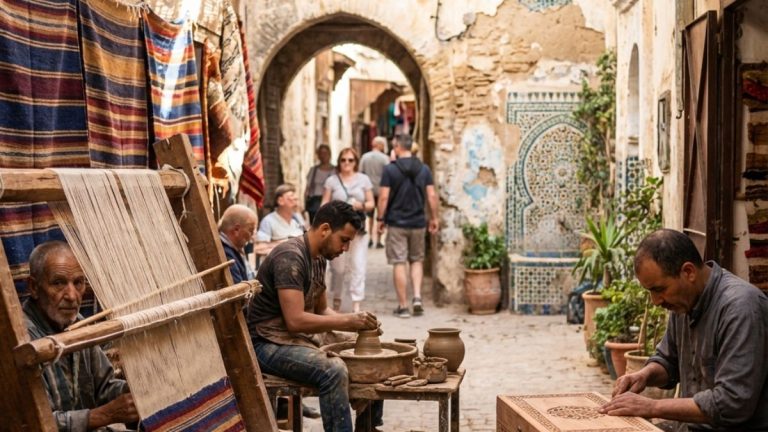
The medina of Fes doesn’t announce itself. It absorbs you. One moment you’re on a wide street with taxis honking, tourists snapping photos, and vendors calling out prices; the next, you’re in a passage so narrow your shoulders brush both walls, sunlight filtering through cracks in wooden lattices like liquid gold, voices echoing in Tamazight, Arabic, and French all at once, yet never in conflict, as if the stones themselves have learned over centuries to hold multiple truths without breaking. The air smells of fresh bread, cedarwood, wet stone, and something older like memory made visible.
I wandered for hours on my first day, turning corners at random, trusting nothing but my feet and the faint hum of my own pulse. No Google Maps. No compass. No internal monologue about “making the most of my time.” Just presence. And slowly, something shifted. My breath deepened. My shoulders dropped. The urgency that had lived in my chest like a second heartbeat the constant hum of “what’s next? what’s next?” began to quiet, not because I silenced it through willpower, but because the alley held it gently, like water holds a stone, like a mother holds a crying child.
An old man sweeping a threshold with a broom made of palm fronds saw me pause, clearly disoriented, looking up and down the same passage three times. He didn’t laugh. Didn’t offer directions. He simply smiled, his eyes crinkling like old parchment, and said, “You’re not lost. You’re being found.”
For those who’ve felt that true belonging isn’t found by arriving, but by wandering, Fes Unfolds: Traditions Where Time Stacks in Layers reveals how an entire city heals not by giving answers, but by dissolving the need for them through alleys that breathe, walls that remember, and silence that speaks in footsteps, not signs.
The Door That Opens to Nowhere
In Fes, not every door leads somewhere. Some exist just to be passed.
I learned this from Amina, a woman who’d lived her whole life in the medina, her family in the same house for five generations. She showed me a narrow alley near the Qarawiyyin where three identical wooden doors stood side by side no signs, no numbers, no handles, just iron studs worn smooth by centuries of hands. “Tourists always stop here,” she said, laughing softly, “pointing at their phones, asking which one is ‘the real one.’ But here, we know: all of them are. And none of them are.”
She explained that in the medina, direction isn’t about destination. It’s about attention. “When you stop looking for the exit,” she said, leaning against the cool plaster wall, “you start seeing the light on the plaster, the pattern in the cobblestones, the way an old man sips his tea at dusk, the shadow of a bird flying overhead. That’s when you arrive not at a place, but at presence.”
I spent a full day following no path. I turned left when my feet felt heavy, right when the light called me, straight when the scent of bread pulled me forward like an invisible thread. I got “lost” a dozen times but each time, I found something: a hidden fountain trickling over carved stone, its sound deepening the silence; a cat sleeping in sunlit zellige tiles, undisturbed by the world; a boy reciting Quran in a courtyard shaded by fig trees, his voice rising like incense. None of it was on any map. All of it was real. And in that reality, I felt more found than I had in years.
In a world that rewards efficiency, speed, and output, this felt like rebellion. Not loud. Not angry. Just deeply, stubbornly human.
The Minaret That Calls Without Words
Not all guidance in Fes comes from voices. Some rises from stone, sky, and silence.
Every afternoon, as the sun began its slow descent, painting the walls in warm amber, I’d find myself drawn to a small square near the Qarawiyyin Mosque not for prayer, but for stillness. There, the call to prayer would echo from the minaret, not as command or ritual, but as invitation: Come back. Breathe. Remember you are here.
I met Karim, an old bookseller with a shop full of yellowed manuscripts, sitting on a low stool outside his door, listening to the call with his eyes closed, his face tilted toward the sound. “You don’t need to understand the words,” he told me when he opened them, his voice as steady as the stones beneath us. “The sound itself is the map. It doesn’t tell you where to go. It reminds you that you’re already home.”
He explained that for centuries, the medina’s layout was designed not to be navigated like a grid, but to be lived like a poem. Streets twist not to confuse, but to slow you down. Alleys narrow not to trap, but to focus your attention inward. Corners turn not to hide, but to reveal. And the call to prayer? It doesn’t mark time like a clock. It marks presence like a breath.
Later, I watched a young woman clearly a tourist, clutching a paper map stop mid-stride as the call began. She looked around, disoriented, then slowly sat on a step, folded her map, closed her eyes, and listened. When it ended, she didn’t check her phone. She didn’t unfold the map. She smiled a real smile, not for a photo and walked on, lighter. In that moment, she wasn’t lost. She was found.
In Fes, orientation isn’t spatial. It’s spiritual. And the truest compass isn’t in your hand it’s in your breath, your feet, your willingness to be held by the unknown.
If your spirit has been shaped by GPS until it forgets how to wander if you’ve sensed that belonging lives not in coordinates, but in surrender then The Paper That Waits for the Hand in Fes will carry you to hidden courtyards where silence is shaped into form, and healing begins not with writing, but with waiting with hands that learn to listen before they create.
The Path That Finds You
On my last evening in Fes, I walked into the medina with no plan, no destination, no expectation. The sun was setting, casting long shadows over the cobblestones, and the air smelled of fresh khobz from the communal oven, cedarwood from a carpenter’s shop, and distant rain gathering over the hills. I turned left, then right, then followed a stray cat with a torn ear down a narrow passage I’d never seen before. At one point, I realized I had no idea where I was but for the first time in years, I didn’t care. The panic that usually rose in my chest when I felt “off course” was absent. In its place was a quiet certainty: I was exactly where I needed to be.
I sat on a low stone step beneath an archway draped with jasmine, listening to the murmur of life around me: a woman singing as she washed clothes in a courtyard, her voice weaving with the splash of water; a donkey’s bell jingling in the distance as it carried olives to a press; the soft slap of wet clay from a potter’s wheel two alleys over. In that moment, I wasn’t searching. I wasn’t producing. I wasn’t even “being present” as a performance or a goal. I simply was unmeasured, unoptimized, unrecorded.
And then, without trying, without remembering a single turn, without consulting any internal map, I found myself back at the heavy wooden door of the riad where I was staying. Not because I recalled the route, but because the path remembered me.
Back in Los Angeles, I keep a small stone from the medina on my desk smooth, warm to the touch, stained with the dust of centuries. Not for luck. Just reminder. And whenever the noise of the city grows too loud when deadlines crowd my chest, screens blur my vision, and I feel myself slipping back into the old rhythm of doing instead of being I close my eyes and walk the alleys in my mind. Instantly, I’m back: not lost, but held. Not searching, but found.
In Fes, the medina doesn’t give you a map. It gives you trust. And in that trust, it teaches us that we, too, don’t need to know the way to be whole. We only need to walk and let the path find us.
Because belonging doesn’t always come from arriving.
Sometimes, it comes from learning to get lost and trusting that even the deepest labyrinth was built not to confuse, but to hold you.