
When the last Muslims left Granada in 1492, they carried something more precious than gold the memory of Al-Andalus encoded in melodies. Five centuries later, those same noubas echo through Tangier’s concert halls, preserved with remarkable fidelity by musicians who trace their lineage back eleven generations. This refined tradition represents one of the most sophisticated expressions within Morocco’s sacred music festivals and spiritual heritage, offering a contemplative counterpart to trance-based rituals.
If you want to understand how Tangier became a refuge for expelled cultures, start by listening to the music that survived the crossing.
The 1492 Crossing
Ferdinand and Isabella’s completion of the Reconquista forced thousands of Muslims and Jews across the Strait of Gibraltar to North African shores. Among the refugees were musicians, poets, and scholars who carried in their memories the artistic traditions developed over eight centuries of Islamic presence in Iberia.
Tangier became one of the cities that absorbed these exiles. Unlike written literature, Andalusian music survived entirely through oral transmission. Masters taught students through repetition, correction, and embodied practice. This living chain preserved not only melodies but an entire aesthetic system—modes, rhythmic cycles, poetry, and performance ethics.
An oud teacher at the Conservatoire de Musique Andalouse once told me his lineage traced back to a master who fled Seville in 1492. That continuity makes this tradition one of the longest continuously practiced classical music systems in the world and a pillar of Tangier’s sacred soundscape.
Understanding the Nouba
Andalusian music organizes itself around the nouba, an elaborate musical suite traditionally associated with one hour of the day. While twenty-four noubas once existed, eleven survive today in the Moroccan tradition.
Each nouba unfolds in a precise order. It begins with an instrumental touchia, establishing the melodic mode (tab‘). Vocal movements follow, gradually increasing in rhythmic complexity and emotional intensity. Slow, contemplative sections give way to joyful, energetic conclusions.
Listening to a complete nouba feels less like attending a concert and more like entering a guided emotional journey. The structure mirrors spiritual practices found in Sufi rituals, creating natural resonance with other expressions explored across Morocco’s sacred music festivals in Tangier.
The Poetry of Exile
The lyrics performed in Andalusian music come from medieval poets such as Ibn al-Khatib and Ibn Zaydun. Their verses speak of love, separation, longing, gardens, and wine often carrying mystical meanings beneath their surface imagery.
The vocal discipline required to perform this poetry is immense. Singers must master microtonal intervals, breath control, and ornamental phrasing that can take decades to refine. Conservatory students train rigorously, preserving pronunciation and melodic detail passed down for centuries.
Watching a young singer perform eleventh-century poetry with complete command reinforces the idea that this is not museum music. It is living heritage, practiced daily and shared publicly throughout Tangier’s cultural institutions and seasonal events detailed in the Tangier sacred music festival calendar.
Instruments of Memory
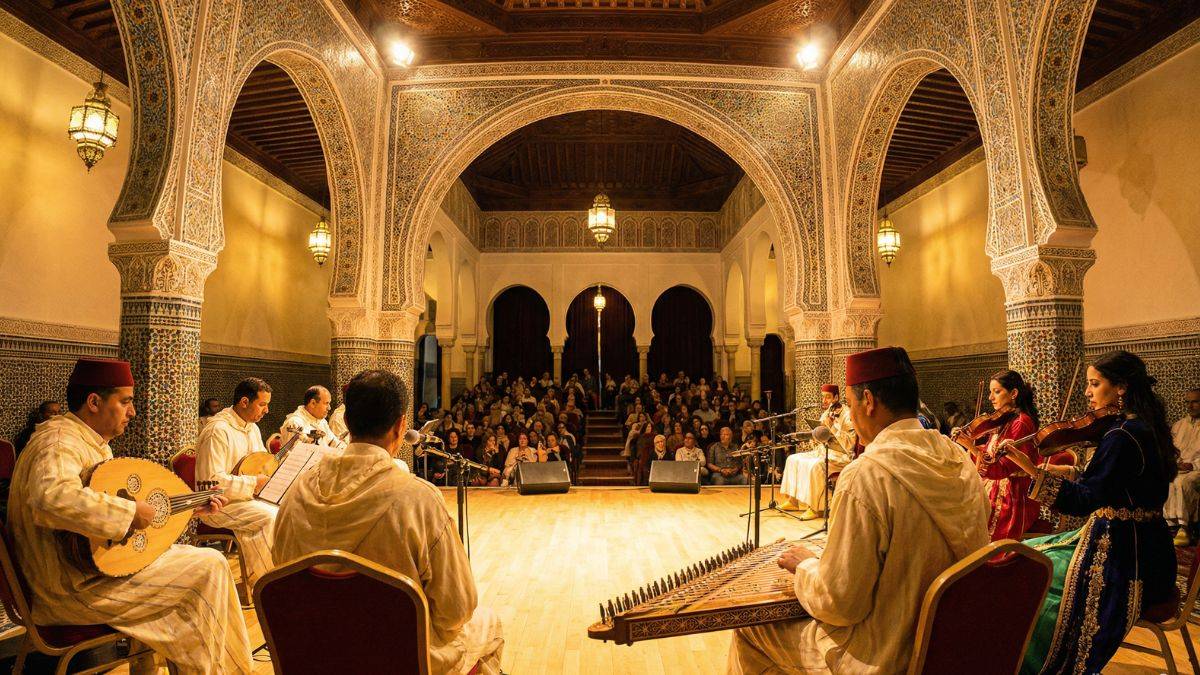
The Andalusian ensemble blends Arab and European influences. The oud anchors the melodic structure, while the qanun adds shimmering textures. Violins introduced later play in unison, enriching the sound without dominating it.
Percussion instruments such as the tar and bendir provide rhythmic frameworks rather than overpowering beats. Every instrument serves the balance of the ensemble, reinforcing the tradition’s emphasis on refinement and restraint rather than spectacle.
This sonic elegance distinguishes Andalusian music from trance traditions like Aissawa, offering a complementary experience within the broader landscape of sacred music in Tangier.
While Andalusian music offers a contemplative passage shaped by exile and refinement, Tangier’s sacred soundscape also contains traditions that move in the opposite direction, toward physical surrender and ecstatic release. This contrast becomes clearer when explored alongside Aissawa Music Morocco: The Ghaita’s Ecstatic Call, where piercing oboes and relentless percussion guide bodies into trance states used for healing and spiritual catharsis. Together, these traditions reveal how Morocco’s sacred music festivals balance inward listening with outward intensity, allowing multiple spiritual languages to coexist within the same urban rhythm.
Where Andalusian Music Lives in Tangier
The Conservatoire de Musique Andalouse remains the institutional heart of the tradition. Student recitals are frequent, often free, and open to the public. These performances offer rare access to a living lineage normally hidden behind academic walls.
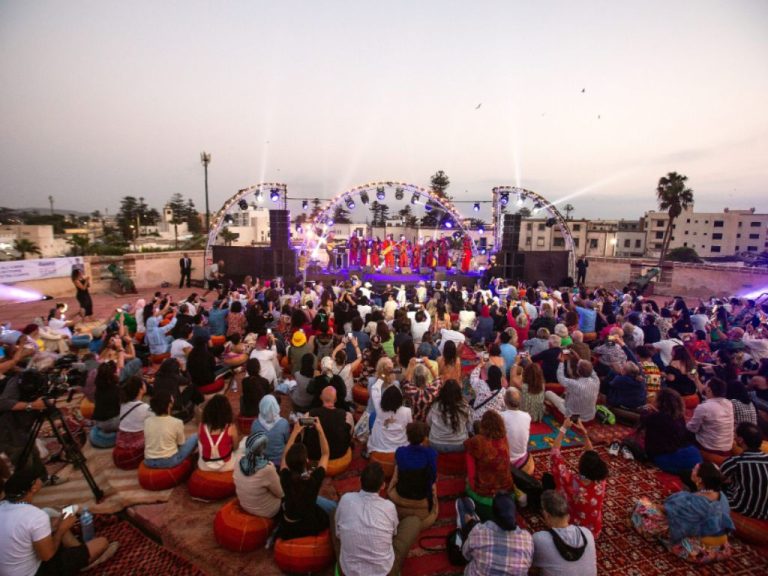
The Institut Cervantes hosts monthly concerts featuring established orchestras, presenting polished interpretations of classical repertoires. During Ramadan, public squares transform into open-air concert spaces where Andalusian orchestras perform nightly after iftar.
For visitors unsure where to begin, a practical overview is available inwhere to hear sacred and classical music in Tangier, mapping venues by accessibility and atmosphere.
Contemporary Expressions
Younger musicians increasingly explore contemporary interpretations, blending Andalusian modes with jazz, classical, or experimental elements. Some projects succeed brilliantly, others less so, but the willingness to innovate keeps the tradition alive rather than frozen.
These fusion efforts often appear during cultural festivals and modern programming, reinforcing Tangier’s role as a city where tradition and experimentation coexist one of the defining features highlighted throughout Morocco’s sacred music festivals.
Experiencing Andalusian Music as a Visitor
Concert etiquette resembles Western classical norms: arrive on time, silence phones, and avoid applauding between movements. Dress respectfully, though requirements are less strict than in religious spaces.
The biggest challenge for visitors is information. Schedules often circulate by word of mouth rather than online. Building local connections hotel staff, café owners, cultural centers makes discovery easier.
Ticket prices remain affordable, reinforcing the idea that this music belongs to everyone. This accessibility mirrors the communal values found across Morocco’s sacred traditions.
What This Music Offers
Andalusian music demands attention. Its slow unfolding resists distraction, inviting listeners into deep presence. In an age of fragmented focus, this sustained listening becomes an act of quiet resistance.
The music carries memory of exile, survival, and continuity. Hearing it in Tangier means witnessing how displaced cultures preserved identity through sound. That continuity links directly to the spiritual resilience found in other traditions such as Sufi dhikr and Aissawa trance.
For travelers seeking a fuller picture of how these traditions intersect throughout the year, exploring Morocco’s Sacred Music Festivals: Where Ancient Rhythms Meet Modern Souls reveals how Andalusian refinement complements more ecstatic forms in the city’s unique spiritual ecosystem.