
I didn’t go to Fes looking for silence.
I went because I couldn’t hear myself anymore not over the ping of emails, the hum of traffic, the endless scroll of curated lives, or even the static of my own thoughts racing in circles like caged birds. In California, I’d built a life that looked successful from the outside: published essays, speaking gigs, a tidy apartment with succulents and good lighting. But inside, I was hollow. My hands moved constantly typing, swiping, grabbing coffee but they hadn’t felt anything real in years. So when a friend who’d apprenticed with a potter in Morocco said, “Go to Fes. Not to find peace. Just to feel your hands again,” I left my headphones behind, turned off my phone, and walked into the medina with nothing but the weight of my own noise and the quiet hope that if I stopped trying to be useful, I might finally remember how to be human.
What I found wasn’t quiet. It was deeper than that. It was silence shaped into form in wet clay, spinning wheels, and hands that knew how to listen without speaking.
The Wheel That Spins Without Sound
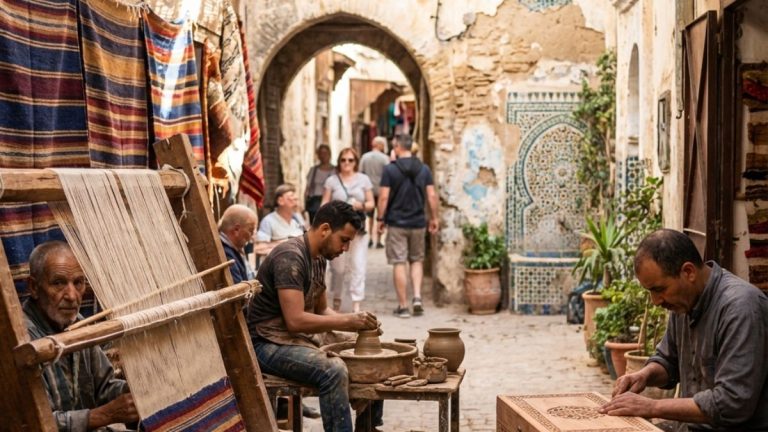
The potters of Fes don’t work in galleries with white walls and price tags. They work in sunlit courtyards tucked off narrow alleys near the Chouara Tannery, where the only sounds are the soft slap of wet clay hitting stone, the rhythmic creak of an old wooden wheel turned by foot, and the distant call to prayer echoing off ancient walls like a lullaby for the soul.
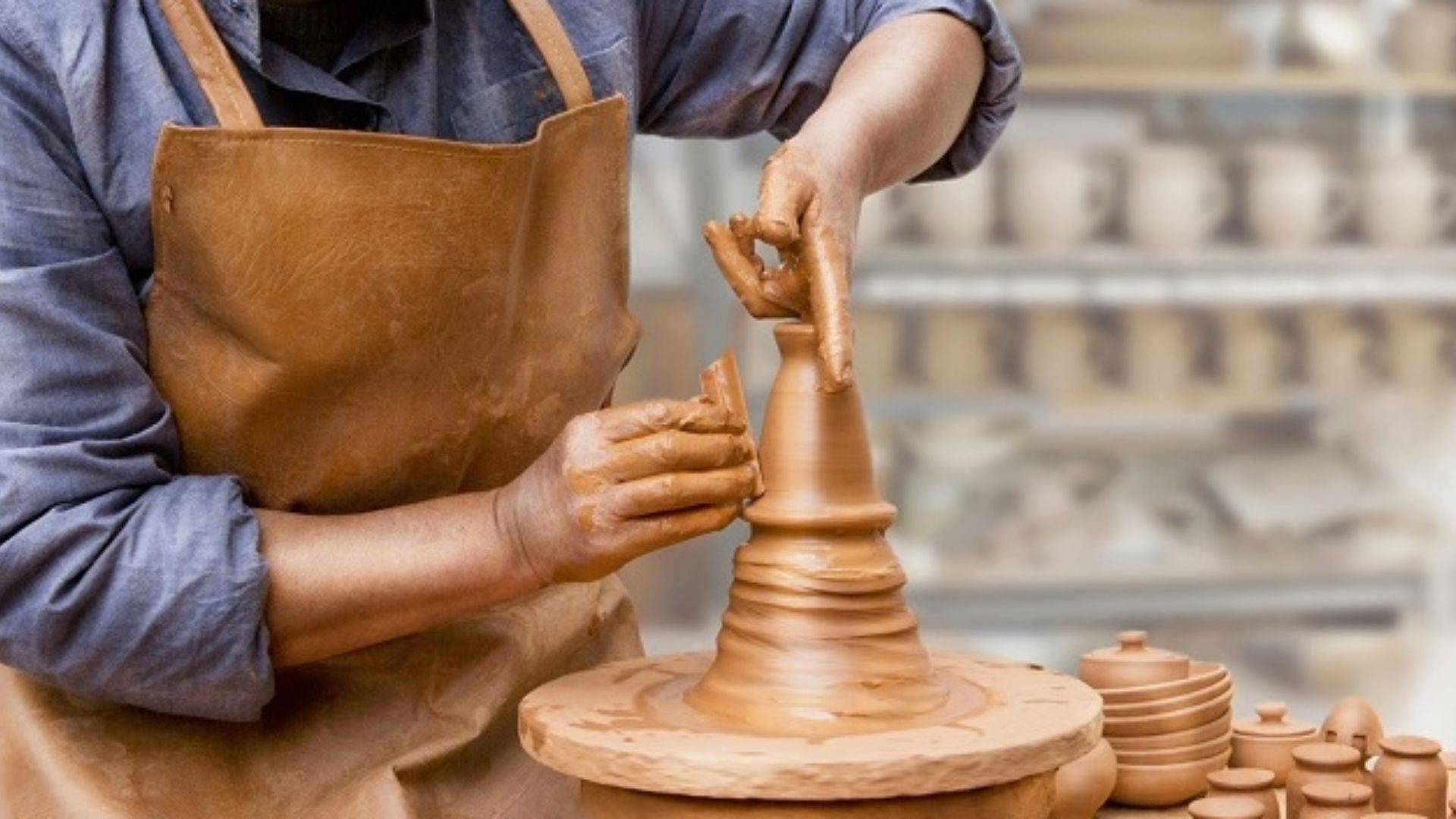
I met Hassan in one such courtyard, his arms stained with red clay from the hills outside the city, his feet bare on the cool tiles, moving slowly on the pedal that spun the wheel. He didn’t greet me with a tour or a sales pitch. He simply pointed to a low stone stool beneath a fig tree and handed me a lump of raw earth, still cool from the pit where it had aged for months. “Feel it,” he said, his voice as steady as the wheel’s spin. “Don’t think. Just feel.”
For an hour, I sat and watched him work. No music. No phone. No internal monologue about what this “meant” or how I could “use” it. Just presence. His hands moved with the certainty of those who know their material not as resource, but as partner. He dipped his fingers into a bowl of rainwater, touched the spinning mound, and gently coaxed it upward thin, smooth, breathing. When the vessel began to rise, he slowed his foot, let the wheel spin freely, and placed his palms gently around the rim, as if cradling something alive. “This,” he whispered, “is where silence lives not in the absence of sound, but in the presence of attention.”
Later, I learned that every potter in this quarter uses clay from the same source: a red-earth quarry near the Oued Fes, dug by hand with wooden shovels, aged for six months in shaded pits lined with straw, and mixed only with rainwater collected in winter and stored in clay jars. “Clay isn’t material,” Hassan explained, wiping his brow with the back of his hand. “It’s memory. It remembers the hands that shaped it, the water that softened it, the sun that dried it, the fire that tested it. And if you listen, it will tell you what it wants to become.”
For those who’ve felt that true stillness isn’t found in retreats, but in rhythm, Fes Unfolds: Traditions Where Time Stacks in Layers reveals how an entire city heals not by escaping noise, but by shaping silence into something you can hold a bowl, a cup, a breath made visible.
The Hand That Learns to Listen
Hassan didn’t let me touch the wheel on my first day. “Your hands are too loud,” he said, watching me fidget with the lump of clay, my fingers twitching as if searching for a keyboard that wasn’t there. “They still think in notifications, in deletes, in likes. Here, we think in breaths, in pressure, in patience.”
Instead, he gave me a task: sit by the drying racks and watch the vessels change as they hardened wet and dark as midnight at dawn, firm and pale as bone by noon, cool and resonant as stone by dusk. “Don’t count them,” he warned. “Don’t imagine what you’ll fill them with. Just see how they hold space. How they wait. How they become.”
So I sat. And for the first time in years, I did nothing but observe. No phone. No notes. No internal monologue about productivity or purpose. Just presence. And slowly, something shifted. My shoulders dropped. My breath deepened. The noise that had lived in my head like static the constant hum of “what’s next?” began to quiet, not because I silenced it, but because the space around me held it gently, like clay holds water.
On the third day, he handed me a small mound of prepared clay, kneaded and ready. “Now,” he said, “your hands are ready to listen.”
I placed it on the wheel, pressed the pedal with my foot, and tried to center it. It wobbled. Collapsed. Spun off into a sad lump. But Hassan didn’t correct me. He didn’t say “wrong.” He just nodded and said, “Again.”
By the tenth try, my movements slowed. Not because I was trying to be slow, but because my body had finally remembered how to listen to the weight of the clay, the tension of the spin, the silence between actions. On the fifteenth try, the mound stayed centered. On the twentieth, it rose slightly, trembling but whole. “Good,” he said. “Not perfect. But honest.”
In Fes, learning isn’t about control. It’s about surrender. And the clay teaches you that not everything needs to be shaped to be whole. Sometimes, the most honest vessel is the one that cracks and still holds.
The Kiln That Breathes Fire
Not all silence in Fes is soft. Some is forged in fire.
Behind Hassan’s courtyard stood a low, dome-shaped kiln built from the same red earth as the clay it fired, its surface blackened by decades of flame. Every week, he loads it with dozens of vessels bowls, plates, tagines each one shaped by hand, dried in the shade for three days, and left to rest another two before facing the flame. “Fire doesn’t punish,” he told me as he stacked greenware inside, his movements deliberate, reverent. “It reveals. What was weak cracks. What was honest becomes strong.”
He doesn’t use gas or electricity. The kiln is fed only by olive wood gathered from groves outside the city, burned slowly over three full days never rushed, never forced. “You can’t rush fire,” he said, closing the heavy iron door. “If you do, the moisture trapped inside turns to steam too fast, and the clay explodes. If you wait, it sings.”
I stayed through the night. As the kiln heated, the air grew thick with the scent of burning wood and hot earth, warm enough to soothe old aches in my bones. At dawn, Hassan opened the door. Steam rose like breath from a sleeping giant. Inside, the vessels glowed faintly, their surfaces transformed some smooth as river stone, others crackled with fine lines called craquelure, not flaws, but signatures of patience, maps of resilience.
He pulled out a small bowl I’d watched him shape days earlier. It had survived. Not perfect. But whole. “This,” he said, placing it in my hands, still warm from the fire, “is what silence sounds like after it’s been tested.”
Later, I learned that broken pieces aren’t discarded. They’re ground into powder with a stone mortar and mixed back into new clay a practice called khammash, meaning “to return to the earth.” “Nothing is wasted,” Hassan explained, showing me a jar of gray powder. “Even failure becomes part of the next vessel. Even grief becomes part of the next song.”
In Fes, resilience isn’t about never breaking. It’s about knowing how to return to the earth and rise again.
If your spirit has been shaped by noise until it feels fragile if you’ve sensed that true strength lies not in perfection, but in the quiet courage to be remade then The Courtyard That Holds a Thousand Whispers of Fes will carry you to hidden riads where water, light, and stillness teach the art of holding space for grief, joy, and everything in between.
The Vessel That Remembers You
On my last morning in Fes, Hassan handed me a small bowl unglazed, slightly uneven, its rim bearing the faint imprint of his thumb, its surface textured with the memory of his fingers. “This one,” he said, his eyes crinkling at the corners, “was shaped while you were here. Your silence helped it dry.”
I ran my fingers over its surface. It felt alive not smooth and sterile like factory ceramic, but textured, breathing, full of tiny imperfections that gave it character, history, soul. He didn’t offer it for sale. He didn’t suggest I fill it with tea or keys or trinkets. He simply said, “Keep it. Not to use. To remember that you, too, are allowed to be unfinished.”
Back in Los Angeles, I placed it on my desk, empty. No pens. No coins. Just presence. And whenever the noise of the city grows too loud when deadlines crowd my chest, screens blur my vision, and I feel myself slipping back into the old rhythm of doing instead of being I hold it in my hands. Instantly, I’m back in that courtyard: the soft slap of clay, the creak of the wheel, the warmth of sun on ancient stone, the quiet certainty that some things are made not to be filled, but to hold space.
In Fes, a vessel isn’t valued for what it carries, but for the emptiness it honors. And in that emptiness, it teaches us that we, too, don’t need to be full of achievements, answers, or noise to be whole. We only need to be present with our cracks, our silence, our waiting hands.
Because healing doesn’t always come from filling the void.
Sometimes, it comes from learning to shape it and trust that even broken clay can hold the light.