
I didn’t go to Fes looking for peace.
I went because I’d forgotten how to be still not just in body, but in spirit. In California, my version of “quiet time” was noise with the volume turned down: podcasts on low, playlists labeled “calm,” apps that promised “mindful minutes” between meetings, and even my meditation cushion had become another item on a checklist. But true stillness? The kind that lets you hear your own breath without commentary, without agenda, without the need to “optimize” it? I hadn’t felt it in years. My mind had become a crowded room where every thought shouted to be heard, and silence felt like failure like I wasn’t doing enough. So when a friend who’d spent a decade restoring riads in Morocco said, “Go to Fes. Not to escape. Just to sit in a courtyard until the walls start speaking,” I left my earbuds behind, turned off my phone, and walked into the medina with nothing but a thirst for silence and the quiet hope that if I stopped trying to fill every moment, something might finally fill me.
What I found wasn’t solitude. It was presence in water, light, stone, and the quiet architecture of belonging.
The Door That Opens to Stillness
The riads of Fes don’t announce themselves. You pass them a hundred times without noticing a plain wooden door, iron studs worn smooth by centuries of hands, no sign, no bell, no Instagrammable facade. But if you pause, if you slow down long enough to listen, you’ll hear it: the soft trickle of water from a hidden fountain, the rustle of orange leaves in an inner garden, the distant murmur of voices like wind through reeds, all wrapped in a silence so deep it feels like breath held.
I was invited into one such courtyard by Amina, a woman who’d inherited her family’s riad near the Qarawiyyin quarter from her grandmother, who inherited it from hers. She didn’t offer a tour. Didn’t explain the history or point out the craftsmanship. She simply opened the heavy door, stepped aside, and said, “Sit. The house will speak.”
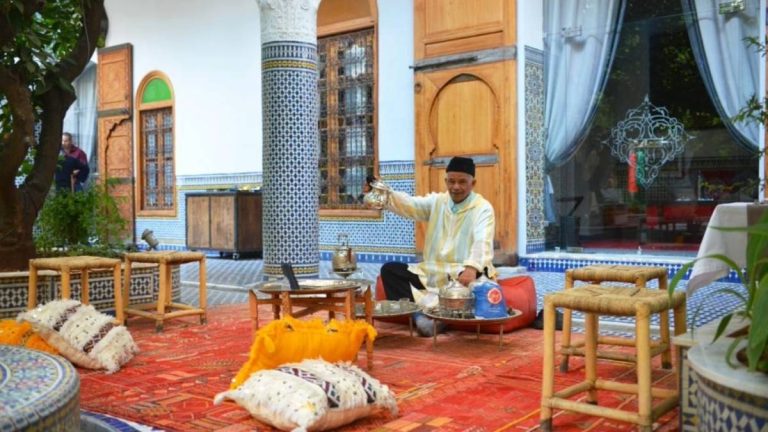
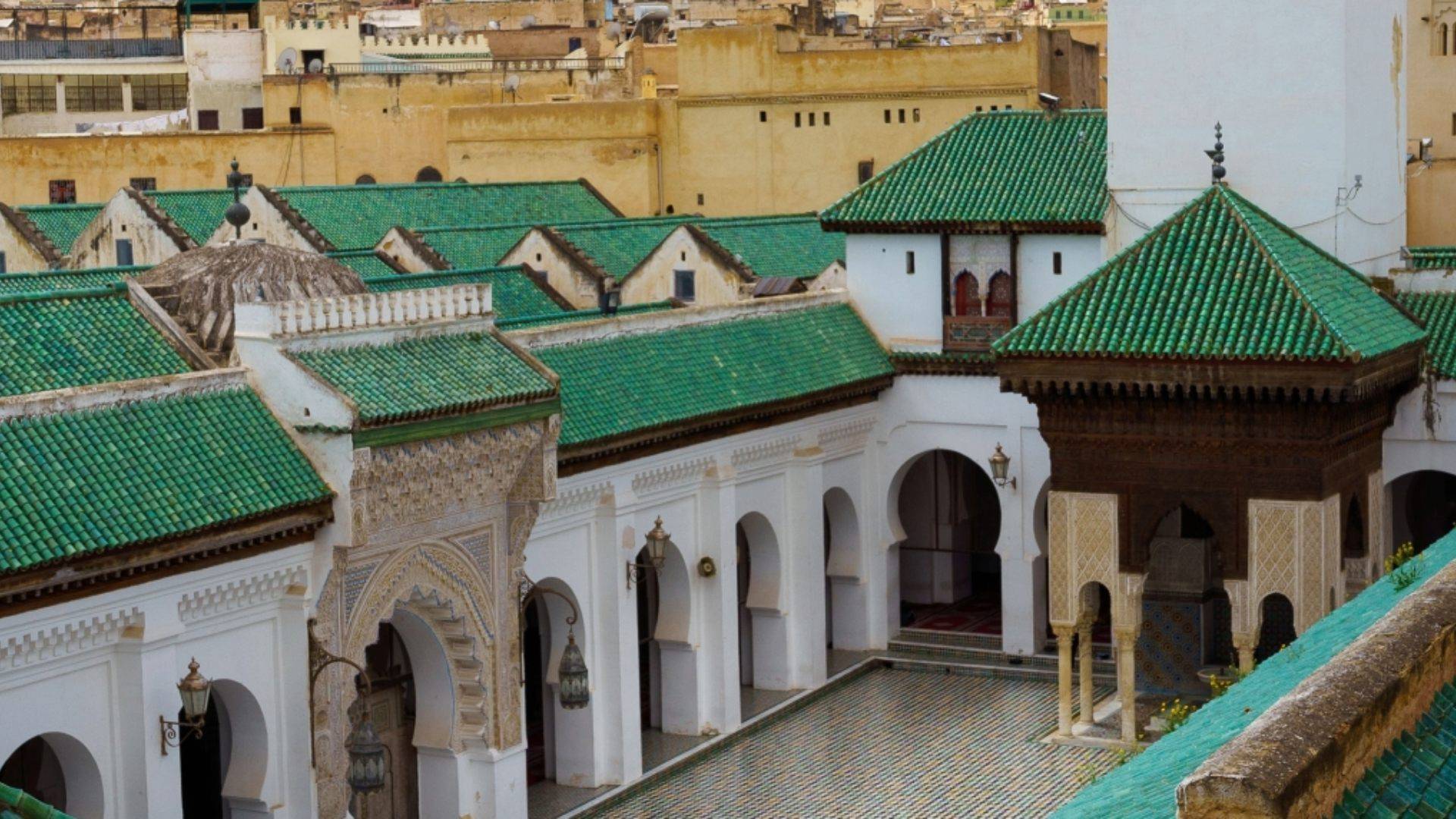
Inside, sunlight fell through a square opening in the roof the skylight they call it, though it’s more like a window to the sky casting a perfect pool of gold on zellige tiles below, each piece hand-cut and fitted without mortar, forming geometric patterns that shimmered as the light shifted. Around it, four archways led to shaded rooms, their walls washed in warm plaster the color of desert sand at dusk, their windows latticed with cedar wood to diffuse the harsh sun into soft, dancing shadows. In the center, a fountain trickled over carved stone, its sound not breaking the silence, but deepening it, like a heartbeat in a sleeping body.
“This isn’t a house,” Amina said, pouring mint tea into small glasses from a height that made it foam. “It’s a vessel. And what it holds isn’t people. It’s attention. Presence. The space between thoughts.”
For those who’ve felt that true sanctuary isn’t found in retreats, but in spaces designed to hold you, Fes Unfolds: Traditions Where Time Stacks in Layers reveals how an entire city heals not by removing noise, but by building courtyards where silence becomes visible in water, shadow, and the slow arc of light across ancient tile.
The Fountain That Teaches Listening
Amina didn’t let me speak for the first hour. “Your words are still too loud,” she said, watching me fidget on the low divan, my fingers twitching as if searching for a phone that wasn’t there. “Sit. Let the water wash them away.”
So I sat. And listened. Not to think of what to say next, not to analyze, not to plan how I’d write about this later but to truly hear: the drip of water from the fountain’s spout, the ripple as it hit the basin, the soft echo against zellige walls, the occasional sigh of wind through the orange tree. At first, it was just sound. But after twenty minutes, something shifted. The noise in my head the endless loop of plans, regrets, to-dos, the constant hum of “what’s next?” began to quiet, not because I silenced it, but because the water held it gently, like a mother holding a crying child, not to stop the tears, but to say, “I’m here.”
“The fountain isn’t decoration,” Amina explained later, running her fingers over the carved stone, its surface smooth from generations of touch. “It’s a teacher. In Fes, we say water doesn’t flow through a courtyard. It flows into it carrying prayers whispered at dawn, laughter shared at dusk, the weight of grief held in silence. And if you sit long enough, it teaches you how to carry your own.”
She showed me how the fountain’s design a central spout feeding a shallow basin surrounded by narrow channels mirrors the rhythm of breath: inhale (the spout), hold (the basin), exhale (the channels), rest (the return). “You don’t control the water,” she said. “You learn its rhythm. And in that rhythm, you find your own.”
In a world that rewards constant output, this felt like rebellion. Not loud. Not angry. Just deeply, stubbornly human.
The Light That Moves Through Time
In Fes, light doesn’t just illuminate it narrates. It tells the story of the day, the season, the year, in colors and shadows that shift with celestial precision.
From dawn to dusk, sunlight moves through the courtyard like a slow reader turning the pages of an ancient book. At sunrise, it spills through the central opening in the roof, casting a sharp square of gold on the zellige floor, precise and full of promise. By mid-morning, it softens, stretching into long rectangles that warm the plaster walls, inviting you to lean against them and feel the day’s warmth seep into your bones. At noon, when the sun is high, it retreats to the center, a perfect circle hovering over the fountain, a moment of balance, of stillness at the peak. And by late afternoon, it slants through the latticed windows, painting the floor with intricate patterns stars, diamonds, waves that shift with every passing minute, as if the house itself is breathing.
I spent a full day watching this dance. No phone. No notes. No internal monologue about productivity. Just presence. And slowly, my sense of time changed. I stopped thinking in hours and started feeling in light when the sun touched the eastern arch, it was time for tea; when it reached the western tiles, it was time to rest; when it disappeared behind the southern wall, it was time to listen to the night.
Amina explained that every riad is built with this rhythm in mind. The height of the walls, the angle of the roof opening, the placement of the fountain, the orientation of the rooms all designed not for beauty alone, but for balance, for harmony with the sky. “Light isn’t managed here,” she said, her eyes following a beam as it traced a path across the floor. “It’s welcomed. And in its movement, we remember how to move with grace, not force.”
Later, I learned that many courtyards were built by scholars, poets, and mystics who sought refuge from the noise of the medina. They didn’t want silence as emptiness. They wanted silence as space to think, to write, to listen, to pray. And so they built rooms that held not just bodies, but breath, memory, and the quiet courage to be alone without being lonely.
If your spirit has been shaped by screens until it forgets the rhythm of natural light if you’ve sensed that true rest lives not in escape, but in alignment with sky and stone then When the Dye Becomes Prayer in Fes’ Souks will carry you to the dyers’ quarters, where color, steam, and patience transform cloth and soul through the quiet alchemy of surrender.
The Courtyard That Remembers You
On my last evening in Fes, Amina handed me a small clay cup filled with water from the fountain. “Drink,” she said. “Not for thirst. For memory.”
I sipped slowly. The water was cool, faintly sweet, carrying the taste of stone and sky, of centuries of rain collected in rooftop cisterns and filtered through earth. As I sat by the fountain, the courtyard seemed to hold its breath light softening into dusk, orange leaves rustling in a gentle breeze, the trickle of water steady as a heartbeat. In that moment, I didn’t feel like a guest. I felt like I belonged not because I’d earned it, not because I’d paid for it, but because the space itself had made room for me, exactly as I was: tired, noisy, unfinished.
Back in Los Angeles, I keep a small bowl of water on my windowsill. Not for ritual. Just presence. And whenever the city’s noise grows too loud when deadlines crowd my chest, screens blur my vision, and I feel myself slipping back into the old rhythm of doing instead of being I close my eyes and listen for the sound of water over stone. Instantly, I’m back in that courtyard: the warmth of sun on plaster, the scent of orange blossoms drifting through the air, the quiet certainty that some spaces aren’t built to impress, but to hold.
In Fes, a courtyard isn’t just architecture. It’s an act of care. And in its stillness, it teaches us that we, too, don’t need to be productive to be worthy. We only need to be present with our breath, our silence, our waiting hearts.
Because healing doesn’t always come from leaving.
Sometimes, it comes from being held by light, by water, by walls that remember how to whisper.