
I used to think healing walks required intention.
A clear mind. A journal tucked in my pocket. Maybe a carefully curated playlist titled “Presence” or “Letting Go.” Back in California, I’d lace up my trail runners before sunrise, sync my watch, and march toward clarity like it was a summit I could conquer if I just logged enough miles. I treated walking as a tool a means to an end, a way to burn off anxiety or generate ideas for work. The ocean was scenery, not participant.
But Taghazout Bay taught me something quieter, something older: healing doesn’t always come from seeking. Sometimes, it arrives when you stop trying to fix yourself and simply let the world hold you.
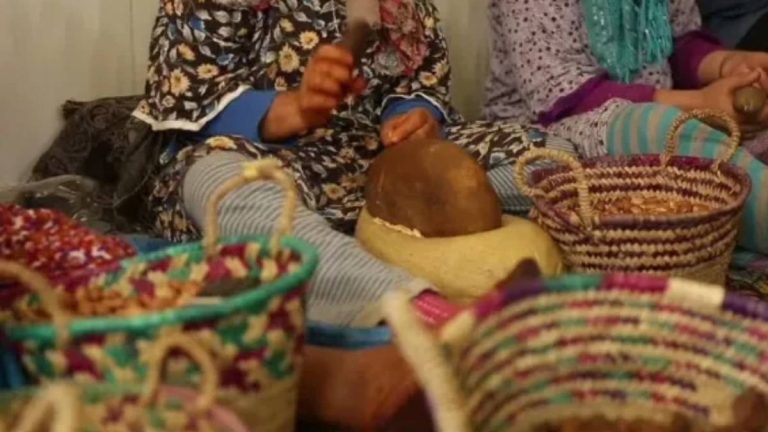
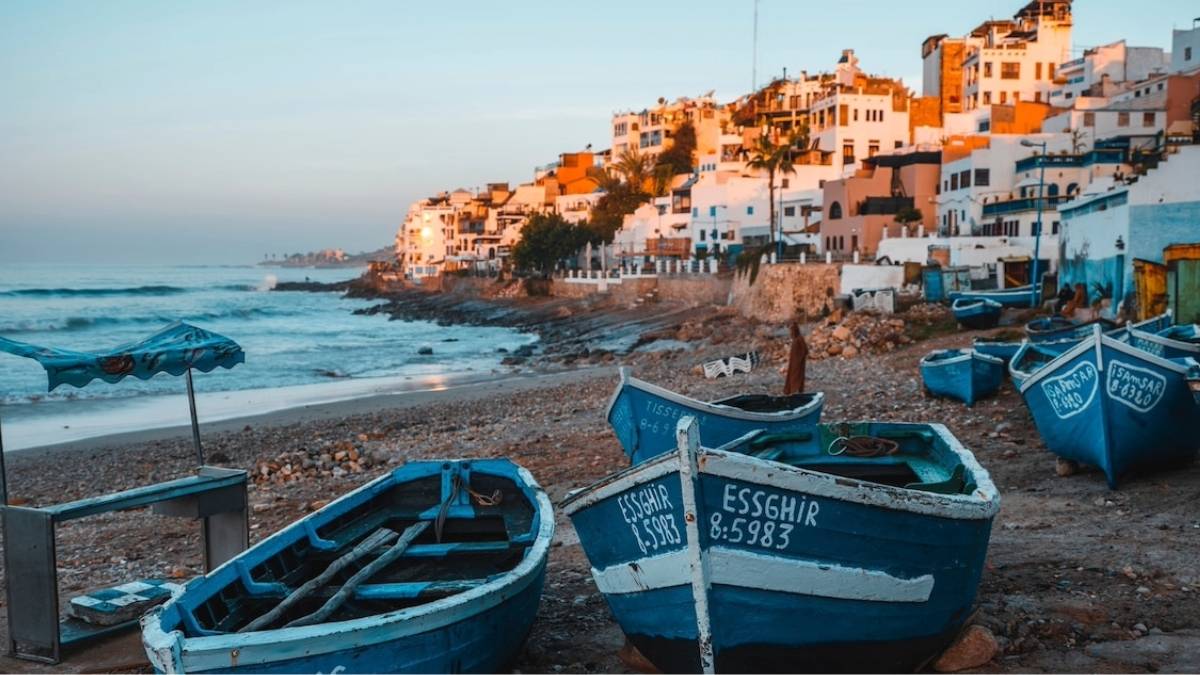
It began with a wrong turn. I’d left Tamanar that morning with the scent of roasted argan still clinging to my clothes, a quiet hum in my bones from hours spent watching Lalla crack shells with a stone. I was heading west toward Agadir, but the road curved unexpectedly, dropping down through eucalyptus groves and dusty olive orchards until the land opened wide and there it was: a crescent of pale sand backed by low red cliffs, rows of surf shacks painted in faded blues and ochres, and the Atlantic stretching endlessly, breathing in and out like a sleeping giant.
I pulled over, not because I planned to, but because the light on the water was so soft it felt like a hand on my shoulder, gently saying, Stay. There were no signs for “wellness trails.” No yoga mats laid out at dawn. Just wet sand, the hush of receding waves, and the kind of silence that doesn’t empty your mind it fills it with what’s already there, waiting to be heard.
I took off my shoes. The sand was cool beneath my feet, damp from the morning tide. And for the first time in years, I walked without a destination. Not to burn calories. Not to clear my head. Just to feel the earth respond to my weight, to listen to the rhythm of my own breath syncing with the sea’s slow exhale.
The Bay That Listens
Taghazout Bay doesn’t announce itself. There’s no grand entrance, no ticket booth, no curated “experience.” You simply arrive by accident, by instinct, or because the road led you here and if you’re quiet enough, the bay lets you in.
I walked south along the water’s edge, where the sand is firm and cool, perfect for bare feet. The tide was going out, pulling back with a soft sigh, leaving behind glistening ribbons of wet earth, scattered shells, and the occasional smooth stone worn down by centuries of waves. Surfers paddled out in silence, their boards cutting dark lines against the blue. Fishermen sat on upturned crates near the rocks, mending nets with hands that moved without thought each knot tied not for show, but because it needed to hold.
This is the first lesson of Taghazout: presence isn’t performed. It’s practiced in the ordinary. No one here talks about “mindfulness” as a concept. They live it in the way they watch the horizon before setting out to sea, in how they pause to pick up a piece of driftwood that might burn well in the evening fire, in the unhurried pace of a morning walk that has no end point.
I met Yusef near the southern curve of the bay, where the cliffs rise like the backs of sleeping animals. He was barefoot, trousers rolled to his knees, collecting stones not for sale, not for decoration, but because his grandson likes to line them up on their windowsill. He didn’t ask where I was from. Didn’t offer a tour. Just nodded toward the water and said, “Walk with the tide going out. It takes things you don’t need.”
I did. And something shifted. My shoulders dropped. My breath deepened. The constant buzz of my thoughts the emails I hadn’t answered, the flight I needed to book, the guilt over taking time away began to loosen, not because I pushed them away, but because the rhythm of the waves gave them space to settle. The ocean didn’t give me answers. It gave me permission to feel heavy, to be still, to exist without producing anything in return.
This is the tradition here: healing isn’t scheduled. It’s allowed. You don’t book a session. You show up. You walk. You wait. And slowly, almost imperceptibly, the bay whispers back not in words, but in salt on your skin, in the coolness of wet sand between your toes, in the quiet certainty that you belong here, exactly as you are.
If you’ve ever stood on a California bluff and felt the Pacific call you deeper than your to-do list if you sense that true wellness might live not in control, but in surrender then Where the Atlas Meets the Atlantic: Living Traditions Around Agadir reveals how this entire coastline, from mountain villages to hidden coves, offers a language of return written in wind, water, and waiting.
Footsteps as Conversation
Later that afternoon, I sat on a sun-warmed rock near the tide line, watching children chase the foam as it rushed toward their ankles, then shriek with laughter as it pulled back, tugging at their feet like a playful friend. Their joy wasn’t staged. It wasn’t for photos. It was pure, unselfconscious presence the kind we spend thousands of dollars trying to recapture in adulthood.
An elder woman passed by, her basket woven from palm fronds, filled with wild mint, sea lavender, and sprigs of thyme she’d gathered from the dunes. Her face was lined like a map of sun and wind, but her eyes were bright, alert. She paused when she saw me, not out of curiosity, but as if checking whether I was listening. Then she looked out to the horizon and said something in Tamazight soft, melodic, unhurried. I didn’t understand the words, but her tone carried meaning: You’re part of this, too. You don’t need to earn your place here.
That moment unlocked something in me. Walking along Taghazout Bay isn’t solitary. It’s a thread in a much older tapestry a conversation between land, sea, and people that’s been unfolding for generations. The fishermen who walk this shore at dawn know which tides bring the clearest water for net-mending. The women who gather herbs know which patches bloom after the first winter rains. Even the goats that wander down from the hills seem to move with the rhythm of the bay, stopping to graze where the grass is sweetest after the salt spray has touched it.
There’s no map for this kind of walking. No app to track your steps or measure your “mindfulness score.” Just attention. And in a world that treats every moment as data to be optimized, this feels quietly revolutionary. Not because it’s difficult, but because it asks nothing of you except your presence and your willingness to receive what the place offers, without trying to turn it into content, insight, or souvenir.
I stayed until the sun began to soften, casting long shadows across the sand. My footprints trailed behind me, already fading as the next wave crept forward, gently erasing them. There was something deeply comforting in that: the idea that you don’t have to leave a permanent mark to matter. Sometimes, just being here breathing, walking, listening is enough.
From Shoreline Silence to Valley Stillness
As the sun began its slow descent, painting the cliffs in layers of gold, rose, and burnt sienna, I turned inland. The path led upward, away from the sea’s constant breath, into the green folds of the Souss Valley where olive groves stretch like open palms and irrigation canals hum with the memory of ancient engineering. The salt on my skin dried into a fine film, but the calm remained a quiet hum beneath my ribs, like the echo of a wave long after it’s gone.
In this part of Morocco, the ocean doesn’t exist in isolation. It flows into the land, shaping not just the coast, but the culture. The same patience that teaches you to read the tides knowing when the waves are too rough for small boats, when the current shifts, when the sea gives up its silver bounty also prepares you for life in the valley, where time moves even slower, and silence isn’t empty, but full of unspoken understanding.
I passed a small farm where a man was watering young argan saplings, his hands moving with the same unhurried certainty I’d seen in Tamanar. He nodded as I walked by, not out of obligation, but as a quiet acknowledgment: We’re both tending something. Later, near a bend in the road, I smelled woodsmoke and mint the first hint of evening tea being prepared in a courtyard just out of sight. No one called out. No one invited me in. But the scent itself felt like an offering, a reminder that hospitality here isn’t announced; it’s sensed.
This is the continuum of wellness in southern Morocco: it begins with the ocean’s whisper, deepens in the mountain’s silence, and settles in the valley’s rituals. You don’t rush from one to the next. You carry each layer with you like sand in your shoes, like salt on your skin, like the rhythm of the tide in your step.
And if your heart has been softened by the whispers of Taghazout if you’ve learned to walk without needing to arrive then Bread, Mint, and the Art of Waiting: Tea Rituals in the Souss Valley will guide you to the courtyards where time slows to the pace of boiling water, where tea is poured three times not for ceremony, but because the third cup holds the truth, and where healing arrives not with fanfare, but with steam rising from a simple pot shared between strangers who soon become guests.
Walking Home, Even When You’re Far Away
Now, back in Los Angeles, when the noise of the city grows too loud when sirens slice through the night, when my inbox pings like a trapped bird, when the pressure to produce, perform, and post becomes a weight on my chest I don’t reach for my phone. I drive west, toward the coast, even if it’s crowded, even if the water is cold, even if the sky is gray.
I take off my shoes. I walk.
Not to fix anything. Not to generate insight. Just to remember.
I remember the way the wet sand held my footprints only briefly before the tide erased them teaching me that impermanence isn’t loss, but grace. I remember Yusef’s quiet nod, his simple wisdom wrapped in a sentence about stones and tides. I remember the elder woman’s eyes, holding mine for just a moment, long enough to say without words: You belong here.
Taghazout didn’t give me a new practice. It reminded me of an old truth buried beneath years of striving: we are creatures of rhythm. Our bodies know how to sync with the world if we stop fighting it. And when we move with the land instead of against it when we walk not to arrive, but to belong the ocean always whispers back.
Sometimes, the whisper is a wave curling gently over your ankles. Sometimes, it’s the silence between breaths as you sit on a sun-warmed rock. Sometimes, it’s the realization that healing doesn’t need a stage, a schedule, or a strategy. It only needs space and someone willing to be still enough to receive it.
I’ve stopped trying to bring Taghazout home with me in bottles of seawater or framed photos. What stays with me isn’t something I can hold. It’s the way my breath slows now when I stand near any body of water. It’s the patience I’ve learned to offer myself on difficult days. It’s the understanding that wellness isn’t something you achieve. It’s something you return to again and again like the tide returning to the shore.
And every time I walk that line between land and sea, I hear it again: soft, steady, sure.
You’re here. That’s enough.