
I didn’t plan to spend a morning in Tamanar.
In truth, I was running late. I’d left Agadir before sunrise, aiming to reach Taroudant by midday for a meeting that now feels utterly forgettable. My mind was still tangled in emails, flight confirmations, and the low hum of California urgency that follows you even across oceans. The road stretched ahead red earth, thorny acacias, the occasional donkey cart moving like a slow thought against the horizon. My rental car, already dusty from the coastal drive, began to cough. Then sputter. Then fall silent just as the asphalt gave way to packed dirt.
I coasted to a stop near a dry riverbed, the engine ticking as it cooled under the growing heat. No cell service. No roadside signs. Just silence so thick it felt like a presence. And then, cutting through it the scent. Warm, nutty, faintly smoky, with an undertone of something green and ancient. It drifted from a cluster of stone houses nestled in the foothills, where the Anti-Atlas rises like a spine against the sky. I didn’t know it then, but that smell was my first real welcome to the Amazigh world not with words, but with fire, fruit, and time.
Back home, I’d known argan oil only as a luxury finish something I drizzled on avocado toast or smoothed onto my skin after a shower, always in a hurry, always with half my attention elsewhere. But here, in this unmarked village where Google Maps shows only blank terrain, argan wasn’t a product. It was a rhythm. And the silence around it wasn’t empty. It was full of wind combing through thorny branches, distant goat bells like scattered notes, the soft tap of a stone cracking a shell, and beneath it all, the quiet certainty that some things are meant to unfold slowly.
An elderly woman appeared at the edge of the path, barefoot, her djellaba faded by sun and washing. She saw me standing by the road, hood up, phone useless in my hand. She didn’t smile. Didn’t call out. Just tilted her chin toward her courtyard a gesture so small it could have been the breeze. But it carried the weight of an invitation. I followed.
Where the Trees Stand Guard
Tamanar isn’t on most tourist itineraries, and that’s precisely why it holds its traditions so close. The argan forest here isn’t manicured or fenced. The trees grow wild, twisted by wind and time, their roots gripping red earth like old hands refusing to let go. They don’t belong to anyone and yet, everyone cares for them. There are no signs declaring “protected area,” no rangers with clipboards. Protection lives in the way people move through the grove with lowered voices, careful steps, and eyes that notice when a branch is broken or a fruit left too long on the ground.
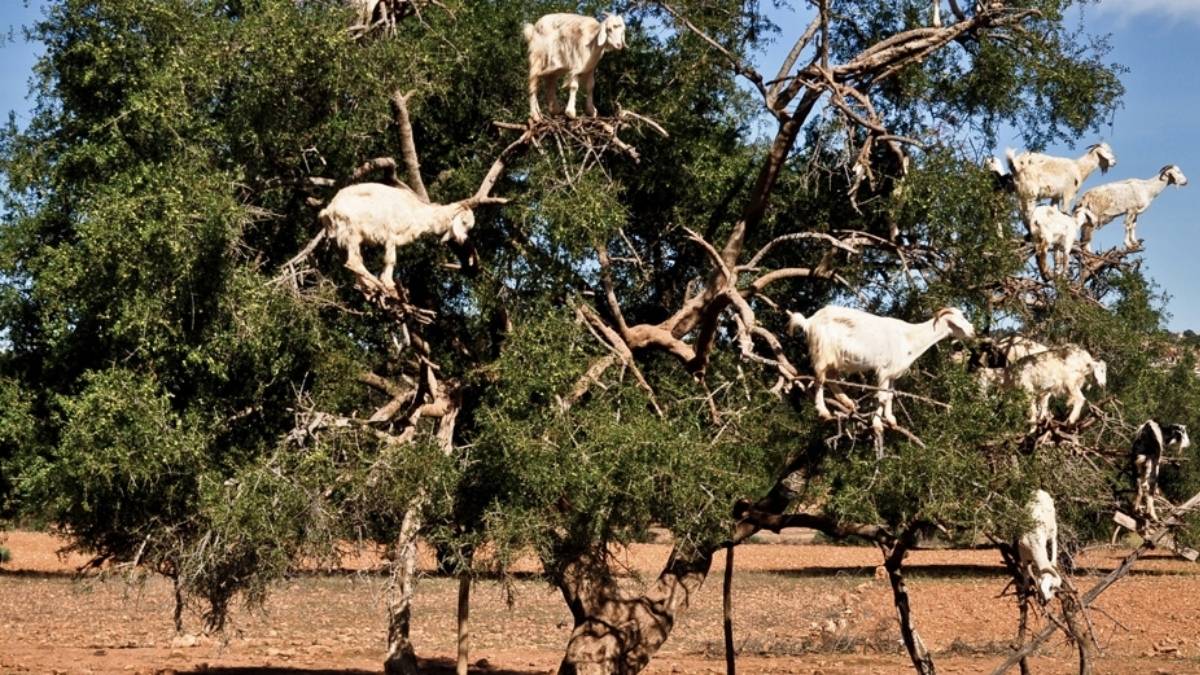
As I walked the path toward the woman’s home, I noticed something I’d never seen before: no fallen fruit was left to rot. Every argan nut had been gathered, not by machines, but by families who know which branches yield the sweetest kernels. Children learn to identify ripe fruit by color and smell before they learn to write their names. They’re taught to leave the highest branches for the goats, whose digestion helps soften the shells for later collection. This isn’t sustainability as a buzzword. It’s survival as symbiosis.
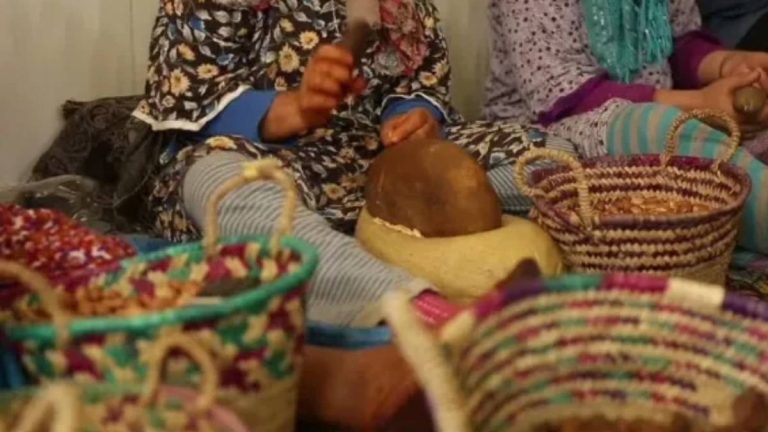
My host, whose name I later learned was Lalla, led me to a shaded corner of her courtyard where a small fire burned beneath a clay pan. Inside, golden kernels popped gently, releasing that deep, earthy aroma. She stirred them with a wooden spoon, her movements unhurried, her eyes on the flame, not on me. There was no performance. Only presence. A rooster strutted past. A cat slept in a patch of sun. Time didn’t feel measured in minutes, but in the slow darkening of the kernels, the gradual shift of shadow across the wall.
This is how wellness begins here not with intention, but with attention. Not with seeking, but with showing up. You don’t come to Tamanar to “experience tradition.” You arrive because your car broke down, or you took a wrong turn, or the road called you. And if you stay long enough, the place reveals itself not in grand gestures, but in the way steam rises from a teapot, or how a woman’s hands know exactly when the nuts are ready without ever looking at a clock.
If you’ve felt this quiet pull toward places where time moves differently if you sense that true tradition lives not in museums but in morning rituals like this one then Where the Atlas Meets the Atlantic: Living Traditions Around Agadir reveals how the entire region, from mountain villages to coastal bays, offers a living map of resilience, rhythm, and return.
The Language of Small Gestures
Lalla never asked why I was there. She didn’t offer a tour or a bottle of oil for sale. Instead, she handed me a small clay cup of mint tea, brewed strong and sweet, and pointed to a low stool beneath an olive tree. I sat. She returned to her roasting.
For nearly an hour, we said nothing. I watched her work: the precise angle of her wrist as she turned the kernels, the way she tested their readiness by pressing one between her fingers, the quiet pride in her posture. This wasn’t labor. It was liturgy. Every movement had been passed down through generations, not in words, but in repetition mother to daughter, aunt to niece, neighbor to neighbor.
Later, when the kernels had cooled, she showed me how to place one on a flat stone and strike it just so with enough force to crack the shell, but not crush the heart inside. My first three attempts failed. The shell shattered into dust, or the kernel flew away, lost in the gravel. She didn’t laugh. She simply placed another kernel in my palm, her fingers rough but gentle, and nodded.
In that moment, I understood something I’d missed in all my years chasing “mindfulness” back home: healing isn’t about getting it right. It’s about being allowed to try, slowly, without judgment, in the company of someone who knows the value of patience. There was no timer. No instructor correcting my form. Just a shared silence that held space for failure, for learning, for becoming.
And the scent oh, the scent. It clung to my clothes, my hair, my skin for days. Not as a fragrance, but as a reminder: some things can’t be rushed. Some wisdom only comes when you stop asking for it. In California, we buy oils in dark glass bottles labeled “cold-pressed” and “unrefined,” as if those words guarantee authenticity. But here, authenticity isn’t certified. It’s lived. It’s in the smoke that curls from the fire, the calluses on Lalla’s palms, the way she saves the smallest kernels for her grandchildren’s porridge.
From Mountain Stillness to Coastal Whisper
By midday, the heat pressed down like a hand on my shoulders, and Lalla gestured toward the road time for me to go. She didn’t say goodbye. She simply refilled my water bottle from a clay jar and touched two fingers to her heart.
As I drove away, the argan forest gave way to open fields, then to the first glimpse of the Atlantic, shimmering in the distance. The silence of Tamanar stayed with me, but it began to shift softening, opening, making space for another kind of listening.
Because in this part of Morocco, the land doesn’t end at the mountains. It flows into the sea. And the same attention that teaches you to crack an argan nut without breaking its soul also prepares you to walk the shore at Taghazout, where the ocean doesn’t roar it whispers. Where healing isn’t found in grand gestures, but in the quiet exchange between your footsteps and the tide’s reply.
You don’t need to choose between the mountain and the sea here. They’re part of the same breath. The same culture that honors the slow roast of a kernel also respects the rhythm of the waves. The same hands that grind argan paste also gather seaweed at low tide, not for spa treatments, but for soups that soothe winter coughs. This isn’t compartmentalized wellness. It’s a whole way of being one that moves with the land, not against it.
If your spirit has been shaped by the stillness of places like Tamanar if you’ve learned to listen with your whole body, not just your ears then When the Ocean Whispers Back: Healing Walks Along Taghazout Bay will guide you to the shoreline where that silence learns to speak in waves, and where every grain of sand holds a story of return.
Returning Without Leaving
Now, back in Los Angeles, when the noise of the city grows too loud, I don’t reach for headphones or a meditation app. I close my eyes and remember the scent of roasting argan, the weight of the stone in my palm, the way Lalla’s silence held more kindness than most words ever could.
I haven’t brought back a single bottle of oil from Tamanar. I didn’t need to. What I carry is far more valuable: the memory that wellness isn’t something you consume. It’s something you receive when you slow down, show up, and let a place teach you how to be human again.
Sometimes, on Sunday mornings, I’ll brew mint tea the way Lalla did strong, sweet, served in a simple cup and sit on my tiny balcony overlooking the alley. No agenda. No journal. Just the steam rising, the sound of neighbors waking, the slow unfurling of the day. And for a moment, I’m back beneath that olive tree, watching sunlight climb a stone wall, learning that the most profound traditions aren’t shouted. They’re whispered in scent, in silence, in the quiet strength of a morning well spent.