
I didn’t come to Dakhla for wellness.
I came because I was tired tired of apps that promised calm but delivered more noise, retreats that charged thousands for silence you could find in your own backyard, and a culture that turned healing into another item on a to-do list. I’d tried meditation cushions, breathwork workshops, forest bathing, even silent monasteries. But each time, I returned home carrying the same weight just wrapped in a different kind of packaging.
Then a friend who’d lived in Morocco for years said, “Go to Dakhla. Not as a tourist. Just go. And don’t bring your watch.”
So I went. Not with expectations, but with exhaustion. And what I found wasn’t a program, a product, or a prescription. I found a pulse the slow, steady rhythm of a place where the Sahara meets the Atlantic in a long, curving embrace, and where tradition isn’t something you observe from a distance, but something you step into, like cool water on a hot day.
This isn’t a destination. It’s a doorway. And what lies beyond isn’t escape it’s return. Return to a way of being that doesn’t ask you to fix yourself, but to remember you were never broken to begin with.
Before the Net Hits the Water
In Dakhla, fishing doesn’t start when the boat leaves shore. It begins long before in the silence before dawn, in the mending of nets by hand, in the cup of water poured over the bow as an offering, not a ritual, but a reminder: We ask permission. We do not take.
I stood on the port one morning at first light, watching men prepare without hurry. No engines roaring, no radios blaring, no checklist of tasks. Just hands moving with the quiet certainty of those who know their work isn’t separate from their lives. One elder, his face lined like desert maps, knelt and touched his forehead to the deck of his boat, then poured a small cup of seawater over the bow. Not as superstition, but as acknowledgment. This wasn’t extraction. It was conversation a dialogue between human and sea that had been going on for centuries.
Later, I learned that the first catch never goes to market. It goes to elders, to neighbors, to strangers who haven’t eaten. Only then is any surplus sold. In this economy, value isn’t measured in dirhams, but in reciprocity. And wellness flows not from abundance alone, but from how it’s shared.
I spent a morning with Youssef, a fisherman whose hands moved like they remembered every knot before he tied it. He showed me how to read the water not for fish, but for mood. “The sea tells you if it’s ready,” he said. “If the waves are choppy and gray, it’s grieving. You wait.” He taught me that readiness isn’t action. It’s stillness. And that the most important part of fishing happens long before the net hits the water in the space between intention and act.
For those who’ve grown weary of wellness as consumption, Before the Net Hits the Water reveals how an entire practice of care lives not in the haul, but in the humility to wait, listen, and receive.
What the Wind Carries in Dakhla
In Dakhla, the wind doesn’t just blow it carries. Salt from the Atlantic, dust from the Sahara, voices from Senegal, Mali, Mauritania. It shapes dunes, cools courtyards, and fills the sails of boats heading out at dawn. But more than that, it carries memory not in words, but in textures: the roughness of woven wool, the scent of drying fish, the hum of a drum echoing through a courtyard at dusk.
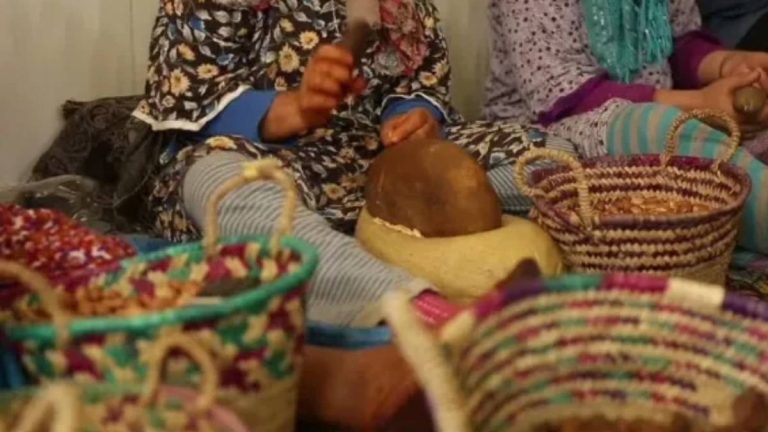
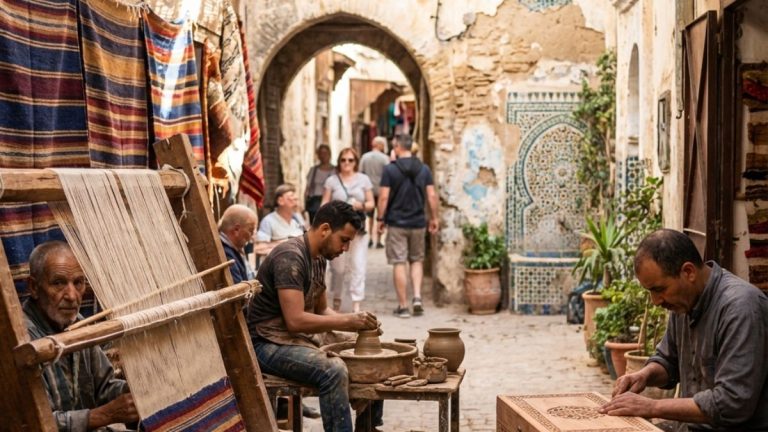
I met Aïcha under a tamarisk tree just beyond the last row of houses, her fingers moving swiftly over a loom made of driftwood and rope. She wove not with factory yarn, but with wool from desert sheep, spun by hand and dyed with crushed shells and desert herbs. “The wind tells me what color to use,” she said, holding up a strip of fabric the deep blue of twilight over the bay. “When it comes from the sea, I use indigo. When it carries sand, I mix in ochre.”
She showed me how each rug tells a story not of heroes or battles, but of daily life: a zigzag for dunes, a circle for the sun, a series of dots for fish swimming in schools. These aren’t decorations. They’re records. Maps of memory woven into cloth.
Later, I watched her son repair a fishing net using the same knotting technique she used in her weaving. “Same hands, different thread,” he said with a quiet smile. In Dakhla, there’s no divide between craft and survival. The same skills that warm a home also feed it. And both are shaped by the wind its direction, its strength, its silence.
One afternoon, she handed me a small pouch made of tightly woven fibers. “For your pocket,” she said. Inside was a mix of dried mint, sea salt, and a single blue thread. “When you feel lost,” she explained, “hold it. The wind that carried this thread also carried your steps here. It will remind you.”
Back in Los Angeles, overwhelmed by traffic and noise, I reached into my coat and found the pouch. Just holding it feeling its roughness, smelling the salt and mint brought me back to that courtyard, to the sound of the loom clicking like a heartbeat, to the certainty that some things are made not to be sold, but to be held.
For those who’ve felt that true belonging lives not in possessions but in what we carry quietly, What the Wind Carries in Dakhla reveals how an entire region weaves memory, wind, and welcome into a living fabric of resilience.
Guests of the Horizon
In Dakhla, you don’t arrive as a tourist. You arrive as a guest not just of people, but of the horizon itself.
I learned this on my second day, when I wandered too far from the port and found myself disoriented by light and scale. The Atlantic stretched to my left, the Sahara to my right, and between them, a narrow strip of life where humans had learned to dwell without dominating. A man tending goats saw me, walked over without a word, and handed me a cup of warm camel milk. No questions. No price. Just presence. Later, I learned his name was Sidi Mohamed, and that his family had welcomed strangers this way for generations not out of duty, but because the horizon, in their view, belongs to no one. It’s a shared threshold. And anyone who crosses it is worthy of rest, food, and silence.
This isn’t hospitality as service. It’s hospitality as belonging. In the Friday market, you’ll hear Hassani Arabic blending with Wolof, Pulaar, Soninke, and French not as competition, but as conversation. Men from Nouakchott trade dried octopus for handwoven belts. Women from Bamako sell indigo-dyed cloth next to locals offering salt-cured sardines and argan oil pressed from nuts gathered near the Mauritanian border. No one asks for papers before sharing tea.
“The horizon doesn’t carry a passport,” Sidi Mohamed told me one evening as we sat outside his tent, watching the sun sink into the Atlantic in a blaze of orange and violet. “Why should we?”
This openness isn’t naivety. It’s hard-won wisdom. For centuries, the Sahara has been a corridor, not a barrier. Caravans, fishermen, poets, and refugees have all passed through Dakhla, leaving traces of rhythm, recipe, and ritual. And instead of building walls, the people here built courtyards with open sides, low walls, and always an extra mat rolled in the corner, waiting.
To be a guest here is to be reminded of something ancient: you belong simply because you’ve arrived. Not because you’ve earned it, paid for it, or proven yourself. But because existence itself is enough.
For those who’ve grown weary of being sized up before being welcomed, Guests of the Horizon reveals how an entire region lives by a different covenant: one where belonging precedes identity, and grace flows without invoice.
Drums That Know the Tide
I didn’t expect to find healing in sound.
In California, I’d chased silence retreats in the redwoods, noise-canceling headphones, apps that promised “deep calm.” But in Dakhla, healing came not from the absence of noise, but from its rhythm. Specifically, from the deep, resonant pulse of the tbal a goatskin drum played not for performance, but for presence.
I first heard it at dusk, walking past a courtyard near the old port. The air was still warm from the day, scented with salt and woodsmoke. No stage, no audience, just three men seated in a circle on low mats, one with a drum between his knees, another humming a low melody, the third swaying gently, eyes closed. They weren’t playing for anyone. They were playing with something something older than words, deeper than song, woven into the very fabric of wind and wave.
When I paused at the edge of the courtyard, an elder motioned me to sit without breaking rhythm. He didn’t speak. He just poured tea from a small pot and nodded toward the drum. “Listen,” he said, his voice barely above the beat. “Not with your ears. With your bones.”
His name was Brahim, and he’d been playing the tbal since he was a boy of seven, taught by his grandfather who learned from his own father before him. “My grandfather said the drum doesn’t make music,” he told me later, running his calloused fingers over the stretched skin. “It releases what’s stuck. Grief, fear, even joy if it sits too long, it hardens. The drum softens it.”
In Dakhla, music isn’t entertainment. It’s medicine. And the tbal is its most trusted healer not because of its sound, but because of its silence between beats. “That’s where the healing lives,” Brahim explained. “In the space between. Not in the noise, but in what the noise makes room for.”
One evening, I watched him play for a young fisherman who’d lost his brother at sea during a sudden squall. No lyrics. No chorus. Just a slow, steady beat that mimicked the pull of the tide retreating and returning. The young man sat cross-legged, hands on his knees, eyes closed. After ten minutes, his shoulders began to shake. Then tears came not from sadness, but from release, as if the rhythm had untied a knot deep inside. “The drum remembered his brother’s name,” Brahim said afterward, wiping his brow. “Even when his tongue couldn’t say it.”
If your spirit has been worn thin by noise that demands attention but offers no nourishment, Drums That Know the Tide will carry you to Dakhla’s courtyards, where rhythm, not words, heals the rift between self and other, and where every heartbeat echoes the sea’s ancient song.
The Shore That Walks With You
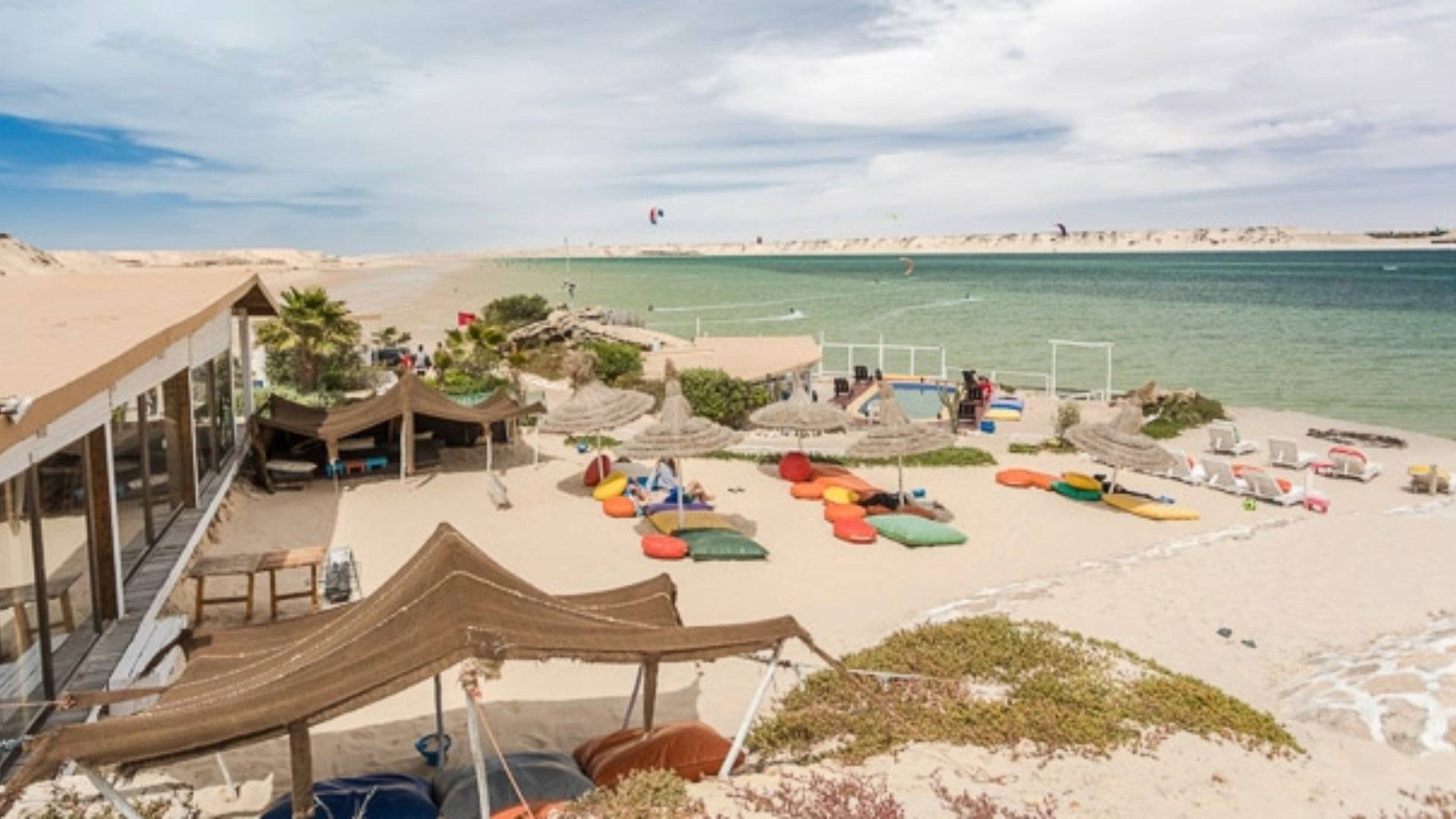
Most travelers see Dakhla’s beach as a backdrop: a place for photos, kitesurfing, or sunset cocktails. But step beyond the resorts, walk past the last café, and you enter a different world one where the shore isn’t scenery, but companion.
My first morning alone on the bay, I walked without destination. No playlist, no goal, no distance to cover. Just feet on wet sand, eyes on the horizon, breath syncing with the pull of the tide. After twenty minutes, something shifted. The usual noise in my head the lists, the worries, the endless scroll of “what’s next” began to quiet. Not because I forced it, but because the space itself demanded presence.
I met Lalla Zineb, an elder who walks this shore every dawn, rain or shine. “The bay doesn’t ask who you are,” she told me, her scarf fluttering in the wind. “It only asks if you’re willing to be here.” She showed me how to read the sand: smooth patches mean calm seas; rippled lines signal wind from the south; footprints erased by waves are reminders that some things aren’t meant to last.
One afternoon, I walked beside her in silence for nearly an hour. No advice. No questions. Just two bodies moving with the rhythm of the tide. When we parted, she pressed a small shell into my palm. “For when you forget how to listen,” she said.
In Dakhla, solitude isn’t isolation. It’s preparation. A way of clearing the noise so you can truly see the other when they appear. And when you do, no introduction is needed. Presence is enough.
For those who’ve mistaken solitude for loneliness, The Shore That Walks With You reveals how empty space becomes sanctuary not by filling it, but by letting it hold what words cannot.
No Clocks in the Dunes
I lost my watch on my third day in Dakhla.
Not misplaced. Not stolen. I took it off and left it on a windowsill in my rented room, next to a half-empty bottle of water and a notebook filled with questions I hadn’t yet learned how to ask. In California, time was a master dictating when to wake, work, eat, sleep, even feel. My days were sliced into blocks: thirty minutes for email, an hour for writing, fifteen for “mindful breathing” (as if mindfulness could be scheduled). But here, time wasn’t something you owned, controlled, or optimized. It was something you entered like the tide, like the wind, like breath returning after holding it too long.
There are no clocks in the dunes. No ticking. No deadlines etched in digital ink. Just the slow arc of the sun across a boundless sky, the shifting color of sand from gold to rose to deep violet, and the quiet rhythm of bodies that know when to rest without being told, when to move without being prompted, when to speak without being asked.
I met a man named Sidi Ahmed who hasn’t worn a watch in forty years, not since his father told him, “A clock measures absence. The sun measures presence.” He lives in a small house near the edge of town, where the paved road gives way to sand. Every morning, he sits under a tamarisk tree, sipping mint tea from a small glass, watching the light change. “Clocks cut time into pieces,” he told me one afternoon, his voice as steady as the breeze. “But time is whole. Like the sea. You don’t measure the ocean in cups.”
He showed me how to tell midday: when your shadow disappears completely beneath your feet, pooling like water around your sandals. How to know evening is near: not by darkness, but by the moment the sand cools enough to sit on barefoot without burning. How to sense night: not by the absence of light, but by the first star appearing over the western ridge a signal that goats should be penned, fires lit, stories begun.
In Dakhla, fatigue isn’t ignored. It’s honored as a message, not a failure. No one pushes through exhaustion with caffeine or willpower. Instead, when the body says “enough,” people listen. I watched a young boy stop mid-game to sit in the shade, not because he was told to, but because his breath had grown short. An elder paused while weaving to close her eyes for ten minutes, not out of laziness, but because her hands needed stillness.
One afternoon, overwhelmed by the heat and the profound silence of the desert, I lay down on a woven mat in his courtyard. I expected him to suggest I “get back to work” or “make the most of the daylight.” Instead, he brought me water and said, “Rest is part of the rhythm. Even the tide pulls back.”
If your spirit has been frayed by the tyranny of calendars and notifications, No Clocks in the Dunes will carry you back to Dakhla’s first lesson: that true readiness begins not with action, but with stillness and that some of the most important work happens long before anything is done.
The Pulse That Holds It All
Dakhla isn’t a place you visit. It’s a rhythm you enter.
And that rhythm woven from wind, tide, silence, and shared breath isn’t found in guidebooks or wellness brochures. It lives in the hands that mend nets before dawn, in the courtyards that welcome strangers without questions, in the drums that remember names when tongues forget, in the shores that walk with you long after you’ve left.
This is tradition not as artifact, but as artery carrying life, memory, and care through generations not by preserving the past, but by living it forward.
You don’t need to “experience” Dakhla.
You only need to slow down enough to feel its pulse and recognize it as your own.