
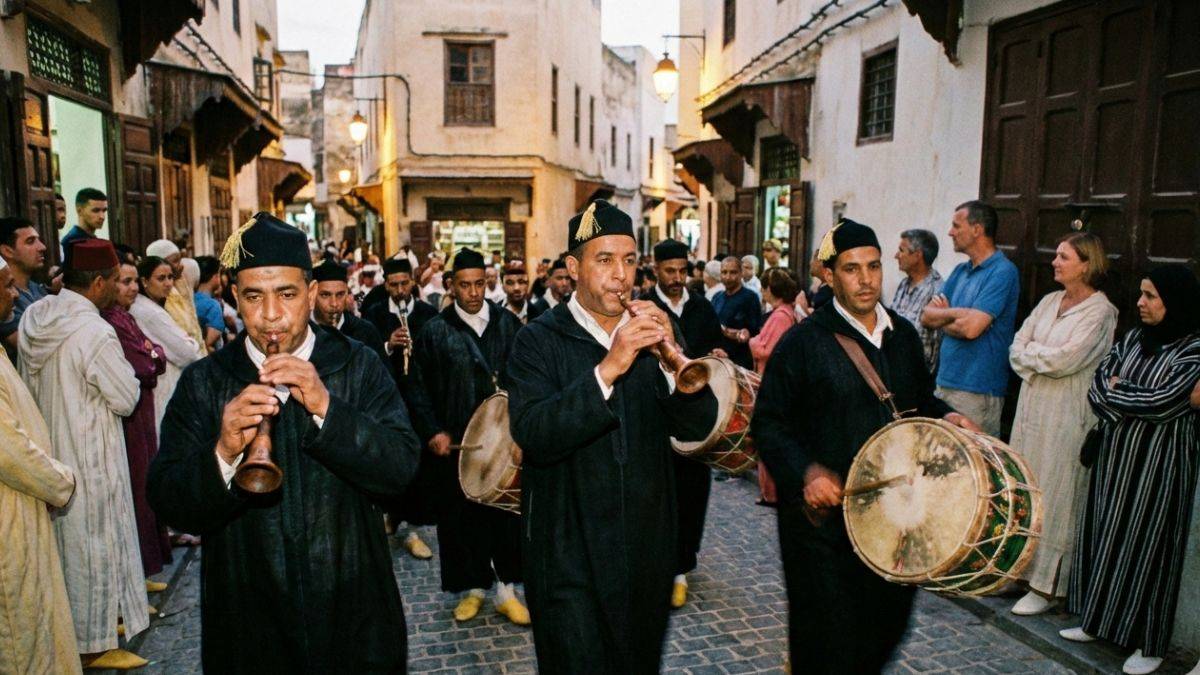
The ghaita’s wail hits you before you see where it comes from.That piercing double-reed oboe doesn’t invite it demands attention, bypassing your rational mind to work on something deeper. The Aissawa confraternity has practiced this intensely powerful music for six centuries, inducing trance states for spiritual healing throughout northern Morocco. Often confused with the better-known Gnawa, the Aissawa maintain their own distinct lineage rooted in the teachings of Sidi Mohamed Ben Aissa. Understanding this northern tradition reveals a different face of Moroccan mysticism.
Sidi Mohamed Ben Aissa’s Legacy
The Aissawa trace their origins to Sidi Mohamed Ben Aissa, a fifteenth-century Moroccan saint from Meknes renowned for miraculous healings and spiritual power.Born around 1465, he established a zawiya that became a center for Sufi practice and teaching. His followers organized into a brotherhood after his death in 1526, spreading throughout northern Morocco and establishing strong presence in Tangier, Tetouan, Fes, and other cities.
What distinguishes the Aissawa is their emphasis on ecstatic trance states achieved through intensely powerful musical practices. Sidi Mohamed Ben Aissa reportedly performed miracles that defied natural laws, and his followers developed techniques to access similar states of consciousness where ordinary limitations dissolve. The music serves as vehicle for entering those altered states.
The brotherhood maintains hierarchical structure with a Sheikh at the top, descended from Sidi Mohamed Ben Aissa’s lineage. Below him, various ranks of initiated members practice and transmit the tradition. In Tangier, several Aissawa zawiyas operate, each with its own Sheikh and community of practitioners.
The Ghaita: Instrument of Transformation
The ghaita produces extraordinarily loud, penetrating sound. This double-reed oboe consists of a wooden body with finger holes and a large bell at the end, similar to the Turkish zurna or Indian shehnai. When two or three ghaitas play in unison, they create a wall of sound that physically vibrates in your chest. The volume isn’t incidental it’s essential to the music’s purpose.
The sound quality itself induces altered states. The ghaita’s timbre contains complex harmonics that seem to work directly on the nervous system. Standing near players during a procession, I felt the sound penetrate beyond my ears, resonating in my ribcage, my skull, my gut. This isn’t metaphor. The acoustic frequencies create physiological responses.
Players develop remarkable endurance. A good ghaita musician can maintain continuous sound for extended periods using circular breathing techniques. During ceremonies, they might play for hours with only brief pauses. The physical demands rival any athletic performance, requiring strength, breath control, and mental focus.
The Percussion Battery
Accompanying the ghaitas, various percussion instruments drive the rhythmic foundation. The bendir frame drum, familiar from other Moroccan traditions, provides both steady pulse and sudden accents. The tbel, a large double-headed drum worn on the shoulder, adds thunderous low frequencies. Metal qaraqeb castanets create sharp cutting sounds that pierce through the ghaita’s wail.
The rhythmic patterns follow specific traditional structures, each with particular function. Some rhythms invite gradual building of energy. Others trigger sudden shifts in consciousness. The percussionists and ghaita players communicate through subtle cues invisible to outsiders, coordinating tempo changes and dynamic shifts that move the ceremony through its intended arc.
Unlike the melodic development in Andalusian music or gradual building of Sufi dhikr, Aissawa music often begins at high intensity and maintains that level for extended periods. The ghaita launches immediately into loud, insistent patterns that circle back on themselves hypnotically.The relentlessness is the point ordinary mental defenses eventually exhaust themselves, allowing the music to penetrate deeper consciousness layers.
The Hadra: Ceremony of Healing
Beyond public processions, the Aissawa maintain specific healing ceremonies called hadra, designed to address particular spiritual or psychological conditions. Traditional diagnosis identifies different spiritual states, each with associated musical patterns. The healing works by invoking and ritually controlling the afflicting force through music specifically designed for that purpose.
I witnessed a hadra in a private home where a family had requested Aissawa intervention for a relative experiencing psychological distress. The ceremony lasted several hours, musicians playing while the afflicted person moved through various states resistance, release, exhaustion, finally calm. The family believed the music successfully addressed the spiritual dimension of the illness.
Whether you interpret this through supernatural or psychological frameworks, the practice clearly provides something valuable to communities who maintain it. The music creates conditions for cathartic release, for processing trauma, for addressing conditions that conventional medicine sometimes struggles to reach. The trance states allow access to aspects of consciousness normally defended or suppressed.
Processions and Public Celebrations
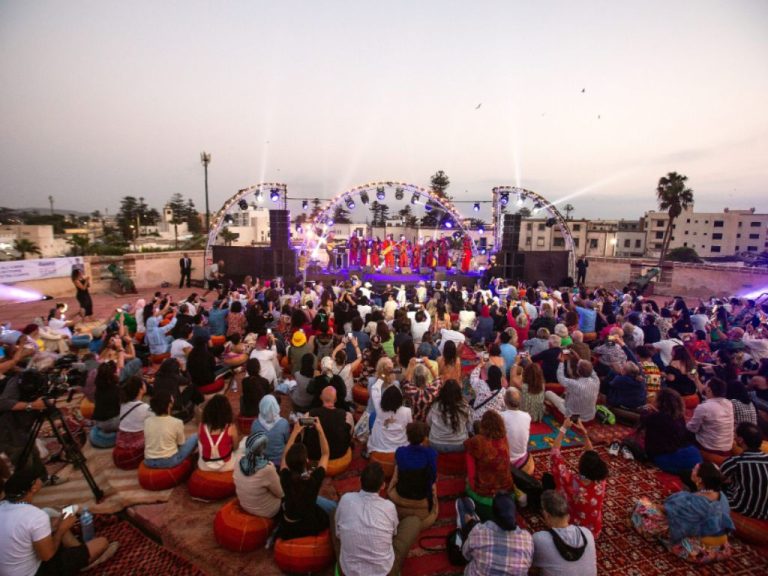
The most publicly visible Aissawa practices occur during religious festivals and moussems. During the moussem of Sidi Kacem in late summer, Aissawa groups converge on Tangier. Musicians lead processions through the medina, ghaitas wailing and drums thundering, followed by brotherhood members in various states of trance performing feats that defy easy explanation.
Some participants walk on broken glass. Others handle fire or sharp objects without apparent injury. These demonstrations aren’t entertainment but expressions of spiritual power accessed through trance states. The music provides the vehicle that allows consciousness to shift to levels where ordinary physical limitations no longer apply in the same way.
The processions follow specific routes through the city, stopping at significant locations for intensified performance. Crowds gather to witness, some people watching with secular curiosity, others participating from deep religious conviction. The boundary between performers and audience becomes porous—anyone might be drawn into the trance if the music works on them powerfully enough.
Not Gnawa: Understanding the Difference
Visitors to Morocco often confuse Aissawa and Gnawa traditions because both involve trance music and healing ceremonies. However, they represent completely distinct lineages with different origins, instruments, and spiritual frameworks. Understanding these distinctions matters for anyone seriously interested in Moroccan mysticism.
Gnawa traces to sub-Saharan African slaves brought to Morocco, their spiritual practices blending Islam with pre-Islamic African elements. Their primary instrument is the guembri, a three-stringed bass lute that creates deep, resonant tones. Gnawa music centers in southern cities like Marrakech and Essaouira, where it has gained international recognition through festivals and fusion projects.
Aissawa originates from Arab-Berber Moroccan Sufism with no African slave heritage. The ghaita creates completely different sonic environment from the guembri loud, piercing, aggressive rather than deep and hypnotic. Geographically, Aissawa maintains strongest presence in northern Morocco, particularly in cities like Tangier, Tetouan, Meknes, and Fes.
The spiritual frameworks also differ. Gnawa ceremonies work with specific spirits called mluk, each with associated colors, rhythms, and offerings. Aissawa practice focuses more on accessing baraka spiritual power or blessing through devotion to Sidi Mohamed Ben Aissa and entrance into altered states that dissolve ego boundaries.
Both traditions deserve respect and understanding on their own terms rather than being conflated into generic “Moroccan trance music.” The Aissawa particularly resist tourist commodification, maintaining their practices primarily for spiritual rather than commercial purposes.
Experiencing Aissawa Music in Tangier
Unlike zawiya dhikr sessions or Andalusian concerts, Aissawa ceremonies don’t follow predictable schedules easily accessible to visitors. The brotherhood operates according to its own rhythms, responding to community needs and religious calendar rather than tourist interest. This makes encountering authentic Aissawa practice more challenging but also more rewarding when it happens.
The moussem of Sidi Kacem in late summer represents your most reliable opportunity. For three days, Aissawa music plays almost continuously as different groups demonstrate their spiritual mastery. The processions follow public routes through the medina, making them accessible to anyone willing to navigate crowds and intense sensory experiences.
During Mawlid celebrations marking the Prophet’s birthday, Aissawa groups often perform in various neighborhoods. Multiple processions might occur simultaneously in different parts of the city. Walking the medina during these periods, you follow the sound of ghaitas echoing off narrow walls, tracking the music to its source.
Building relationships with local residents provides the most reliable access. Shop owners, café regulars, hotel staff people embedded in community networks know when and where Aissawa events will occur. Express genuine interest in understanding the tradition, demonstrate respect for its sacred nature, and doors may open that remain closed to casual tourists.
Appropriate Engagement
If you encounter Aissawa processions or ceremonies, maintain respectful distance unless explicitly invited closer. The music serves spiritual purposes, not entertainment. People in trance states operate in altered consciousness where unexpected interference could prove dangerous both to them and to you.
Photography requires particular sensitivity. Some practitioners welcome documentation while others consider it inappropriate violation. When in doubt, don’t photograph. The experience matters more than the documentation. Allow yourself to be fully present rather than viewing everything through a camera screen.
The intensity of Aissawa music affects people differently. Some find it exhilarating, others overwhelming. The loud volume and insistent rhythms can trigger headaches or anxiety in sensitive individuals. Know your limits. Step away if the experience becomes too much. No obligation exists to endure discomfort in the name of cultural authenticity.
The Power of Sound
What makes Aissawa music remarkable is its unapologetic power. This isn’t gentle spiritual practice. The ghaita doesn’t soothe it confronts, challenges, breaks through resistance.The music acknowledges that transformation sometimes requires force, that ego defenses don’t dissolve through quiet contemplation alone.
Western spiritual seekers often favor gentle, comfortable practices meditation apps, yoga classes, mindfulness training. The Aissawa offer something different a tradition that uses overwhelming sensory input to blast through ordinary consciousness, creating openings for experiences that transcend everyday awareness.
Whether you interpret the trance states as divine ecstasy, psychological catharsis, or neurological response to acoustic stimulation, the practices clearly produce powerful effects. People emerge from hadra ceremonies transformed. The healing the Aissawa provide serves communities that maintain these traditions across centuries.
For travelers drawn to understand the full spectrum of Morocco’s sacred music, the Aissawa represent the wild, untamed current alongside the refined beauty of Andalusian orchestras and the devotional focus of Sufi dhikr. All three streams flow through Tangier’s spiritual landscape, each offering different paths toward transcendence.
Placed alongside other spiritual sound worlds of Tangier, Aissawa music reveals only one dimension of a much wider sacred landscape that unfolds across seasons, rituals, and communal gatherings. Its raw intensity finds balance when viewed within Morocco’s Sacred Music Festivals: Where Ancient Rhythms Meet Modern Souls, where trance, refinement, and devotion intersect to form a living musical ecosystem shaped by history, belief, and collective memory.
If timing your visit to catch these remarkable convergences of sound and spirit interests you, understanding the complete pattern of when Tangier’s various sacred music traditions come alive throughout the year helps you plan your journey around the experiences that call to you most strongly. The Aissawa’s fierce cry represents just one voice in the larger chorus, but what a voice impossible to ignore, impossible to forget once you’ve heard the ghaita’s ecstatic call echoing through ancient medina walls.
If you’re ready to continue exploring Tangier’s sacred soundscape, follow the journey into Tangier Music Festivals: Sacred Sounds Year-Round, where Andalusian orchestras, Sufi brotherhoods, and contemporary artists share stages across the city’s cultural calendar.