
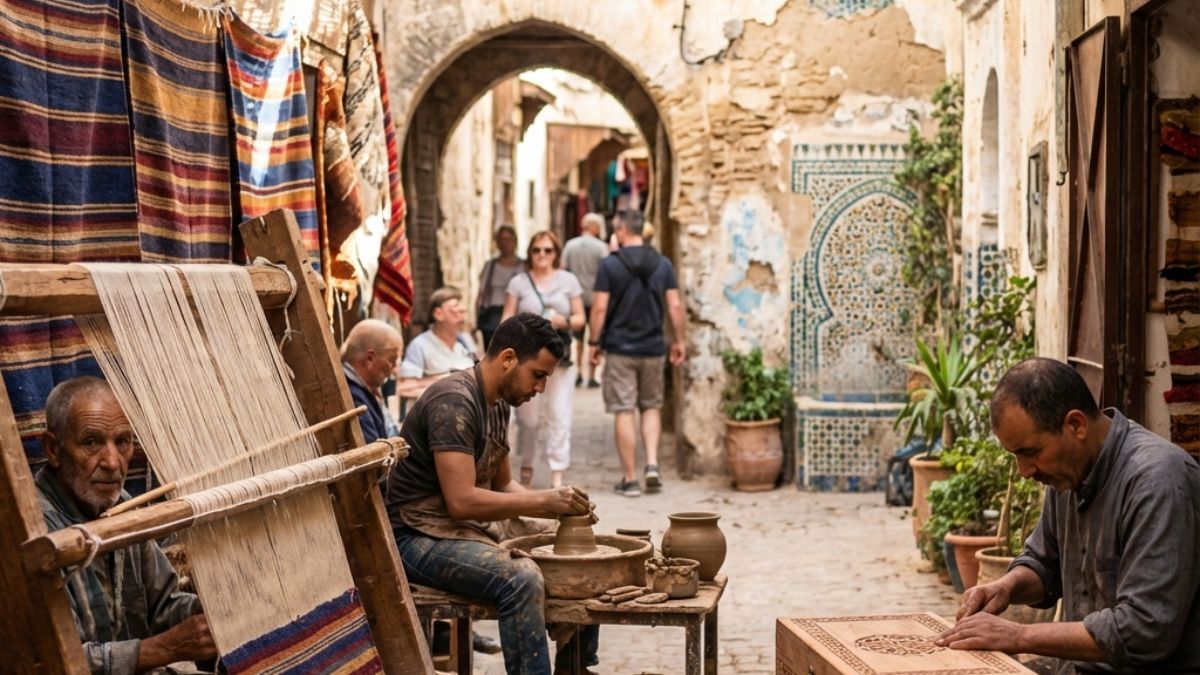
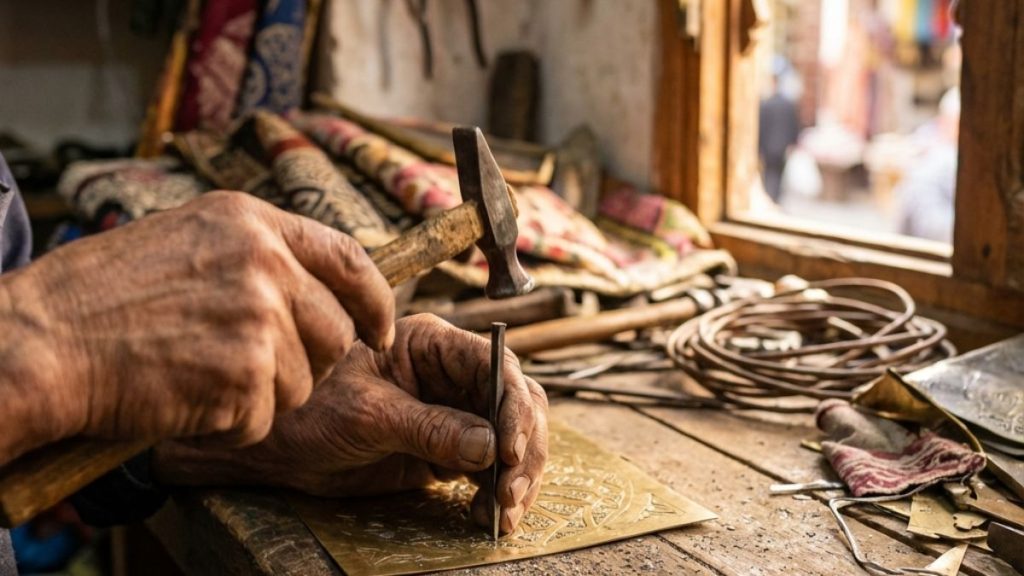
There are cities you visit for their views, and others you remember for their hands. Tangier belongs to the second kind. Long after the sea fades from memory, what stays with you is the texture of wool between your fingers, the soft rhythm of a hammer shaping copper, the scent of cedar drifting from a narrow workshop hidden behind an unmarked door.
I first noticed this while wandering without a plan through the medina. Not shopping, not searching. Just walking. A craftsman sat cross-legged near a wooden frame, weaving patiently as if time had agreed to slow down for him. No display window. No sign. Just work, quietly continuing a tradition older than the street itself.
Craft as Daily Life, Not Decoration
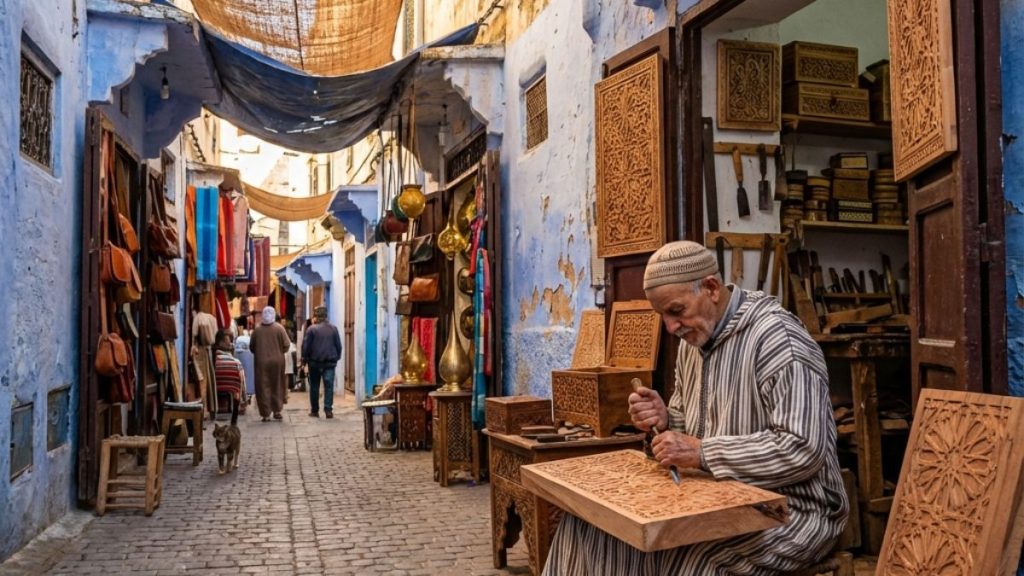
In Tangier, crafts are not souvenirs first. They are tools, garments, vessels, and habits of everyday life. A woven basket carries bread before it ever carries a traveler’s curiosity. A ceramic bowl is meant to be used long before it is admired.
You feel this difference immediately. Objects are not rushed. Patterns repeat with intention, not trend. Even imperfections seem accepted, almost respected, as proof of the human hand.
This living relationship between object and use is what connects Tangier’s crafts to the city’s wider cultural rhythm, a theme explored more deeply in Tangier’s Living Traditions: A Mindful Cultural Guide for 2026.
Artisan Districts Hidden in Plain Sight
Unlike cities where craft quarters are clearly marked, Tangier asks you to pay attention. Workshops appear quietly inside the medina, near the Kasbah, or behind modest wooden doors you might pass without noticing.
Listen for sound. The scrape of metal. The tap of tools. Follow scent. Leather, dye, wood shavings. These cues often guide you better than maps.
Some artisans welcome visitors with warmth, others prefer silence. Both responses are part of the culture. Observation, not intrusion, is the key.
Materials That Carry Memory
Each material tells a story tied to land and history. Wool speaks of mountain routes and seasonal movement. Clay reflects soil and water. Wood, often cedar, carries the scent of northern forests.
What struck me most was how little explanation was needed. Watching an artisan work was often enough. Hands moved with certainty, repeating gestures learned not from books, but from years of quiet repetition.
This same respect for inherited knowledge appears again in Tangier’s traditional clothing and healing practices, where technique is passed through presence rather than instruction.
Workshops as Encounters, Not Attractions
Some travelers search for workshops that offer demonstrations. Others stumble into them by chance. Both experiences can be meaningful, as long as expectations remain gentle.
A short conversation. A shared smile. A question asked with patience. These moments matter more than photographs or purchases.
If invited to watch, stand where you are guided. If invited to buy, do so without pressure. Craft here is not performance. It is continuity.
Choosing Meaningful Souvenirs
If you decide to take something home, choose objects you will use. A cup you drink from. A textile you live with. This honors the work far more than items kept only for display.
Ask where something comes from. Not as an interrogation, but as interest. Most artisans are proud to share a few words, even if language is limited.
Your choices directly support the preservation of Tangier’s cultural ecosystem, linking everyday travel decisions to broader traditions and sustainable journeys.
Linking Craft to the Wider Journey
Arts and crafts do not stand alone in Tangier. They echo in music, clothing, rituals, and daily gestures. Understanding them opens doors to deeper layers of the city.
For travelers seeking a more complete experience, this journey continues through Music & Dance in Tangier: Rhythms of the North, spiritual practices, and the subtle etiquette that shapes daily life.