
Marrakech does not present its craft traditions as finished objects waiting to be admired. They appear gradually, revealed through repetition, sound, and texture. A hammer meets brass in a narrow derb, steady and unhurried. The scent of cedar drifts from a workshop near the Mellah, lingering in the warm air. In a shaded riad courtyard, wool moves slowly between practiced hands. Here, craftsmanship is not performance. It is presence.
Unlike places where tradition is packaged for display, Marrakech carries its crafts as part of daily life. The city’s red walls hold centuries of gestures passed quietly from one generation to the next. Every bowl, lantern, rug, and door carries both memory and touch. To move through Marrakech with attention is to witness making as a living act rather than a preserved one.
This article explores the arts and crafts of Marrakech as they exist today, rooted in continuity, shaped by rhythm, and sustained by human presence rather than spectacle.
The Medina as a Living Workshop
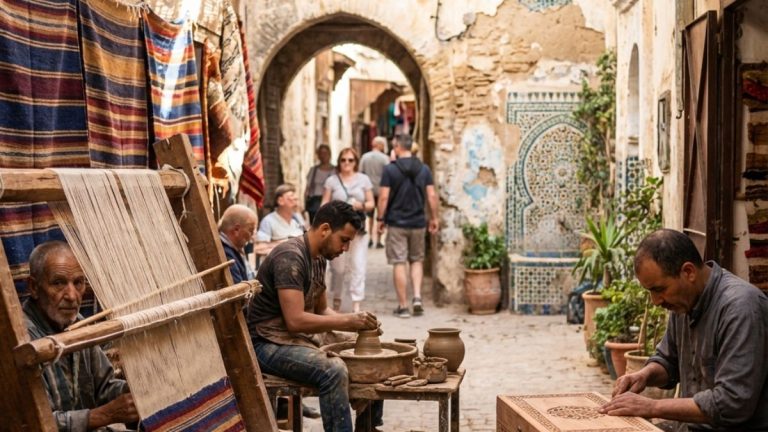
The medina of Marrakech functions less as a residential quarter and more as a continuous workshop. Craft here is not hidden behind curated storefronts. It opens directly onto the street. Doors remain ajar. Work spills into alleyways. The act of making is visible, audible, and ongoing.
Souks organize themselves by material and lineage. Woodworkers carve cedar near Bab Debbagh. Metalworkers shape brass and copper further north. Leather artisans cluster near the tanneries, following a spatial logic that has endured for centuries. This organization reflects an ecosystem rather than a marketplace, where each craft depends on another for materials, tools, and knowledge.
This medina-centered relationship between place and practice forms a core element of the broader cultural framework explored in Traditions of Marrakech: Living Heritage in the Red City, where craft is understood as one of the city’s most enduring forms of expression.
Cedar Wood and the Grammar of Carving
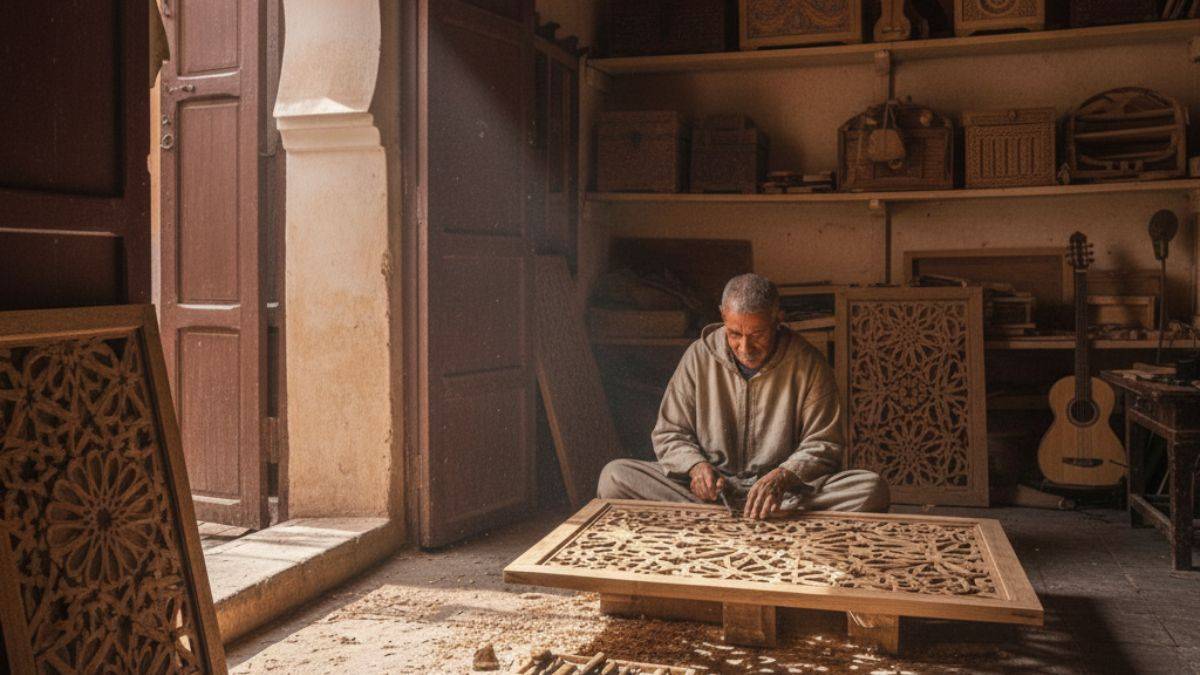
Cedar wood occupies a central place in Marrakech’s craft identity. Harvested from the Middle Atlas, it carries a scent that defines interiors throughout the city. Doors, ceilings, lattice screens, and chests all speak a shared visual language shaped by geometry and restraint.
Wood artisans begin by selecting planks with care, guided by grain, density, and scent. Carving unfolds slowly using hand tools refined through decades of use. Patterns often follow Islamic geometric principles, where repetition produces balance rather than excess.
Many workshops are quiet. Conversation is minimal. Attention rests fully on the material. Watching this process reveals an ethic rooted in patience, where speed is never rewarded. The work progresses according to the wood itself.
This discipline reflects the same relationship between repetition and meaning found in the city’s ritual life, where rhythm and intention shape experience.
Metalwork, Sound, and Light
Metalwork announces itself before it appears. The steady percussion of hammer against brass echoes through the souks, forming part of Marrakech’s daily soundscape. Lanterns, trays, and teapots take shape through rhythm rather than force.
Light defines this craft. Pierced lanterns scatter moving shadows across walls and courtyards. Brass trays catch sunlight, reflecting warmth rather than glare. Balance is everything. Too thin and the metal bends. Too thick and it loses grace.
Metal artisans rarely sign their work. Authorship matters less than function and durability. Objects are meant to circulate, to be used, touched, and worn over time. This humility defines much of Marrakech’s craft culture.
The relationship between sound, rhythm, and craft connects naturally with the musical traditions explored in Music & Dance of Marrakech: Rhythms Shaped by the Red City, where repetition and cadence guide both creation and expression.
Wool, Textiles, and Quiet Knowledge
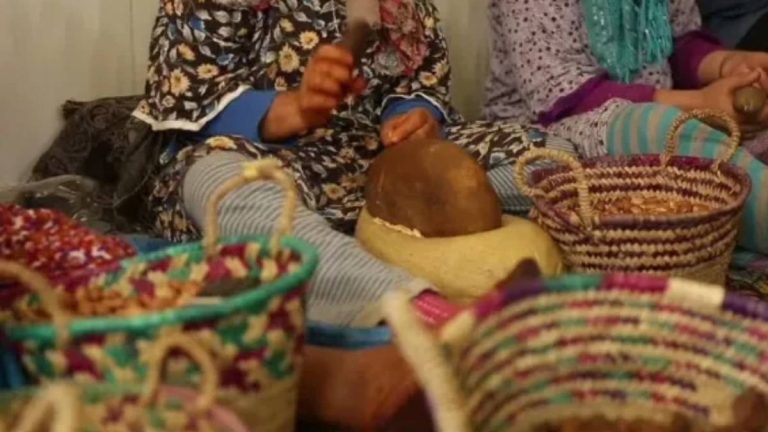
Textile traditions in Marrakech follow a quieter path. While men often occupy visible workshops, women sustain weaving, embroidery, and textile finishing within homes and cooperatives. This knowledge moves through family lines rather than formal institutions.
Wool is washed, spun, dyed, and woven using natural pigments drawn from plants, minerals, and insects. Each region brings its own patterns and palettes, yet Marrakech acts as a meeting point where these influences converge.
Rugs are not designed to match interiors. They are woven as records of experience. Symbols speak of journeys, protection, fertility, and memory. Meaning is embedded rather than explained.
Textiles here function as both utility and language, extending cultural memory through touch and use.
Leather Beyond the Tanneries
The tanneries of Marrakech remain iconic, yet leatherwork extends far beyond them. Once prepared, hides travel through networks of small workshops where they become slippers, bags, belts, and book covers.
Leather artisans judge quality through touch. Softness, flexibility, and grain guide the object’s future. Stitching is done by hand, guided by practiced eye and muscle memory rather than measurement.
Leatherwork engages all senses. Smell, texture, and color shape decisions. This immersion demands patience and presence, reinforcing a relationship with material that resists haste.Buying Crafts with Awareness
Purchasing crafts in Marrakech carries responsibility. Bargaining is part of tradition, but respect remains essential. Each object reflects time, skill, and lineage.
Asking questions opens dialogue. Observing before photographing shows consideration. Accepting that some workshops prefer privacy preserves trust. Often the most meaningful exchanges unfold quietly, without negotiation.
Supporting artisans directly sustains traditions that survive through practice rather than preservation.
Craft as Living Continuity
Arts and crafts in Marrakech are not frozen heritage. They evolve slowly, adapting to contemporary needs while maintaining ancestral techniques. Younger artisans reinterpret forms without abandoning foundations.
What endures is not the object, but the relationship between hand, material, and time.
To understand Marrakech is to witness its crafts not as souvenirs, but as living gestures of continuity woven into daily life.