
Marrakech does not reveal its music all at once. It unfolds gradually, much like the city itself, layer after layer. Rhythm here is not an ornament added to daily life but one of its foundations. From early morning chants drifting through the medina to late-night drums echoing beyond the city walls, sound becomes a language through which Marrakech remembers itself.
Unlike coastal cities shaped by constant movement and exchange, Marrakech carries the weight of inland traditions. Its music is grounded, percussive, and often circular. It reflects a city built around gathering, ritual, and repetition. To understand Marrakech fully, one must listen as much as observe.
This exploration forms part of a wider reflection on Marrakech as living heritage, where cultural expressions remain active rather than preserved. That broader context is explored in Traditions of Marrakech: Living Heritage in the Red City, where music and dance appear as essential threads within the city’s enduring cultural fabric.
The Sonic Identity of Marrakech: A City Shaped by Rhythm
Marrakech has always been a crossroads. Caravans arriving from the Sahara, Amazigh communities descending from the Atlas Mountains, scholars traveling from Fez, and traders from sub-Saharan Africa all passed through its gates. Each group left traces not only in architecture and customs, but also in rhythm.
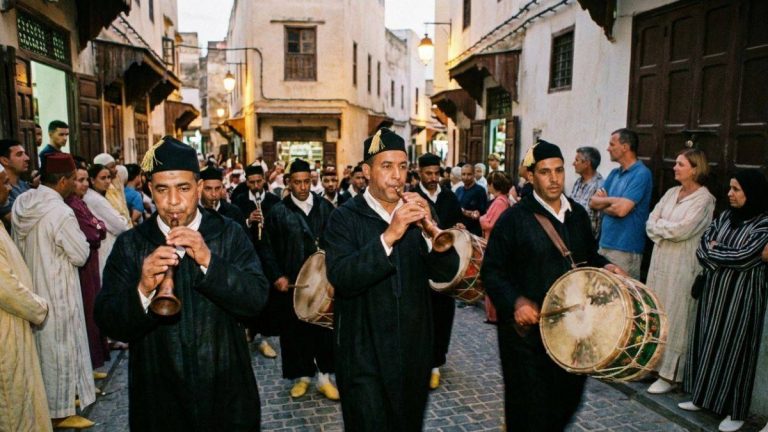
Percussion dominates the city’s soundscape. Hands striking drum skins, metal clashing against metal, feet stamping dust into repeated patterns. Even spoken language in Marrakech carries cadence and musicality. Sound is not confined to designated performance spaces. It emerges naturally from markets, celebrations, and moments of collective pause.
This rhythmic identity reflects a city shaped by continuity rather than interruption. Music here is not designed to be consumed quickly. It unfolds through time, asking for presence and patience.
Music as Collective Experience
In Marrakech, music is rarely a solitary act. It belongs to gatherings rather than stages, to ceremonies rather than concerts. Weddings, healing rituals, seasonal festivals, and informal neighborhood celebrations all create spaces where music becomes shared movement rather than individual display.
Participation matters more than technical perfection. Many performances dissolve the boundary between musician and audience, inviting clapping, chanting, or subtle movement. The emphasis lies on shared momentum, not virtuosity.
This collective approach mirrors other traditional expressions within the city, where creation is rooted in repetition and communal memory rather than personal authorship.
Ahwash and Ahidous: Amazigh Echoes in the City, Mountain Rhythms in Urban Spaces
Although Ahwash and Ahidous originate in Amazigh communities of the High Atlas and Middle Atlas, Marrakech has long served as their urban stage. During major celebrations and cultural festivals, these dances bring mountain rhythms into city squares.
Large circles form, often with men and women facing each other. Drums establish a steady pulse while voices rise together in unison. There is no central performer. Strength comes from synchrony and endurance.
The city absorbs these movements without diluting them. Marrakech does not replace their origins but provides a space where they continue to live and adapt.
Memory Carried Through Movement
These dances preserve histories that were never written down. Lyrics speak of land, seasons, love, separation, resilience, and belonging. Even when performed far from their original villages, they retain grounding force.
Movement becomes a form of memory. Each repeated step carries stories forward, allowing the city to remember landscapes beyond its walls. Through dance, Marrakech remains connected to the mountains that surround and sustain it.
Gnawa Traditions in Marrakech: A Spiritual Language of Rhythm
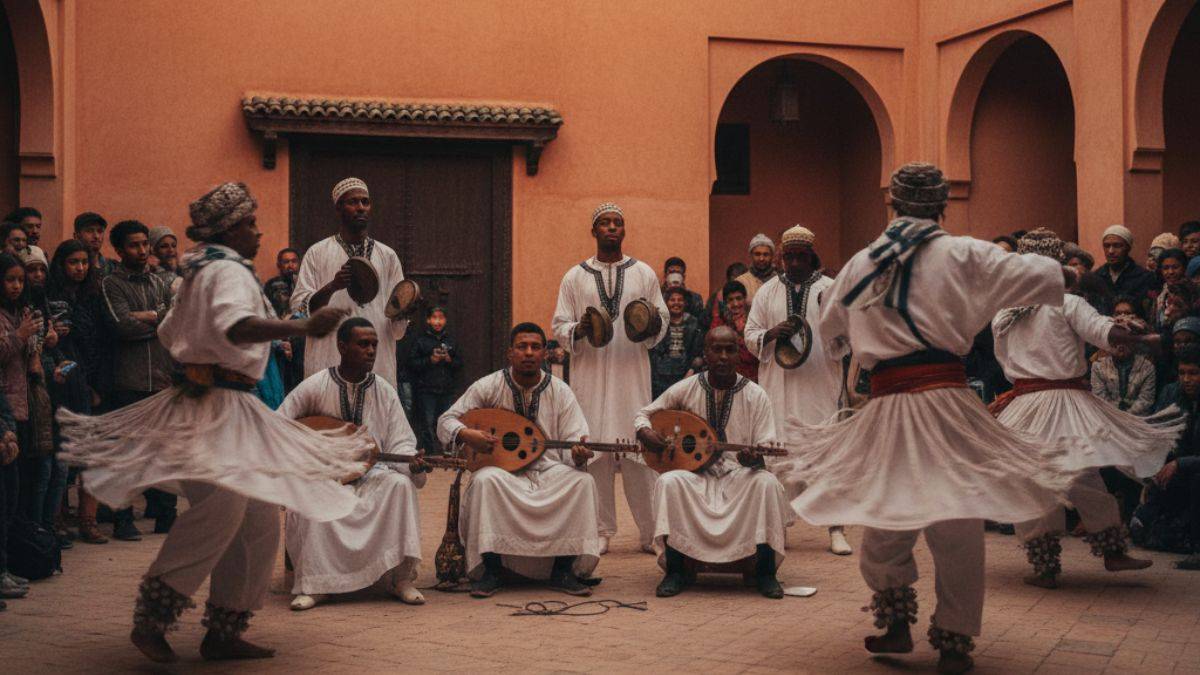
Marrakech stands as one of Morocco’s most important centers for Gnawa music. Descendants of sub-Saharan African communities transformed histories of displacement into a spiritual art form that blends rhythm, ritual, and healing.
The deep bass of the guembri anchors the music, while metal qraqeb create layered metallic waves. Songs invoke saints and ancestral spirits not as distant symbols, but as living presences woven into everyday life.
Gnawa music does not seek spectacle. It seeks alignment.
Ceremonies Beyond Performance
Gnawa traditions are often misunderstood when reduced to staged entertainment. At their core lie night-long healing ceremonies known as lila. These gatherings use repetition, rhythm, and controlled trance to restore balance between body, spirit, and memory.
Understanding this depth is essential before attending any Gnawa event. The same sensitivity applies to many spiritual expressions within the city, explored more deeply in Rituals & Spiritual Life of Marrakech: Unseen Pathways of Devotion, where sound, devotion, and daily practice overlap quietly.
Dance as Storytelling: Gestures That Speak
Dance in Marrakech often communicates what language cannot. Whether through ceremonial Amazigh movements or Gnawa trance gestures, the body becomes a vessel for narrative.
Rather than dramatic leaps or theatrical display, traditional dances emphasize grounded steps and subtle shifts of weight. Meaning accumulates slowly through repetition. Endurance matters more than visibility.
In this way, dance mirrors the city itself: restrained, layered, and deeply expressive beneath the surface.
Public Squares and Private Courtyards
Some musical and dance expressions unfold openly in places such as Jemaa el-Fna, where sound fills public space and draws spontaneous attention. Other practices remain private, reserved for family gatherings, spiritual circles, or community rituals.
Both forms coexist without conflict. Public performance introduces rhythm to visitors and passersby. Private gatherings preserve depth and intimacy. Together, they sustain the city’s cultural ecosystem.
Where to Experience Music and Dance in Marrakech
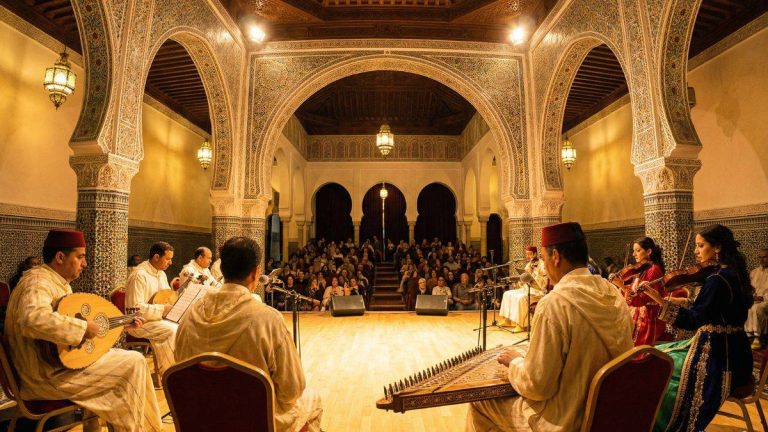
Marrakech offers multiple entry points depending on intention. Jemaa el-Fna provides immediate exposure, though context may be limited. Cultural institutions offer curated performances with clearer framing. Private ceremonies, when approached respectfully through local relationships, provide the deepest understanding.
Observation should always come before participation. Listening matters more than recording. Respect opens doors that curiosity alone cannot.
Living Rhythm, Not Frozen Tradition
Music and dance in Marrakech are not remnants of the past. They remain active forces shaping how the city breathes, gathers, and remembers. Rhythm carries history without freezing it. Movement connects generations without explanation.
To truly encounter Marrakech, one must slow down enough to feel these rhythms rather than consume them. When approached with patience and humility, the city reveals a soundscape as meaningful as its architecture and as enduring as its red walls.