
In Dakhla, the wind doesn’t just blow it speaks.
It carries salt from the Atlantic, dust from the Sahara, and voices from across Africa. It shapes dunes, cools courtyards, and fills the sails of fishing boats heading out at dawn. But more than that, it carries memory. Not in words, but in textures: the roughness of woven wool, the scent of drying fish, the hum of a drum echoing through a courtyard at dusk.
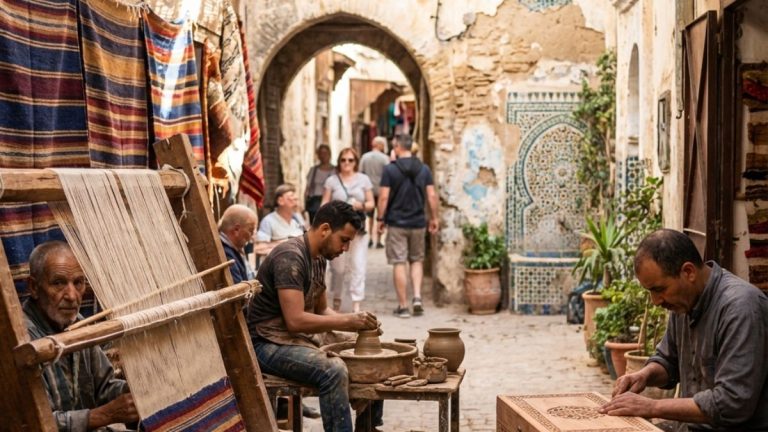
I first noticed it while walking the edge of the city, where paved streets give way to sand. A gust lifted the corner of a faded blue tent, revealing a woman inside, fingers moving swiftly over a loom made of driftwood and rope. She didn’t look up. She didn’t need to. Her hands knew the pattern by heart a design passed down not through diagrams, but through touch, repetition, and the rhythm of the wind itself.
Here, craft isn’t art for sale. It’s language. And the wind is its oldest messenger.
The Loom That Listens to the Wind
Her name was Aïcha, and her loom stood in the shade of a tamarisk tree just beyond the last row of houses. She wove not with factory yarn, but with wool from desert sheep, spun by hand and dyed with crushed shells and desert herbs. “The wind tells me what color to use,” she said, holding up a strip of fabric the deep blue of twilight over the bay. “When it comes from the sea, I use indigo. When it carries sand, I mix in ochre.”
She showed me how each rug tells a story not of heroes or battles, but of daily life: a zigzag for dunes, a circle for the sun, a series of dots for fish swimming in schools. These aren’t decorations. They’re records. Maps of memory woven into cloth.
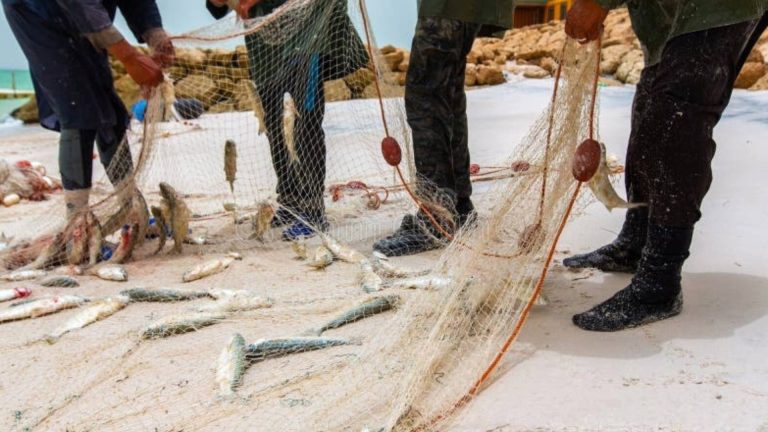
Later, I watched her son repair a fishing net using the same knotting technique she used in her weaving. “Same hands, different thread,” he said with a quiet smile. In Dakhla, there’s no divide between craft and survival. The same skills that warm a home also feed it. And both are shaped by the wind its direction, its strength, its silence.
Wool, Wind, and the Weight of Memory
Aïcha’s wool wasn’t just material it was archive.
She kept bundles of it in clay jars, each labeled not with dates, but with seasons: “The year the wind blew from Mauritania,” “The spring the sea gave sardines for forty days,” “The winter we welcomed refugees from Mali.” To touch the wool was to touch time not as a line, but as a spiral.
One afternoon, she handed me a small pouch made of tightly woven fibers. “For your pocket,” she said. Inside was a mix of dried mint, sea salt, and a single blue thread. “When you feel lost,” she explained, “hold it. The wind that carried this thread also carried your steps here. It will remind you.”
I didn’t understand then. But weeks later, back in Los Angeles, overwhelmed by traffic and noise, I reached into my coat and found the pouch. Just holding it feeling its roughness, smelling the salt and mint brought me back to that courtyard, I kept that pouch on my desk for months, next to my laptop and coffee mug a small rebellion against the sterile rhythm of digital life. On hard days, I’d close my eyes and rub the thread between my fingers, and suddenly, I was back under the tamarisk tree, hearing the loom click like a heartbeat. It wasn’t nostalgia. It was recalibration. In Dakhla, healing doesn’t come from escaping life, but from remembering how to be in it with your hands, your breath, your full attention. to the sound of the loom clicking like a heartbeat, to the certainty that some things are made not to be sold, but to be held.
In Dakhla, objects carry presence. And presence is the deepest form of care.
For those who’ve felt that true belonging lives not in possessions but in what we carry quietly, Dakhla’s Pulse: Traditions Where the Sahara Greets the Atlantic reveals how an entire region weaves memory, wind, and welcome into a living fabric of resilience.
The Wind That Shapes Shelter
Dakhla’s traditional tents low, dome-shaped, and anchored deep in the sand are not built to resist the wind, but to dance with it. Made from tightly woven goat or camel wool, their fabric breathes: tightening in rain, loosening in heat, always moving with the air. “A stiff tent breaks,” Aïcha told me. “A wise one bends.”
I spent a night in one such tent on the outskirts of town, hosted by her cousin, a former fisherman turned storyteller. As dusk fell, the wind rose, humming through the fibers like a lullaby. Inside, the air stayed cool, scented with cedar and dried dates. No walls, no locks just fabric held by rope and trust.
“Strangers come from all over Africa,” he said, pouring tea into small glasses. “Mauritania, Senegal, Mali. We don’t ask papers first. We ask if they’ve eaten.” The tent, he explained, is more than shelter it’s a promise: You are safe here, even if you’re unknown.
In a world that builds walls, Dakhla builds openings. And the wind carries that invitation far beyond the dunes.
Threads That Cross Borders
The wind in Dakhla doesn’t recognize frontiers.
It carries Wolof songs from Senegal, Hassani poetry from Mauritania, and rhythms from the Sahel that blend with the crash of Atlantic waves. And the crafts here reflect that flow. Aïcha’s rugs sometimes feature geometric patterns I’d seen in Malian textiles; her son’s fishing nets use knots taught by a Senegalese friend who settled here years ago.
One market morning, I watched a young woman from Guinea-Bissau barter dried fish for a handwoven belt. No money changed hands. Just goods, smiles, and a few words in a mix of Arabic, French, and Fulani. “We learn each other’s languages through trade,” she told me. “Not in schools. In courtyards.”
This is Dakhla’s quiet genius: it doesn’t preserve culture in isolation. It lets it breathe, mix, and evolve. The wind brings change and instead of fearing it, the people weave it in. Every new thread strengthens the fabric.
If your spirit has been stirred by this living tapestry if you sense that true tradition isn’t about purity, but about generosity then Guests of the Horizon will welcome you deeper into Dakhla’s most radical practice: where every stranger is honored not as visitor, but as guest of the infinite sky.
What the Wind Leaves Behind
On my last evening, I walked alone to the edge of the bay, where the desert meets the sea in a long, curving line of foam and sand. The wind was strong that day coming from the south, carrying the scent of distant rains and dry grass. I sat on a dune, watching it lift grains of sand and carry them out over the water, as if returning dust to wave.
Aïcha had told me earlier, “The wind takes, but it also gives. It scatters seeds. It cools fevered brows. It brings voices we need to hear.” I thought of her pouch in my pocket, of the tent that bends but doesn’t break, of the nets and rugs woven with stories from across continents.
In California, I’d chased permanence buildings that defy weather, products that promise forever, schedules that pretend time can be controlled. But here, I learned the wisdom of impermanence: that what lasts isn’t what resists change, but what moves with it.
The wind doesn’t leave monuments.
It leaves patterns in sand, in wool, in the way people greet strangers.
And those patterns, repeated with care, become tradition.
Not because they’re old.
But because they’re alive.
Back in California, I tried to explain Dakhla’s wisdom to a friend over coffee. “It’s not about the objects,” I said, fumbling for words. “It’s about what they carry.” He nodded politely, but I knew he didn’t understand. How could he? We live in a world that measures value by ownership, speed, and novelty. But in Dakhla, value lives in continuity in the way a rug holds a season, a tent shelters a stranger, a net honors the sea.
The wind taught me that tradition isn’t something you preserve behind glass. It’s something you let move through you like air, like breath, like memory. You don’t hold it still. You let it shape you.
And perhaps that’s the deepest healing of all: to stop trying to control time, culture, or meaning and instead, open your hands, like Aïcha’s loom, and let the wind weave what it will.
How the Wind Heals
I used to think healing required stillness quiet rooms, guided meditations, retreats far from noise. But Dakhla taught me otherwise. Here, healing lives in movement. In the constant flow of wind that never stops carrying stories, salt, and strangers to your door. It’s not about escaping life, but about letting life move through you like air through a woven tent, like memory through wool.
One afternoon, while sitting with Aïcha, I asked how she stays calm amid uncertainty storms, market shifts, distant wars. She paused, then pointed to her loom. “The wind doesn’t ask permission,” she said. “It just passes through. And if your heart is open, it leaves something beautiful behind.”
That’s the secret no app can replicate: wellness isn’t found in control, but in permeability. In allowing the world in all its chaos and grace to shape you, thread by thread, breath by breath.