

Most travelers come to Agadir for the beach.
They book resorts with infinity pools that mirror the ocean, snap sunset photos from the kasbah ruins, and leave thinking they’ve seen Morocco. But just beyond the promenade, where the city gives way to red earth and olive groves, another Agadir lives one that doesn’t perform for cameras, but breathes in quiet rhythms passed down not through tourism brochures, but through hands, voices, and daily acts of care.
I remember my first morning here. Jet-lagged and disoriented, I walked past the hotel strip toward the old port, drawn by the smell of grilling sardines and the call to prayer echoing off low hills. An old man mending nets looked up, nodded once not as greeting, but as acknowledgment and went back to his work. No pitch. No tour offer. Just a man doing what his father and grandfather had done, long before cruise ships appeared on the horizon. In that moment, I knew I’d come to the right place. Not for escape, but for encounter.
This is the Agadir I came to know not as a destination, but as a threshold. Here, the Atlantic doesn’t just meet the coast; it meets the foothills of the Anti-Atlas, and in that meeting, a unique culture has taken root: Amazigh, resilient, deeply attuned to land and season. Wellness here isn’t purchased in spas or retreats. It’s received in silence, in steam, in shared bread, in stories told under fig trees. It’s not about escape. It’s about return.
Over months of walking these paths, sitting in courtyards, and listening more than speaking, I learned that true tradition isn’t preserved in museums. It lives in the morning ritual of cracking argan nuts, in the three pours of mint tea, in the way women read the moon to time their cheese-making. These aren’t performances. They’re practices ways of being that offer an alternative to the burnout culture so many of us carry from the West.
What follows isn’t a guide. It’s an invitation to slow down, to listen, and to discover six living traditions that reveal how wellness, belonging, and time itself are understood in this corner of Morocco.
The Scent of Argan and Silence: A Morning in Tamanar
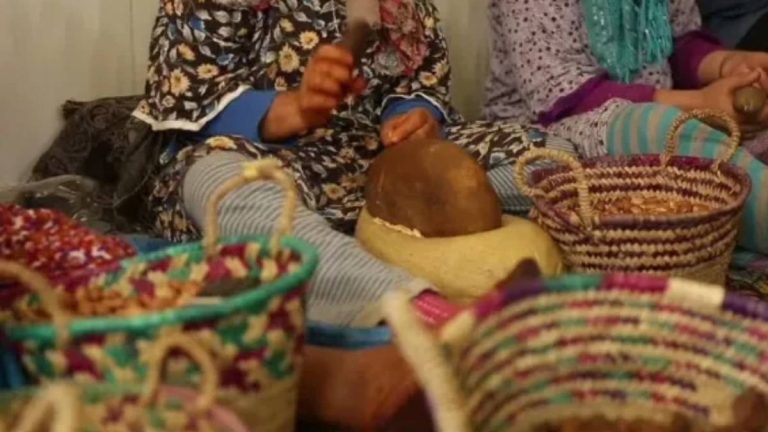
It begins before dawn, in the village of Tamanar, where the air still carries the coolness of night and the first light gilds the argan trees. Here, elders mostly women gather under ancient canopies, their hands moving with a rhythm older than memory. They crack the hard shells of argan fruit not with machines, but with stones, extracting kernels that will become oil used for skin, hair, and cooking.
But this isn’t labor. It’s meditation. No one speaks much. There’s no playlist, no productivity goal. Just the soft tap of stone on shell, the rustle of leaves, the occasional birdcall. In this silence, something profound happens: the mind quiets. The body settles. And you realize that wellness isn’t something you chase it’s something you allow, simply by showing up and paying attention.
The argan tree itself is a teacher. It grows slowly, survives drought, and gives generously but only to those who respect its pace. To rush the harvest is to break the nut unevenly, wasting precious oil. To rush the process is to miss the lesson: that abundance flows not from speed, but from patience.
For anyone weary of curated “wellness experiences” The Scent of Argan and Silence: A Morning in Tamanar offers a return to the source where healing begins not with a product, but with presence, and where the most powerful rituals require nothing more than your willingness to sit, watch, and listen.
When the Ocean Whispers Back: Healing Walks Along Taghazout Bay
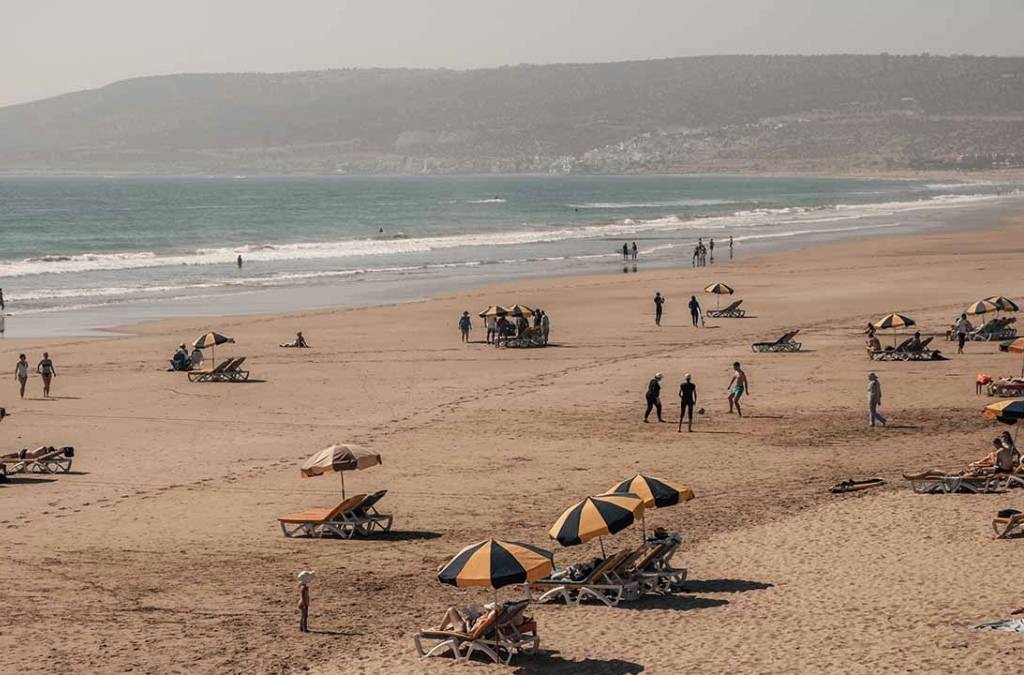
Just north of Agadir, where the Atlantic crashes against volcanic cliffs and surfers paddle out at dawn, lies Taghazout Bay a place often reduced to a postcard of waves and yoga retreats. But beyond the rented boards and beachfront cafés, the ocean speaks a quieter language, one that locals have learned to hear over generations.
Here, healing doesn’t come from a massage or a meditation app. It comes from walking the shore at low tide, barefoot on wet sand, letting the rhythm of the waves recalibrate your nervous system. Fishermen don’t call it “mindfulness.” They call it listening. They watch how the gulls gather, how the foam curls, how the wind shifts and in those signs, they read not just weather, but mood, memory, even warning.
I joined an elder named Youssef one morning as he walked the tideline, not to fish, but to remember. His father had taught him to walk this stretch after loss. “The ocean takes what you can’t carry,” he said, eyes fixed on the horizon. “You just have to stand still long enough to let it.”
There’s no ritual prescribed, no mantra chanted. Just presence. And in that presence, something loosens the grip of anxiety, the weight of unresolved grief, the illusion that you must always be doing. The sea doesn’t care about your productivity. It only asks that you show up, open, and let its vastness hold what your shoulders can no longer bear.
In a world that treats nature as backdrop for self-optimization, this kind of coastal wisdom feels radical. Not because it’s rare, but because it refuses to be packaged. You can’t book it. You can’t Instagram it. You can only receive it by walking slowly, breathing deeply, and trusting that sometimes, the best thing you can do is nothing at all.
For those who’ve grown tired of wellness as performance, When the Ocean Whispers Back: Healing Walks Along Taghazout Bay reveals how the Atlantic, in its endless return, offers a form of therapy that costs nothing but attention and gives back everything.
Bread, Mint, and the Art of Waiting: Tea Rituals in the Souss Valley
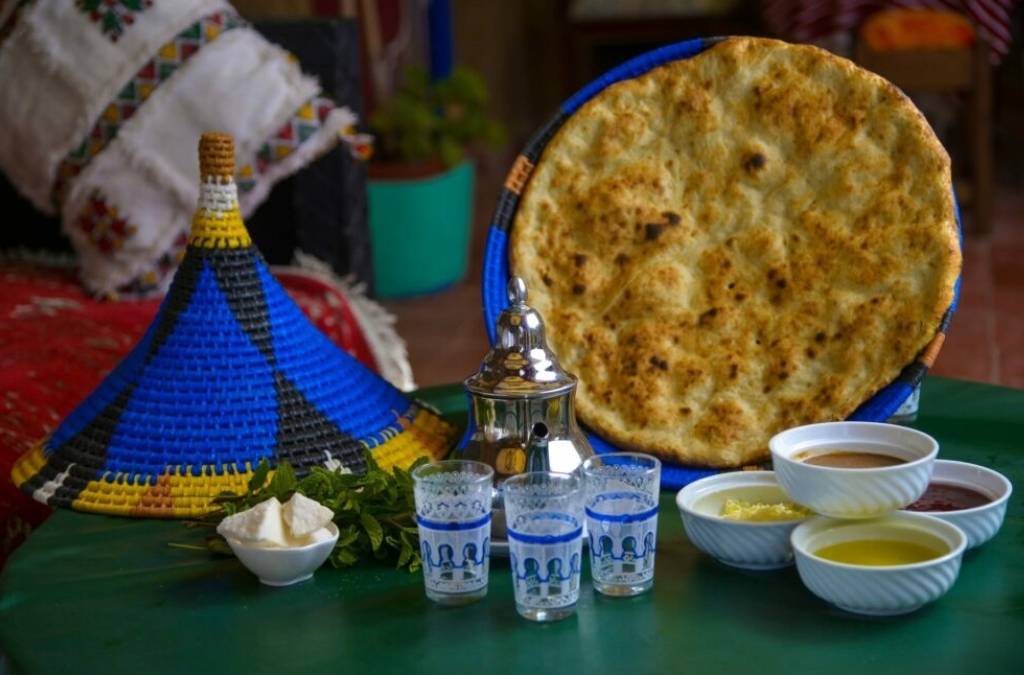
In the fertile plains of the Souss Valley, south of Agadir, tea isn’t served it’s shared. And it begins not with boiling water, but with waiting. Not the anxious kind, but the kind that opens you, like soil after rain.
I learned this from Amina, a woman whose courtyard became my classroom in stillness. She didn’t ask about my life or offer advice. She simply broke warm bread from the communal oven, washed mint by hand, and placed sugar cubes on a tray. Then she lit a small brazier and sat beside me beneath a fig tree. “The tea will tell us when it’s ready,” she said.
What followed was the three pours a practice passed through generations. The first, strong and sharp, to cut through distraction. The second, balanced and fragrant, to open the heart. The third, gentle and floral, to settle the soul. Between sips, silence reigned not as emptiness, but as fullness: of shared breath, unspoken understanding, the simple fact that two people could sit together without needing to prove anything.
This ritual isn’t about refreshment. It’s about fellowship. Bread is never eaten alone. Tea is never rushed. And time? Time is not spent it’s held, like a gift.
In California, I’d mistaken busyness for purpose. Here, I learned that presence is its own form of productivity. The women who bake bread at dawn, the men who tend mint gardens, the elders who pour the third cup without being asked they aren’t idle. They’re practicing a quiet resistance against a world that equates speed with success.
For anyone who’s ever felt that true connection lives not in efficiency but in stillness, Bread, Mint, and the Art of Waiting: Tea Rituals in the Souss Valley offers a return to the most radical act of all: sitting down, sharing bread, and letting the world wait.
Under the Fig Tree: Stories That Mend in the Anti-Atlas Villages
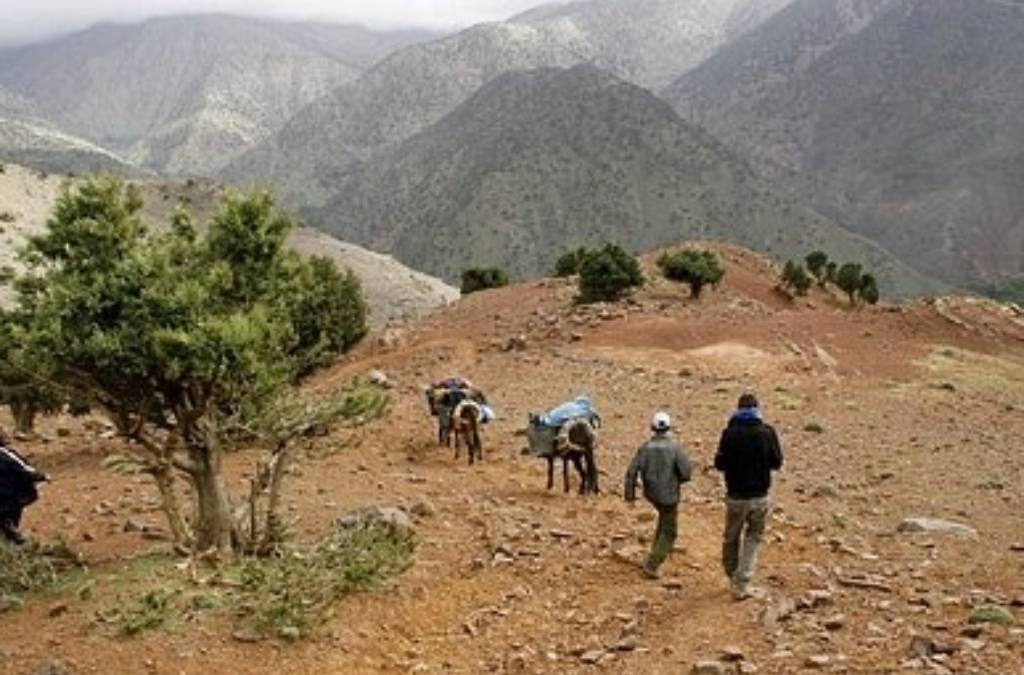
High in the red hills of the Anti-Atlas, where stone villages cling to slopes like ancient secrets, healing doesn’t come from advice it comes from stories. Not the kind told on stages or recorded for podcasts, but the kind whispered beneath the shade of a centuries-old fig tree, where elders speak in parables and children listen without interrupting.
I arrived in one such village by accident, drawn by a road that climbed until the air grew thin and the silence deepened into something sacred. There, I met Brahim, a man whose voice carried the weight of generations. He didn’t ask my name right away. He simply said, “Sit. The story isn’t ready yet.”
And so I waited. Day after day, I returned to the circle of flat stones beneath the fig tree, watching as women mended wool, boys cracked almonds, and men washed dust from their boots before joining the gathering. No one performed. No one explained. They simply showed up and in that showing up, a space opened for wounds to be held, not fixed.
Brahim’s tales were never just entertainment. A story about a river changing course taught resilience. A parable of a bird that lost its song spoke to grief. And when I finally shared my own unspoken sorrow, he wove it into his next telling not directly, but as a thread so I felt seen without exposure, understood without interrogation.
This is the quiet genius of Amazigh storytelling: it doesn’t isolate your pain. It weaves it back into the fabric of community. Your loss becomes part of a larger narrative one that has endured drought, earthquake, and exile, yet still finds reason to gather under leaves and listen.
In a culture that treats vulnerability as weakness, this practice feels revolutionary. Not because it’s dramatic, but because it’s ordinary woven into daily life, passed hand to hand, ear to ear, heart to heart.
For those who’ve carried grief too heavy for words, Under the Fig Tree: Stories That Mend in the Anti-Atlas Villages reveals how healing often arrives not as an answer, but as a companionable silence and how the oldest trees sometimes hold the wisest listeners.
Steam, Clay, and the Quiet Strength of the Moroccan Hammam Near Agadir

Just beyond the city’s edge, where the noise of traffic fades into the rustle of olive groves, the traditional hammam near Agadir operates not as a spa, but as a sanctuary of shared humanity. There are no robes, no reception desks, no curated playlists just a heavy wooden door, the scent of eucalyptus, and the low hum of women’s voices echoing through steam.
I was invited by Fatima, who handed me a bundle wrapped in cotton: black soap she’d made from olives pressed after the first rain, rhassoul clay mined from the Atlas, and a rough kessa glove woven by her mother. “Wear this,” she said. “Leave everything else outside.”
Inside, time dissolved. The hammam unfolds in three rooms each warmer than the last leading to a central chamber where heat rises from the floor like breath from the earth. But the real work happens not in the steam, but in the touch. An elder named Zineb scrubbed my back with firm, knowing hands not to exfoliate skin, but to release what the body holds: grief, fatigue, the invisible weight of living in a world that never stops asking for more.
No one spoke much. No one needed to. A tear mixed with clay on my cheek; a woman nearby silently offered a dry corner of her sheet. In that space, vulnerability wasn’t weakness it was welcome.
This isn’t self-care as performance. It’s care as community. The same hands that scrub your back also plant barley in spring and prepare preserves before winter. Wellness here isn’t a break from life. It’s a return to its pulse.
And the ritual begins long before you cross the threshold dawn preparations, shared bread afterward, the walk in pairs along red-earth paths. You can’t replicate this in a luxury resort. It lives in reciprocity, in generations of women who know that healing flows not from products, but from presence.
For anyone who’s ever felt that true restoration requires not solitude but shared silence, Steam, Clay, and the Quiet Strength of the Moroccan Hammam Near Agadir reveals how cleansing can be an act of belonging and how the deepest wellness is received, not purchased.
Harvesting Time: The Forgotten Rhythms of the Amazigh Calendar Around Agadir

In the villages surrounding Agadir, time isn’t measured in minutes or managed through digital alerts. It’s harvested read in the sky, felt in the wind, tasted in the soil. The Amazigh calendar, one of the oldest in North Africa, doesn’t begin on January first. It begins with Yennayer, around mid-January, when the earth exhales after winter and the first rains soften the ground for planting.
This isn’t folklore. It’s a living system of ecological intelligence honed over millennia. Elders watch the stars Vega’s appearance signals sowing; Orion’s position marks the argan harvest. Women time cheese-making by the moon’s phases, knowing full-moon milk is richer because goats graze longer under its light. Children learn to read the wind: a south breeze carrying the scent of wet stone means rain in three days.
I sat with Lalla Zoubida on her rooftop in Tiznit as she pointed to the Pleiades low on the horizon. “The cold won’t last,” she said. No app. No forecast. Just generations of observation passed hand to hand. In this world, productivity isn’t the goal balance is. You don’t take everything from the thyme patch; you leave some for bees and next year. You scatter seeds on your threshold not as ritual, but as promise: We will plant again.
This rhythm resists commodification. You can’t book it. You can’t speed it up. You can only join it by watching, listening, and trusting that the land speaks a language older than clocks.
For those exhausted by the tyranny of the schedule, Harvesting Time: The Forgotten Rhythms of the Amazigh Calendar Around Agadir offers a return to a deeper truth: that time isn’t lost when you’re still. It’s gathered like rain in a cistern, like stars in a night sky, like silence between heartbeats.
A Living Map of Care
Together, these six traditions form more than a collection of practices they compose a living map of care that stretches from the Atlantic shore to the high ridges of the Anti-Atlas. This isn’t heritage preserved behind glass. It’s wisdom lived daily: in the crack of an argan nut at dawn, the rhythm of waves along Taghazout, the patience of three tea pours, the silence beneath a fig tree, the firm kindness of hands in the hammam, and the stars that guide planting and harvest.
What unites them all is a quiet refusal to commodify healing, to isolate wellness, to treat time as a resource to be spent. Instead, they offer something radical in our age of burnout: belonging. Not as a feeling, but as a practice. You belong by showing up without agenda, without performance and allowing yourself to be held by land, community, and rhythm.
I came to Agadir seeking escape. I left with something far more valuable: the understanding that true restoration doesn’t require leaving your life behind. It requires returning to its pulse to the breath, the soil, the shared silence that reminds you you’re not alone.
Back in Los Angeles, I catch myself checking my phone less. I sit longer with my coffee. I notice when the jacaranda trees bloom. These small shifts aren’t coincidental. They’re echoes of what I learned here: that wellness isn’t something you achieve. It’s something you remember. And what I remembered, standing on a ridge above the Souss Valley at dusk, is that we were never meant to live at war with time. We were meant to move with it like waves, like seasons, like stories passed from one generation to the next.
This region doesn’t need to be discovered. It’s been here all along, tending its gardens, telling its stories, waiting patiently for those willing to slow down enough to listen. And in that listening, you might just find what so many of us have lost: a way of being that doesn’t ask you to do more, but to be here fully, gently, and without apology.