
I used to think “mindfulness” required a cushion, a timer, and twenty minutes of uninterrupted silence.
Then I got lost in the medina of Essaouira.
Not the kind of lost that panics you, but the kind that frees you. No Google Maps. No itinerary. Just narrow alleys that turn like river bends, blue doors that blink in the sun, and the distant clang of a copper hammer that pulls you forward like a compass needle finding true north.
Back in California, I’d paid for “mindful walking” workshops where we moved at half-speed across manicured lawns, counting breaths and naming sensations. It felt like work. But here, mindfulness wasn’t something I practiced. It was something that practiced me, through cobblestones underfoot, the scent of cedar sawdust, and the sudden burst of a child’s laughter around a corner I didn’t know existed.
In Essaouira, presence isn’t achieved. It’s invited, by color, by craft, by the quiet insistence of a place that refuses to hurry.
The Medina as a Living Labyrinth of Attention
Unlike the grand plazas of Marrakech or the bustling souks of Fes, Essaouira’s medina doesn’t overwhelm. It whispers.
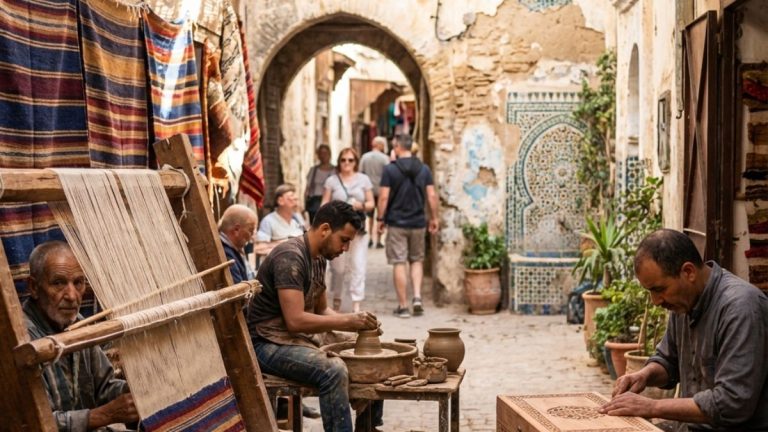
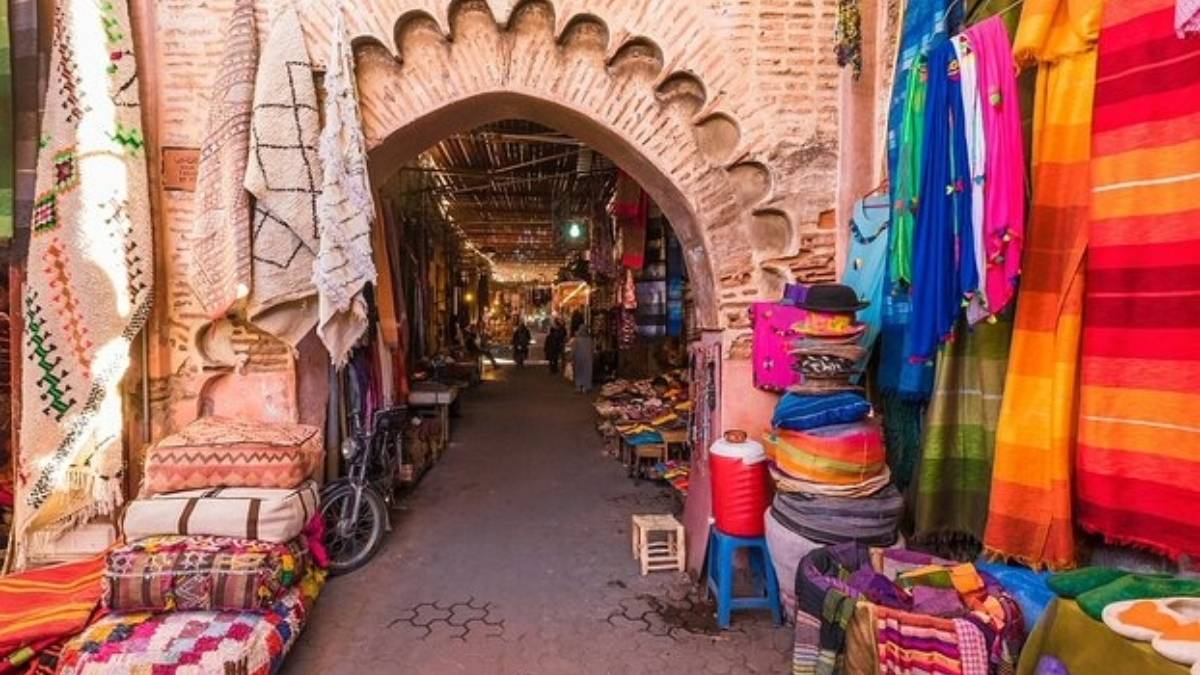
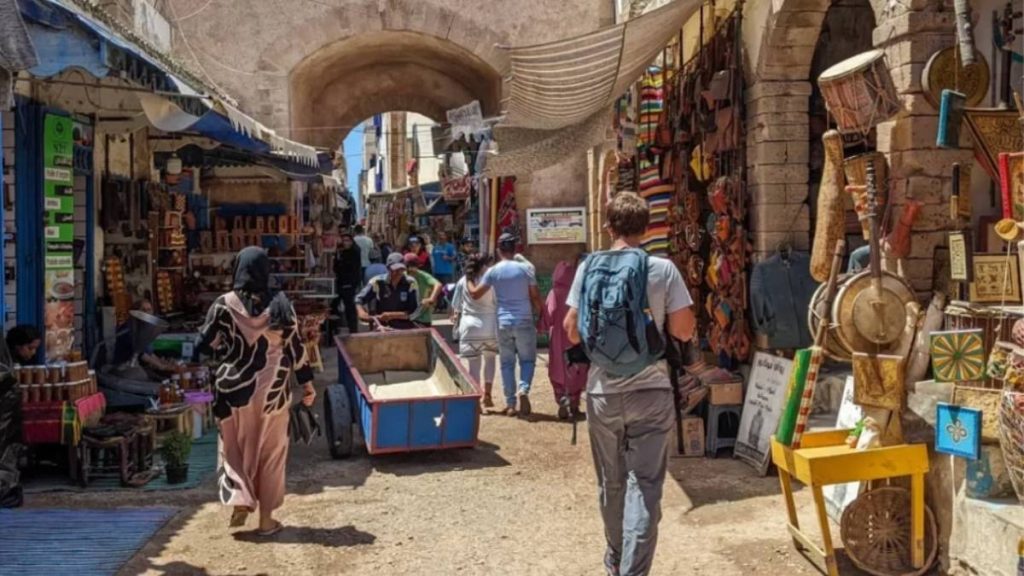
Its streets are human-scaled, just wide enough for two people to pass, narrow enough that you feel the warmth of the walls on your arms. Sunlight falls in stripes through carved wooden shutters. Shadows shift like slow breaths. Every turn offers a new composition: a basket of saffron threads glowing like embers, a fisherman mending nets in a sunlit niche, a splash of cobalt blue paint drying on a freshly washed step.
There’s no “right” way to walk it. And that’s the point.
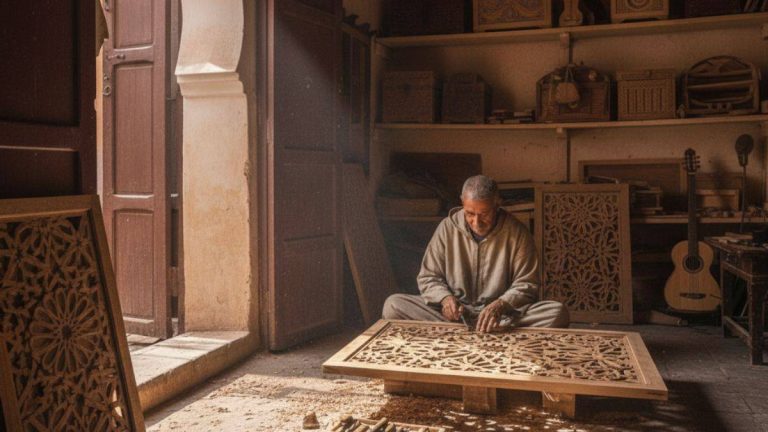
Locals don’t rush through these alleys. They linger. They greet the spice merchant by name. They stop to watch an artisan chisel a cedar box, not to buy it, but to witness the patience in his hands. Time here isn’t measured in minutes, but in interactions, each one a small anchor to the present.
I asked Leila why no one seems hurried. She smiled. “When your eyes are busy with beauty, your mind stops chasing tomorrow.”
Walking Without a Destination: The Antidote to Productivity
In a world that equates movement with progress, walking without a goal feels radical, even rebellious.
But in the medina, aimless wandering is sacred. It’s how you discover the woman who sells rosewater in recycled glass bottles. It’s how you hear the hidden courtyard where a Gnaoua musician rehearses alone. It’s how you notice the subtle shift from ochre to terracotta in the plaster walls as you move from the sea side toward the old kasbah.
This isn’t tourism. It’s attunement.
One morning, I followed the smell of baking msemen, flaky, buttery pancakes, down a corridor so narrow my shoulders brushed both sides. At the end, an elderly woman stood at a clay stove, flipping dough with bare hands. She didn’t speak English. She didn’t offer a menu. She just handed me a warm piece wrapped in paper. “For your walk,” she said in Darija, before turning back to her fire.
I ate it sitting on a low step, watching sunlight climb a turquoise door. No photos. No notes. Just taste, warmth, and the quiet hum of a city breathing.
For the first time in years, I wasn’t documenting an experience. I was living it.
If you’ve felt this shift in Essaouira, if the ocean’s rhythm, the scent of argan, and the silence between waves have all pointed toward a slower way of being, then Wellness and Cultural Travel in Essaouira: The Ocean, The Body, and The Quiet Mind maps the full philosophy behind this gentle, place-based approach to wellness.
Craft as Contemplation: The Rhythm of Making
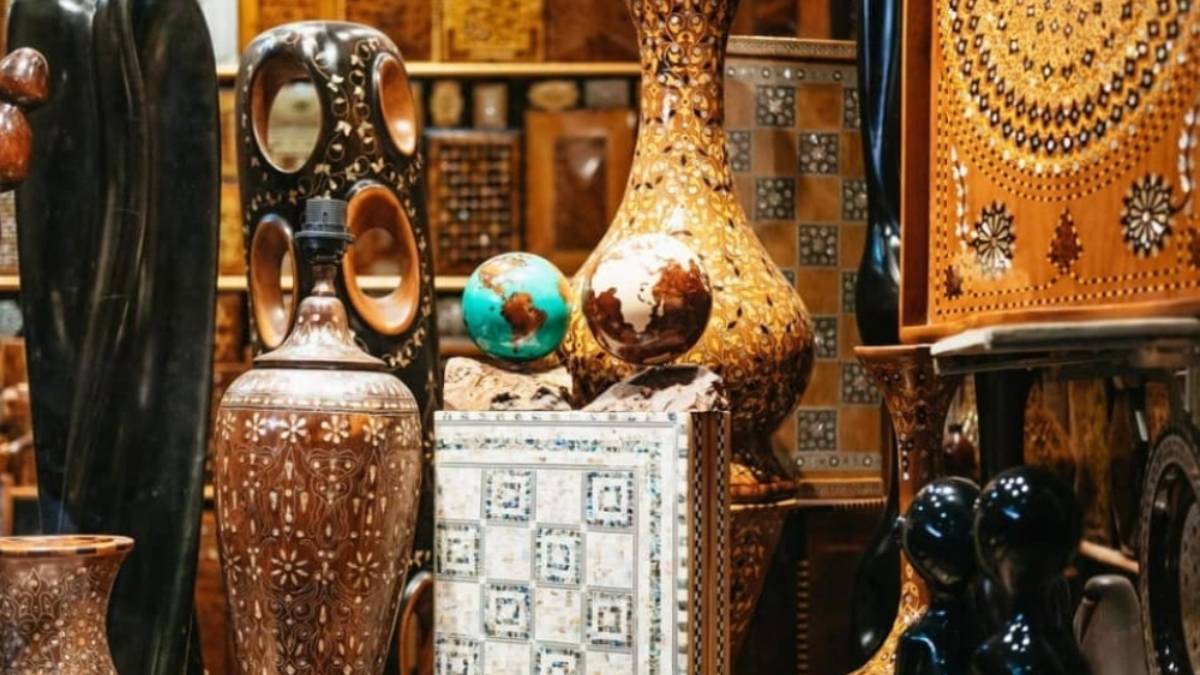
In the medina, every craft is a meditation in motion.
You don’t have to sit still to be present, you just have to pay attention to what’s being made, and by whom.
At the coppersmith’s stall near Place Moulay Hassan, I watched a young artisan hammer a teapot for nearly an hour. His movements were unhurried, precise, almost devotional. Each strike shaped not just the metal, but the silence around it. Tourists passed by, snapping photos from a distance, but he never looked up. His focus was total, not because he was performing, but because the work demanded it.
“What happens if you rush?” I asked later, when the square had emptied.
He smiled. “The metal remembers. It cracks where the mind wasn’t.”
That stayed with me. In a culture obsessed with output, Essaouira’s artisans measure value not by speed, but by presence. The weaver at her loom, the woodcarver in his shaded workshop, the woman hand-stitching leather babouches, they all move with the same quiet intensity. Their hands know what their minds have long surrendered to: that making something well is a form of prayer.
The Language of Color: How Hues Hold You Here
Color in the medina isn’t decoration. It’s orientation.
The famous blue isn’t just pretty. It’s protective. Traditionally, the pigment came from crushed indigo or even crushed scorpions, a folk remedy to ward off the real ones, and it was believed to keep evil spirits from crossing thresholds. Today, it’s more about mood: cool blues calm the eye, fiery reds energize doorways, and earthy ochres ground the soul in the desert’s memory.
But the real magic is in the variation. No two blues are alike. One door might be the color of twilight, another the deep of ocean trenches, a third the pale wash of dawn. Walking through the alleys becomes a slow study in subtlety, training your eyes to see what your busy mind has long filtered out.
I spent an entire afternoon just watching light move across a single wall, how it turned terracotta to gold at three o’clock, then to burnt sienna by four. My phone stayed in my pocket. Not because I was “detoxing,” but because nothing on a screen could compete with the living canvas before me.
This is the medina’s silent teaching: attention is a muscle. And like any muscle, it grows stronger with use.
From Spectator to Participant: The Ethics of Looking
It’s easy to walk the medina as a gallery, observing, photographing, consuming beauty without connection. But true mindful walking here requires a shift: from spectator to participant.
That means asking before you photograph a craftsperson. It means buying a small item not out of pity, but as an act of reciprocity. It means sitting with a tea vendor not to “experience local life,” but to share a few quiet minutes with someone who’s spent decades watching the world pass by his stall.
One afternoon, I sat with Hassan, who’s sold mint tea in the same corner for forty years. He didn’t speak much English, but he pointed to his heart, then to the medina, and said, “She teaches. If you listen.”
I realized then that mindfulness here isn’t a technique. It’s a relationship, with place, with people, with the slow unfolding of ordinary moments.
And that’s what the wellness industry so often misses: presence isn’t something you cultivate in isolation. It’s something you co-create with the world around you.
Walking as Returning, Not Escaping
Back home in California, I used to walk to “clear my head” or “get ideas.” Walking was a tool for productivity. But in Essaouira, I learned to walk without purpose, to let the alley decide where I go, to follow a scent or a sound, to trust that wandering is its own kind of arriving.
The medina doesn’t reward efficiency. It rewards curiosity. The dead ends lead to hidden courtyards. The detours reveal murals you’d never find on a map. The pauses, leaning against a sun-warmed wall, watching laundry flutter from a balcony, become the real destination.
This is the gift of mindful walking here: it doesn’t ask you to become more mindful. It reminds you that you already are, beneath the noise, beneath the plans, beneath the illusion that you’re ever truly lost.
If this path of slow seeing and quiet connection speaks to you, if you sense that true presence might live not in stillness alone, but in the rhythm of hands shaping wood, colors shifting with the sun, and footsteps echoing through ancient stone, then Seasonal Wellness Rituals: Wind, Water, and Slow Living will guide you into Essaouira’s cyclical rhythms, where healing aligns with the seasons, the wind, and the quiet pulse of the year.
The Return Walk: Carrying the Medina Within
Leaving the medina for the last time, I didn’t feel like I was saying goodbye.
I felt like I was taking it with me, not in souvenirs or photos, but in a new way of seeing.
Now, back in Los Angeles, when I walk through my neighborhood, I notice things I used to miss: the way light filters through a neighbor’s jasmine vine, the rhythm of a street sweeper’s broom, the quiet pride in a shopkeeper arranging fruit at dawn. The medina didn’t change me. It reminded me how to pay attention, to let the world speak without trying to translate it into content, productivity, or even meaning.
Mindfulness, I learned, isn’t about emptying the mind. It’s about filling it with what’s real: texture, scent, sound, the imperfect beauty of human hands at work.
How to Walk the Medina, Even When You’re Not There
You don’t need to be in Essaouira to practice this kind of walking.
You just need to slow down enough to let your surroundings in.
Start small. On your next walk, choose one sense to follow, sound, color, or texture. Let it lead you. If you’re drawn to a patch of peeling paint, stop. Look at its layers. Wonder who painted it, and why. If you hear hammering, follow it, not to buy, but to witness. Let yourself be interrupted by beauty. Let yourself be late.
In a world that rewards speed, choosing slowness is an act of quiet rebellion. And in a culture that treats attention as a commodity to be monetized, giving it freely, to a wall, a craftsperson, a patch of sky, is a radical return to self.
Walking as a Daily Practice, Not a Destination
The medina doesn’t exist to heal you. It simply is.
And in its being, it offers a mirror: Are you rushing past your life, or walking through it?
Every time I feel myself slipping back into autopilot, I close my eyes and remember: the cool blue of a doorway, the smell of cedar shavings, the steady clang of the coppersmith’s hammer. I take a breath. I slow my step. And for a moment, I’m back, not in Essaouira, but in presence.
That’s the true souvenir. Not a trinket, but a shift. Not an escape, but a return.