
I didn’t expect to find healing in a basement in Essaouira.
Especially not on a Tuesday night, in a room lit by a single hanging bulb, with sweat on the walls and the smell of cedar smoke curling through the air. I’d come to Morocco looking for quiet, not rhythm. But the Gnaoua don’t ask if you’re ready. They meet you where you are exhausted, distracted, half-lost and invite you to move, not to fix yourself, but to remember you’re still alive.
Back home in California, “music therapy” meant curated playlists for sleep or focus apps that promised to “rewire your brain in ten minutes.” But here, in this dim room where the guembri’s bass line vibrated through the floorboards and the qraqeb’s metallic clack cut through thought like a knife, therapy wasn’t something you consumed. It was something you entered. Something you surrendered to. Something that moved through you, whether you understood it or not.
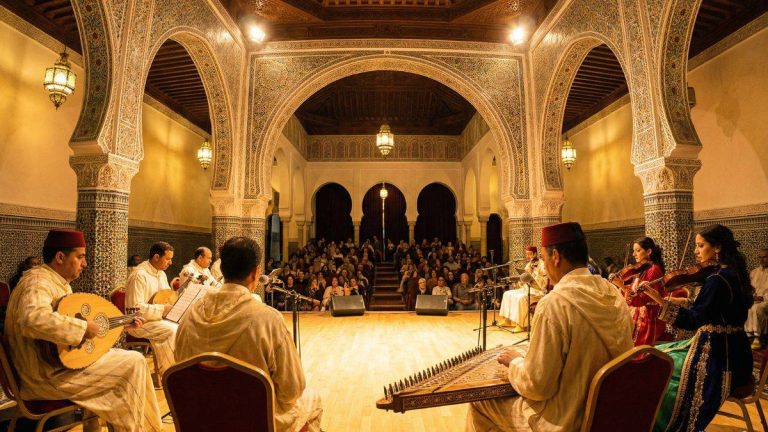
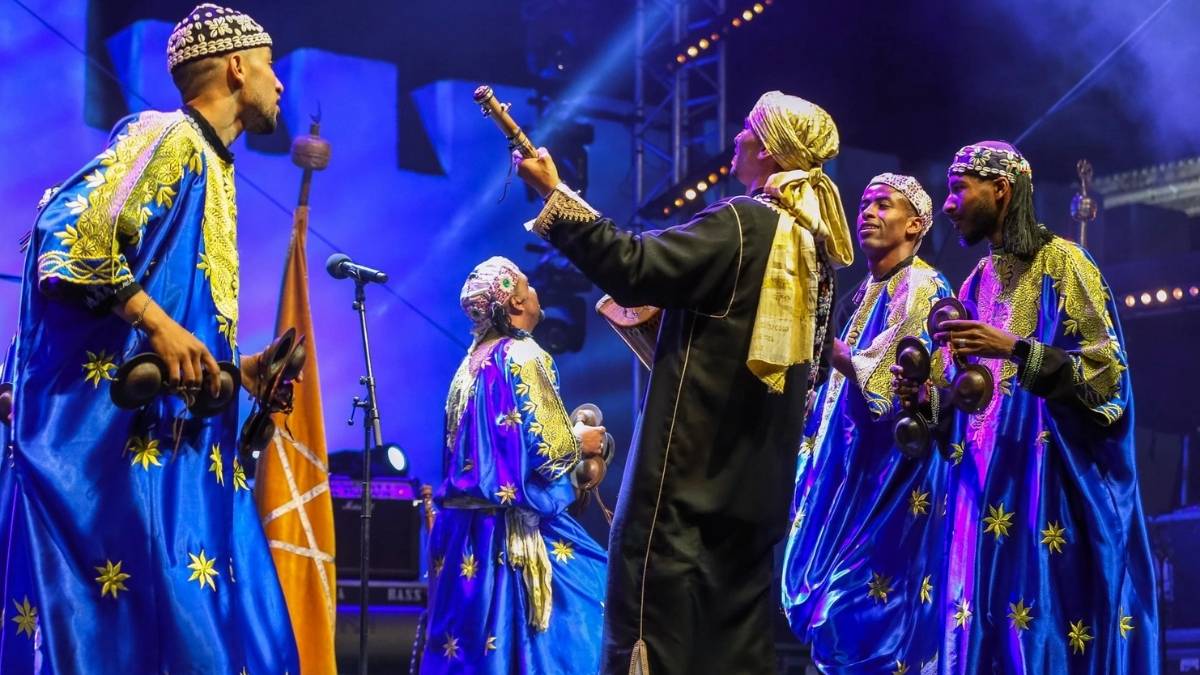
The musicians dressed in white djellabas with embroidered red tassels didn’t perform. They summoned. And the people in that room? We weren’t an audience. We were participants in an ancient dialogue between body, spirit, and sound.
Roots in Resistance, Rhythm in Release
Gnaoua music isn’t just Moroccan. It’s a sonic archive of the African diaspora, born from the forced migration of enslaved people from sub-Saharan regions Senegal, Mali, Guinea brought to Morocco centuries ago. Their songs carried the memory of rivers they’d never see again, the names of ancestors, and the prayers of a people who refused to let their spirits be erased.
Over time, those chants blended with Sufi Islam and local Amazigh traditions, evolving into a spiritual practice that uses rhythm, repetition, and movement to cleanse the soul. Today, Gnaoua isn’t performed for entertainment not in its true form. It’s a healing ritual, often held in private homes or community spaces, where music becomes medicine.
In Essaouira, the birthplace of the modern Gnaoua Festival, this tradition walks a delicate line. Every summer, tourists flood the medina, drawn by world-famous musicians and fusion sets that blend jazz or electronic beats. And while that visibility has helped preserve the art form, it’s also risked turning sacred trance into spectacle.
But step away from the festival stages, and you’ll find the real work still happening in back rooms, in courtyards, in late-night lila ceremonies where the goal isn’t applause, but presence.
The Lila: A Night of Unraveling and Return
I was invited to a lila a full-night Gnaoua healing ceremony by a friend of Leila’s, a musician named Yusef. “Don’t come to watch,” he said. “Come to listen with your bones.”
The lila begins at sunset and can last until dawn. It’s structured around seven colors, each representing a different spiritual energy or “mlouk” (spirits). The music shifts with each color red for strength and fire, blue for calm and water, green for healing, white for purity. As the rhythms change, so do the movements. Some people sway gently. Others enter deep trance, shaking, crying, laughing releasing what the rhythm calls forth.
There’s no diagnosis. No intake form. No promise of “results.” The only requirement is willingness to stay, to let the music find what’s buried, and to trust that the body knows how to release it when given the right frequency.
I sat near the back, legs crossed on a woven mat. At first, my mind raced analyzing the rhythm, wondering if I was “doing it right.” But after an hour, something softened. The guembri’s pulse matched my heartbeat. The qraqeb’s sharp clack cut through my thoughts like scissors through static. And then, without warning, I began to cry not from sadness, but from relief. It was the first time in months I’d felt my body respond to something without trying to control it.
Yusef later told me, “The music doesn’t heal you. It reminds you that you’re already whole. It just removes the noise so you can hear it.”
The Instruments: Voices of the Unseen
In Gnaoua music, every instrument carries a voice not just sound, but intention.
The guembri is the heart of it all. A three-stringed, skin-covered lute carved from olive or fig wood, its deep, resonant hum doesn’t just accompany the singers it anchors the entire ceremony in the earth. Played with the palm and fingers, its rhythm mimics the human pulse, slow at first, then rising like breath during exertion. Master players say the guembri doesn’t belong to them; they are merely its caretakers. Its wood remembers every hand that’s held it, every sorrow it’s helped release.
Then there are the qraqeb large iron castanets held in each hand, clacked together in precise, driving patterns. Their metallic ring cuts through mental fog like a bell in fog. Unlike Western percussion, which often marks time, the qraqeb creates time pulling the listener out of linear thought and into the eternal now. To play them is to surrender to repetition until the mind lets go.
And finally, the voice raw, unfiltered, rising in call-and-response chants that mix Arabic, Bambara, and mystical phrases passed down for generations. The lead singer, or maâlem (master), doesn’t sing to impress. He sings to invoke. Each phrase is a key. Each melody, a doorway.
I watched Yusef play the guembri that night, his eyes closed, his body swaying as if pulled by an invisible tide. “This instrument,” he told me later, “was made by a man who never saw the sea. But he carved it with the sound of waves in his memory. That’s how deep this music goes.”
Trance Not as Escape, but as Presence
In the West, we often fear trance. We associate it with dissociation, loss of control, or even danger. But in Gnaoua practice, trance jedba is the opposite. It’s the moment you become more present, not less.
When someone enters jedba, they’re not “checked out.” They’re fully in their body, responding to frequencies that bypass the thinking mind. Their shaking isn’t random it’s a physical release of stored tension, grief, or energy blockages. Elders in the room watch closely, offering support if needed, but never interrupting. They know the body is doing its work.
One woman at the lila began trembling violently during the blue phase the color of water and emotional cleansing. Instead of stopping her, the maâlem deepened the rhythm, and two other women gently held her elbows, grounding her as she moved through it. After ten minutes, she collapsed into their arms, laughing through tears. “I haven’t cried like that since my father died,” she whispered. “But it didn’t feel sad. It felt like coming home.”
This is the paradox of Gnaoua healing: you don’t find peace by silencing the storm. You find it by dancing in the middle of it until the storm becomes part of your rhythm.
From Sacred Ritual to Global Stage And Back Again
Every June, Essaouira transforms. The narrow alleys of the medina fill with musicians from across the globe. The Gnaoua World Music Festival launched in 1998 has brought legendary maâlems like Mahmoud Guinea and Hamid El Kasri to international fame, while fostering collaborations with jazz, reggae, and electronic artists.
On one level, this exposure has been vital. It’s funded instrument repairs, supported apprenticeships, and given young Gnaoua artists a platform. But with visibility comes dilution. Today, you can book a “Gnaoua healing session” at luxury riads that last forty-five minutes and end with a mint tea and a photo op. The qraqeb are handed to guests as props. The guembri is played softly in the background while people sip cocktails.
Yusef refuses these gigs. “You can’t schedule healing like a spa treatment,” he says. “The mlouk don’t arrive on demand. They come when the space is clean inside and out.”
The true lila doesn’t happen on a stage. It happens in intimacy. In darkness. In trust. And it can’t be rushed.
Why Gnaoua Doesn’t Fit Into Wellness Boxes
Try to categorize Gnaoua music, and it slips through your fingers.
It’s not meditation because it’s too embodied.
It’s not therapy in the clinical sense because it doesn’t pathologize.
It’s not entertainment because its purpose is transformation, not applause.
Gnaoua exists in a space Western wellness hasn’t yet named: communal catharsis through sacred rhythm. It assumes that healing isn’t a solo journey. It’s something we do together, in real time, with our voices, our sweat, and our willingness to be moved literally.
When I returned to California, I tried to recreate the feeling with headphones and a “Gnaoua playlist” on a streaming service. It was empty. The rhythm was there, but the intention wasn’t. The music had been stripped of its context its lineage, its ritual, its reciprocity.
That’s when I understood: you can’t download this medicine. You have to show up for it.
If you’ve felt the echo of this truth in Essaouira the way the ocean teaches surrender, the way argan oil carries memory, the way silence can be a companion then Wellness and Cultural Travel in Essaouira: The Ocean, The Body, and The Quiet Mind reveals how these threads form a living philosophy where healing isn’t achieved, but received.
How to Approach Gnaoua with Respect Not Curiosity
If you feel drawn to Gnaoua, ask yourself: Am I seeking experience or understanding?
Tourists often show up at lila ceremonies with phones in hand, hoping to “witness trance.” But the Gnaoua tradition isn’t a performance. It’s a covenant between community, ancestors, and spirit. To enter it as a guest is a privilege, not a right.
Yusef once told me, “You don’t attend a lila. You are invited into it.” That invitation isn’t about tickets or timing. It’s about humility. It means sitting quietly in the back, not asking questions during the ritual, not touching instruments unless offered, and never recording audio or video. The energy of the space is fragile. One distracted gaze can break the thread.
If you’re in Essaouira and want to connect with this tradition authentically, start small. Attend a public festival performance to listen, not to participate. Speak with musicians after their set not to “get healed,” but to learn. If a relationship forms over days or weeks, and trust is built, an invitation might come. But never assume it’s owed to you.
True engagement means supporting the culture beyond consumption: buying music directly from maâlems, donating to apprenticeship programs, or simply sitting in respectful silence when you’re near a ceremony.
The Gift of Being Moved Without Knowing Why
On my last night in Essaouira, I returned to Yusef’s basement. No expectations. No notes. Just presence.
The room was fuller this time families, elders, a few quiet foreigners like me. As the guembri began its low hum, I closed my eyes and let the rhythm find me. I didn’t try to trance. I didn’t try to “receive healing.” I just let my shoulders drop, my breath deepen, my feet press into the cool stone floor.
At some point, my body began to sway not dramatically, just a gentle rocking, like seaweed in current. And in that movement, something unclenched inside me. Not a thought. Not a memory. Just a knot I didn’t know I was carrying.
Afterward, Yusef handed me a small cup of bitter mint tea. “You don’t need to understand it,” he said. “Just thank it.”
That’s the final lesson of Gnaoua: healing doesn’t always come with explanations. Sometimes, it arrives as a vibration in your chest, a tear you didn’t see coming, or the sudden ability to breathe fully for the first time in years. And that’s enough.
Carrying the Rhythm Home Without Taking It
I didn’t bring back a guembri. I didn’t buy a recording. I didn’t even take a photo.
But I carry the rhythm.
Now, when anxiety tightens my chest in Los Angeles traffic or the noise of modern life drowns out my inner voice, I don’t reach for an app. I close my eyes and remember: the pulse of the guembri, the sharp clack of the qraqeb, the smell of cedar smoke. I let my breath sync with that memory. And for a moment, I’m back in that basement not as a seeker, but as a participant in something ancient and kind.
Gnaoua doesn’t ask you to become someone new. It asks you to return to who you’ve always been beneath the noise, beneath the speed, beneath the illusion that you have to earn your right to rest.
If this path of sound and surrender resonates with you if you sense that true wellness might live not in optimization, but in communal rhythm then Ocean-Based Healing: Thalassotherapy and Marine Air offers another doorway into Essaouira’s living traditions, where the Atlantic itself becomes a healer, and the sea breeze carries more than salt it carries restoration.