
I arrived in Tangier without expecting answers.
Like many travelers, I came with questions, curiosity, and a quiet desire to understand how a place carries its past without becoming trapped in it. Tangier did not explain itself all at once. It revealed its traditions slowly, through gestures rather than declarations.
This city has always lived between worlds. The Atlantic and the Mediterranean meet here, as do Africa and Europe, memory and movement, ritual and daily life. Traditions in Tangier are not preserved behind glass. They breathe through hands shaping clay, voices repeating old melodies, fabrics worn with intention, and healing practices passed down without ever needing to be written.
What makes Tangier unique is not the age of its traditions, but the way they remain alive. They adapt without losing meaning. They welcome without performing. They exist quietly, waiting for travelers who are willing to slow down and listen.
This guide is written for those travelers.
For those who seek cultural experiences rooted in respect rather than consumption. For those who understand that tradition is not something you observe from a distance, but something you encounter through presence.
Across this pillar, you will explore the living traditions of Tangier through five essential pathways: craftsmanship, music and movement, spirituality, clothing, and healing. Each section connects to a deeper satellite guide for travelers who wish to go further, while also weaving naturally into the broader journeys found in destinations, events, flavors, and mindful trips across Morocco and beyond.
Arts & Crafts Heritage in Tangier
Tradition in Tangier often begins with the hands.
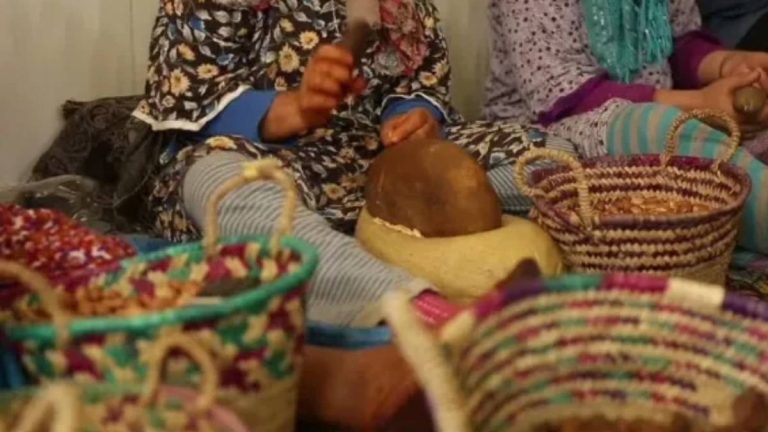
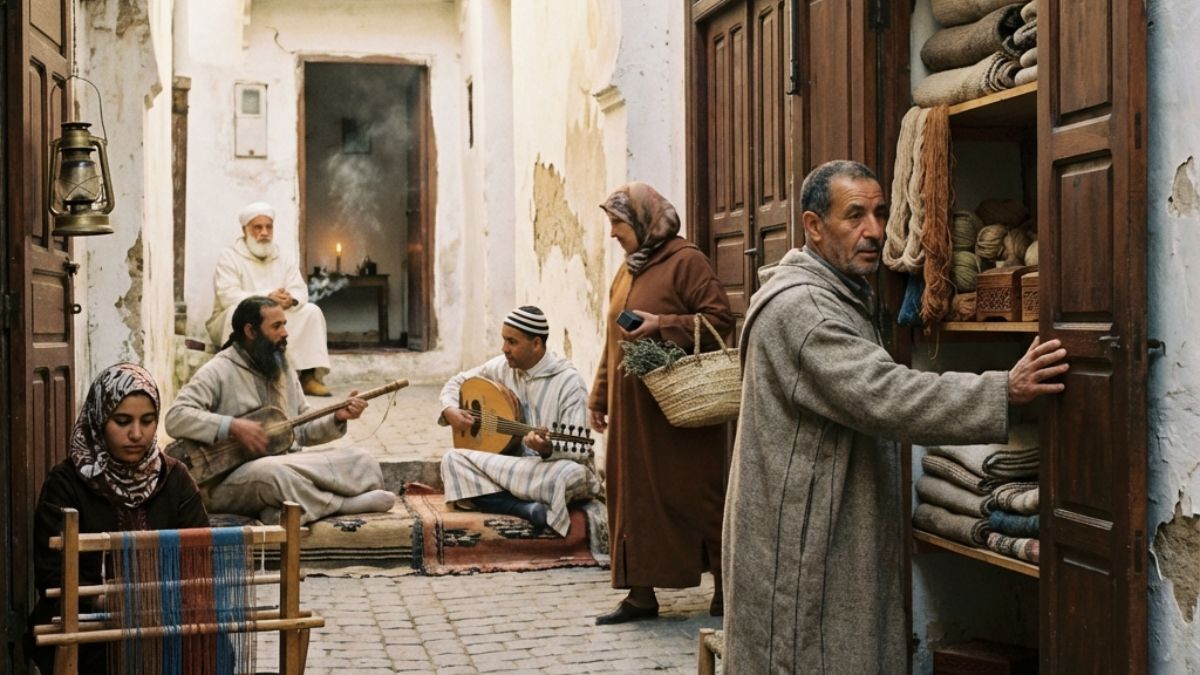
In quiet workshops tucked behind the medina’s narrow streets, artisans repeat gestures learned long before them. Wood is carved slowly. Wool is woven with patience. Copper is shaped through rhythm rather than force. These crafts are not designed to impress; they are designed to endure.
What struck me most was the absence of urgency. An artisan does not rush to finish a piece. Time stretches differently here, shaped by repetition and care. You hear it in the soft tapping of metal, feel it in the texture of unfinished wood, smell it in leather treated with natural oils.
Unlike cities where crafts become souvenirs detached from their origins, Tangier’s craftsmanship remains part of daily life. A ceramic bowl is meant to be used. A woven blanket is meant to warm. Beauty here is functional, and function carries memory.
Many of these traditions reflect Tangier’s position as a cultural crossroads. Andalusian patterns sit beside Amazigh symbols. Arab calligraphy shares space with African geometry. The result is not fusion for novelty’s sake, but coexistence shaped by centuries of exchange.
Travelers who take time to engage respectfully often discover that these crafts open doors to conversation. A question about technique becomes a story about family. A simple purchase becomes an exchange of trust. Supporting artisans directly helps sustain these traditions far more than any museum ever could.
For a deeper immersion into these practices, the dedicated guide on Arts & Crafts of Tangier: A Cultural Journey explores artisan districts, workshops, and meaningful encounters in greater detail, offering practical ways to connect without intruding.
These crafts also echo through other aspects of the city’s culture. The same patience appears in traditional clothing, the same rhythm in music and dance, and the same respect for balance in healing practices. In Tangier, tradition is not fragmented. It flows.
Music and Dance Across Northern Morocco
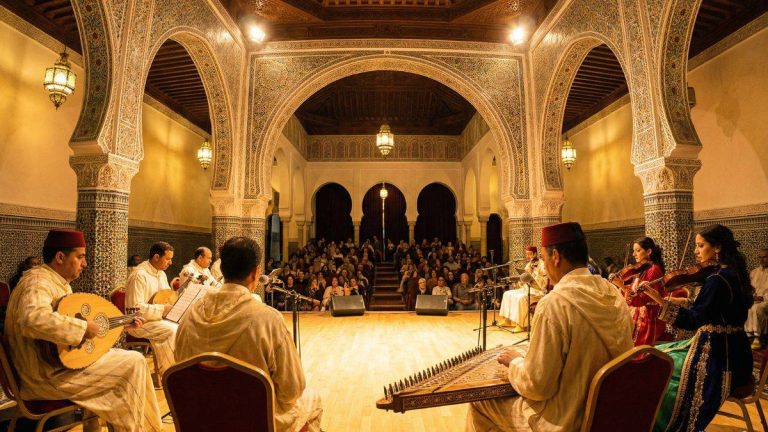
Music in Tangier is not staged.
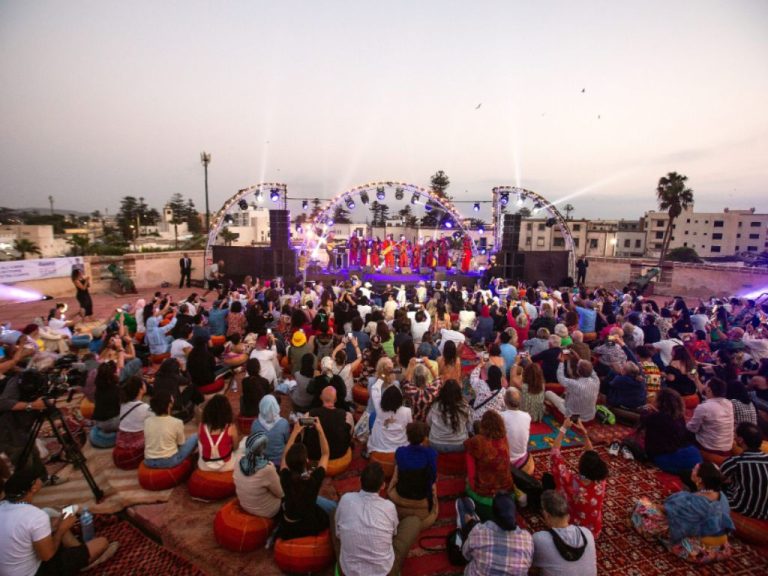
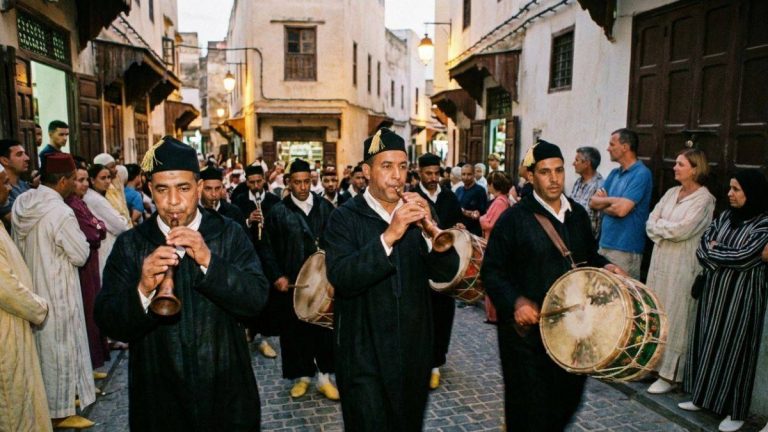
It appears when needed, then fades back into daily life. You hear it drifting from a family gathering, echoing softly from a zawiya, or rising unexpectedly during a neighborhood celebration. Sound here is not performance first. It is presence.
Northern Morocco carries a musical identity shaped by movement and memory. Andalusian melodies arrived centuries ago, carried by exile and longing. Gnawa rhythms followed older routes, rooted in healing and trance. Urban sounds grew later, absorbing influences without erasing what came before. In Tangier, these layers coexist without competition.
Listening closely, you begin to notice how rhythm replaces explanation. A steady beat grounds the body. A repeated melody invites reflection. Dance follows naturally, not as choreography, but as response. Movement here is communal. It connects people to one another and to something older than themselves.
What makes these traditions remarkable is their discretion. They are not advertised. You are rarely told where to find them. They reveal themselves when you are patient enough to stay. In that sense, music in Tangier mirrors the city’s crafts and rituals. It rewards attention rather than ambition.
Travelers who approach with curiosity rather than expectation often find themselves welcomed into moments that feel private yet shared. A drum circle becomes a lesson without words. A song becomes a bridge between languages.
For those who wish to explore these soundscapes more deeply, the guide Music & Dance in Tangier: Rhythms of the North offers a focused journey through Andalusian music, Gnawa rituals, and contemporary expressions, helping travelers understand when to listen, where to stand, and how to remain respectful.
These musical traditions also connect naturally to Tangier’s spiritual life, where sound plays a role in healing and remembrance, and to cultural events that still unfold beyond official calendars. They are part of a wider rhythm that extends across northern Morocco, shaping gatherings, ceremonies, and everyday encounters.
Rituals and Spiritual Pathways
Spiritual life in Tangier rarely announces itself.
It moves quietly through daily routines, woven into gestures that seem ordinary until you learn how to notice them. A whispered prayer at dawn. Incense drifting from a small zawiya. A pause before entering a space that feels heavier with memory.
These rituals are not meant to be observed as spectacle. They exist for those who practice them, not for those who document them. That is why respectful distance matters. Presence here means knowing when to step forward and when to remain still.
Tangier’s spiritual landscape reflects centuries of coexistence. Sufi traditions sit alongside everyday expressions of faith. Sacred sites are scattered across the city, sometimes marked clearly, sometimes known only to locals. What unites them is intention rather than architecture.
Sound plays a central role. Chanting, repetition, and rhythm guide inner attention. Silence, too, is part of the practice. The absence of explanation allows space for personal meaning to emerge.
Travelers who approach these pathways with humility often experience moments that feel grounding rather than mystical. A simple visit becomes an act of listening. A shared tea after prayer becomes connection without words.
For those wishing to understand these dimensions more deeply, the guide Rituals & Spiritual Life in Tangier: Quiet Pathways of Meaning explores sacred spaces, local customs, and respectful ways to engage without intrusion.
These spiritual practices are closely connected to the city’s music, healing traditions, and even its crafts. The same repetition found in weaving appears in chanting. The same patience shaping pottery guides prayer. Together, they form an inner architecture that supports daily life.
Beyond Tangier, similar pathways can be found across Morocco and other destinations shaped by ritual and spirituality, reminding travelers that meaning often lives beneath the surface, waiting to be approached gently.
Traditional Clothing and Festive Attire
Clothing in Tangier is not decoration.
It is language.
Walk through the medina on an ordinary morning and you will see how fabric carries meaning quietly. A djellaba chosen for comfort rather than display. Slippers worn smooth by years of walking the same paths. Colors that speak softly instead of demanding attention.
Traditional clothing here adapts to rhythm and place. Daily garments prioritize movement and modesty, while festive attire appears only when the moment calls for it. Weddings, religious celebrations, family gatherings. Clothing marks transitions, not trends.
What struck me most was how little performance surrounds these garments. People dress for themselves, for family, for ritual. Not for cameras. Embroidery is deliberate, not excessive. Materials are chosen for durability as much as beauty. Wool for warmth. Cotton for breathability. Silk when ceremony asks for it.
Festive clothing tells longer stories. Patterns hint at regional roots. Colors reflect joy, protection, or respect. Jewelry is worn sparingly, often passed through generations rather than purchased for occasion. Each element carries memory.
Travelers sometimes misunderstand this subtlety. Traditional clothing is not costume, and imitation can feel hollow. Respect begins with observation. When curiosity is paired with humility, conversations open naturally. A question about fabric becomes a lesson about heritage. A compliment becomes shared pride.
For those wishing to understand these layers more deeply, the guide Traditional Clothing of Tangier: Threads of Identity explores everyday attire, ceremonial dress, symbolism, and where to encounter authentic pieces without reducing them to souvenirs.
These garments also connect to Tangier’s crafts and healing traditions. The same hands that weave textiles prepare herbal remedies. The same patience shapes clothing, music, and ritual alike. Clothing becomes another expression of balance between body, environment, and culture.
Healing Practices and Ancestral Wellness
Healing in Tangier begins with listening.
Not only to the body, but to memory, environment, and rhythm. Wellness here is not separated from daily life. It is woven into routines, foods, scents, and quiet gestures passed down through generations.
Ancestral healing practices remain present without being formalized. Herbalists prepare remedies using knowledge learned through observation rather than instruction. Hammams offer more than cleansing; they restore balance through heat, water, and repetition. Spiritual healing appears gently, often through prayer, intention, or shared silence.
What stands out is restraint. There is no promise of instant cure, no performance of mystery. Healing unfolds gradually. Trust matters more than technique. The body is treated as part of a larger system that includes emotion, community, and belief.
Scents play a powerful role. Eucalyptus, orange blossom, thyme, and lavender linger in the air, grounding experience through smell before thought. Touch, too, is intentional. Movements are slow, respectful, never rushed.
Travelers drawn to wellness often expect structured experiences. Tangier offers something different. Healing here requires patience and humility. Participation means observation first, consent always, and respect without expectation.
For those wishing to approach these practices with awareness, the guide Healing Practices in Tangier: Between Body, Spirit, and Memory explores herbal traditions, hammam rituals, spiritual healing, and how travelers can engage responsibly without appropriating or simplifying what they encounter.
These healing traditions connect naturally to the city’s spiritual life and crafts. The repetition found in prayer mirrors the preparation of remedies. The care used in weaving appears again in massage and bathing rituals. Wellness becomes continuity rather than destination.
Beyond Tangier, similar practices exist across Morocco and other regions where ancestral knowledge continues quietly alongside modern life, reminding travelers that healing often begins where attention returns to the present moment.
Practical Tips & Cultural Etiquette
Traditions in Tangier are sustained through everyday care.
Cultural etiquette here is less about rules and more about attention. The city responds well to those who move gently, listen closely, and accept that understanding comes slowly.
One of the most important practices is pacing. Tangier rewards those who slow down. Walking through the medina without rushing allows encounters to unfold naturally. A brief exchange can turn into conversation. Silence often carries more meaning than questions.
Dress is another form of communication. While Tangier is diverse and coastal, modesty remains appreciated, especially in traditional neighborhoods and sacred spaces. Choosing clothing that respects local norms often opens doors without needing explanation.
Sacred and personal spaces require sensitivity. Zawiyas, mosques, and family homes are places of lived meaning. Observation matters. Photography is not always appropriate. Permission, when needed, should be asked quietly and accepted gracefully if declined.
Communication favors warmth over formality. Simple greetings, eye contact, and patience matter more than perfect language. Conversations grow organically, shaped by mutual respect rather than curiosity alone.
Supporting local artisans, musicians, and healers contributes directly to the survival of tradition. Buying thoughtfully, asking respectfully, and avoiding transactional attitudes help keep cultural practices grounded in dignity.
These principles echo across Tangier’s cultural landscape. They align with the care found in crafts, the humility required in spiritual spaces, and the patience essential to healing traditions. Together, they form an ethic of mindful travel that extends beyond this city.
For travelers seeking practical guidance rooted in respect, the article Practical Tips & Cultural Etiquette in Tangier: Traveling with Awareness ,offers deeper insight into social norms, dress codes, and navigating shared spaces with awareness.
These practices also connect naturally to experiences found in destinations, events, flavors, and mindful trips across Morocco and other regions where culture lives through daily interaction rather than performance.
Traditions in Tangier do not ask to be collected.
They ask to be met.
What stays with you after leaving the city is not a checklist of experiences, but a series of quiet impressions. The rhythm of hands at work. The patience of sound repeated over centuries. The softness of fabric worn with intention. The calm presence of healing practices that never rush.
Tangier teaches through continuity. Its traditions are not preserved by isolation, but by participation rooted in respect. They survive because they remain useful, meaningful, and deeply human.
For mindful travelers, this city offers more than cultural discovery. It offers a way of moving through the world with greater awareness. A reminder that tradition is not the opposite of change, but its anchor.
If one pathway resonates more strongly with you, begin there. Follow the thread that feels familiar or challenging. Whether through crafts, music, spirituality, clothing, or healing, each satellite guide opens a door into the same living system.